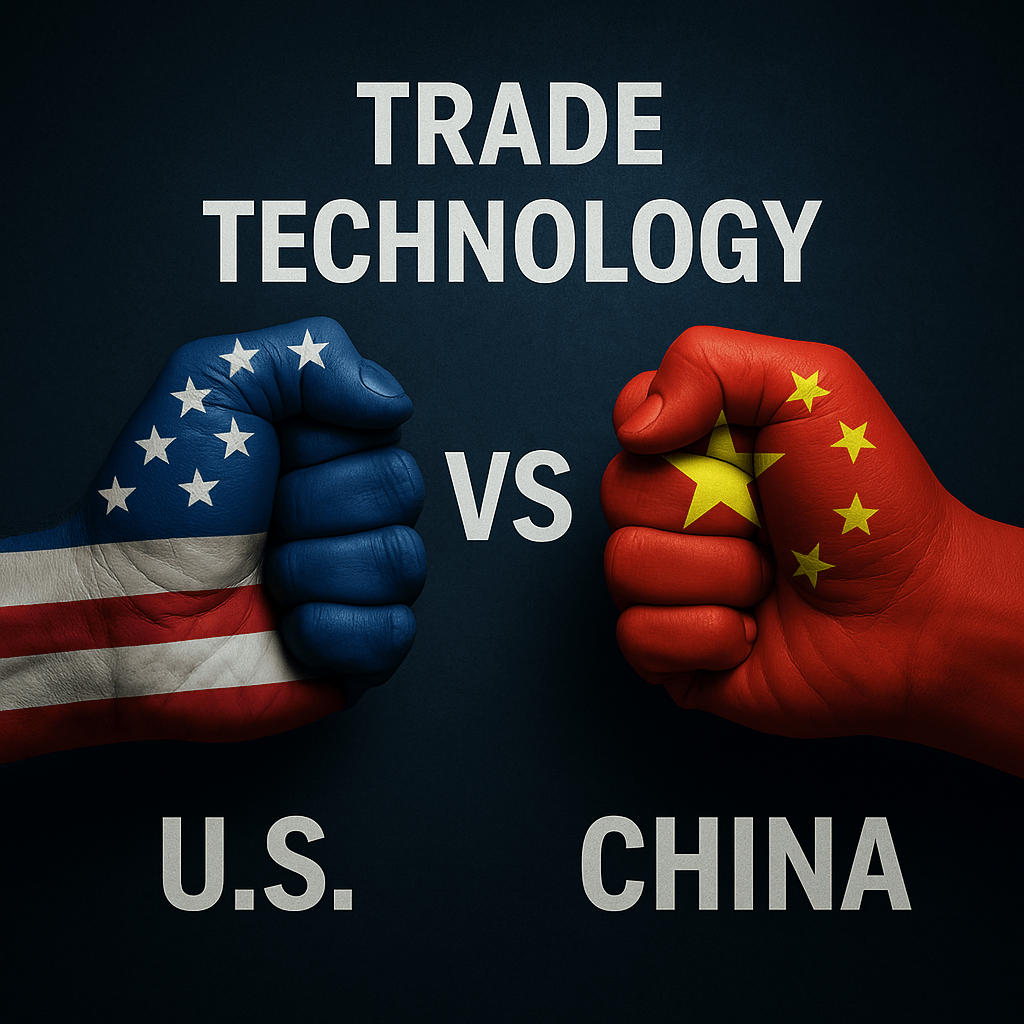
In today’s globally interwoven economy, three themes weave together into a tapestry of deep structural change: the escalating trade and technology confrontation between the United States and China, the domestic fiscal debates within the United Kingdom (as captured by the independent Office for Budget Responsibility), and the imperative for companies and policymakers to move beyond merely cyclical thinking to anticipate genuine structural realignments. In what follows I offer a historically-grounded, data-reasoned, forward-looking critique of these themes—and why ignoring them risks being blindsided by the next wave of global economic change.
1. The U.S.–China Trade & Technology Confrontation: From Tariffs to Decoupling
Historical context
The relationship between the U.S. and China on trade, investment and technology is not new — it has origins in the post-1978 era of China’s opening, its accession to the World Trade Organization in 2001, and the subsequent surge in global supply-chain integration.
However, a significant rupture began around 2018, when under the Trump administration the U.S. imposed tariffs and other measures citing unfair trade practices, intellectual-property concerns, forced technology transfers, and state-subsidised industries in China.
Over the past years the friction has shifted from pure tariffs to technology-centric controls: export restrictions on advanced semiconductors, rare-earth minerals, limitations on Chinese access to certain technologies, and related supply-chain re-engineering.
Why the risk is rising
Three major drivers elevate the risk of a full-blown confrontation:
- Technology dominance: Semiconductors, artificial intelligence, quantum computing, rare earths—these are no longer niche items but central strategic assets. The U.S. worries about China leap-frogging; China worries about being locked out.
- Supply chain vulnerability and strategic dependence: When a country depends on another for critical inputs (e.g., rare-earth elements, high-end manufacturing tools), the possibility of coercion, disruption or forced realignment becomes real.
- Geopolitical spill-over: Trade and technology are no longer separate from geopolitics. Taiwan, South China Sea, export-controls, national security all bleed into this confrontation. Hence, policy oscillations can be swift and unpredictable.
Structural data suggests that:
- China remains deeply embedded in global value chains (GVCs) despite pressure. One recent study finds that China’s “upstream” role in intermediate goods actually increased even through multiple shocks (US-China tension + pandemic + Ukraine war).
- The U.S. and allies are increasingly pursuing “friend-shoring” or “allied-shoring” of critical supply-chains, but complete decoupling from China is extremely difficult and expensive in the near-term.
- Historical tariff wars have had measurable drag on growth, investment and innovation. For example, a working paper estimated that by late 2019 the U.S. had imposed tariffs on roughly $350 billion of Chinese imports and China had responded with roughly $100 billion of U.S. exports.
A futuristic outlook: what to anticipate
Looking ahead to the 2030 horizon, several possible structural realignments should be on the radar:
- Bifurcated innovation ecosystems: We may see the emergence of two (or more) parallel technology systems: one anchored around the U.S. and its allies, the other around China (and maybe a broader Chinese-dominated coalition). Firms may need to choose which “ecosystem” they plug into—or maintain dual-track strategies.
- Commodity and input re-engineering: Tightening China’s export controls on rare-earths or advanced manufacturing tools (or conversely U.S. export restriction on chip-equipment) could accelerate investment in alternative sourcing (Australia, Africa, Southeast Asia) or recycling/up-cycling.
- Supply-chain fragmentation and “China +1” strategies: Many multinational firms will shift from China-centric production to a “China plus one” model (e.g., Vietnam, India, Mexico) to reduce risk. But the result will be higher costs and complexity.
- Policy shock volatility: Because technology and trade have strategic dimensions, policy changes will be less incremental and more abrupt (“big switch” export controls, or tariff hikes as strategic signals). Firms and governments that assume slow linear change will be caught off-guard.
- Innovation slowdown or reshuffling: If access to global talent, open research, or cross-border collaboration becomes more restricted, the pace of global innovation may slow or shift. We may see new innovation hubs outside the U.S./China axis.
Critical caveats
- Some pundits assume decoupling is complete or inevitable. But the data suggest China remains deeply integrated, and immediate full decoupling would impose huge costs. The structural realignment will be uneven and unevenly timed.
- Policymakers may over-estimate their leverage: Tariffs and controls beget retaliation; global firms may find work-arounds. The geopolitical chessboard is multi-vector, not only bilateral.
- Firms that treat this as a short-term “cycle” (tariff spike → calm → revert) rather than a long-term structural shift in how technology and trade are governed may fail to adapt effectively.
2. UK Domestic Fiscal Debates: Structural Stresses Beneath the Surface
While the trade-technology confrontation grabs headlines, the fiscal battleground at home is equally important—particularly in the U.K. where the Office for Budget Responsibility (OBR) casts independent oversight over government finances.
Institutional background
The Office for Budget Responsibility is the independent body tasked with forecasting the economy and public finances, assessing fiscal risks and testing whether government fiscal policy is consistent with long-term sustainability.
It was created after concerns that Treasury forecasts were too optimistic and politically influenced. Its role is to inject transparency and credibility into fiscal policy.
Current debates and structural challenges
Recent commentary notes key structural pressures:
- The UK faces weak productivity growth, ageing demographics, slow wage growth, cost-pressures in public services—all of which reduce fiscal headroom.
- The OBR’s forecasts already show that real household disposable income per person made the largest historical fall in 2022-23 and 2023-24.
- Debate has emerged on whether the OBR should reduce forecast frequency (e.g., to once a year) to reduce policy-tinkering and better force structural policy thinking.
- Some think-tanks argue for replacing or reforming the OBR, claiming it may constrain bold structural investment by government.
Why this matters in a structural realignment world
- Fiscal policy is not just cyclical: If governments treat the home as a stable platform while only adapting to short-term cycles (recessions, booms), they fail to prepare for structural shocks (population shifts, digital transition, climate, global fragmentation).
- Public investment and productivity link: The OBR has published work on how public investment affects potential output—the long-run ceiling of growth.
- Structural fiscal risks amplify with global shifts: The U.S.–China technology/ trade confrontation will have spill-over effects on U.K. firms, supply-chains, and hence tax-bases and public finances. For example, if U.K. businesses invest less in China or see supply disruptions, productivity could fall, reducing tax revenue.
- Policy credibility and markets matter: When fiscal frameworks lose credibility, borrowing costs rise, or the capacity for structural investment shrinks—this matters for realignment.
A more futuristic vantage
- Re-thinking the role of the state: The U.K. may move from short-term austerity/boom cycling to a regime of strategic investment (digital infrastructure, advanced manufacturing, skills ecosystems) — akin to a “mission-economy” posture.
- Fiscal‐industrial policy nexus: As global supply-chain fragmentation and geoeconomic blocs arise, the U.K. may need to coordinate fiscal policy with industrial strategy: e.g., building domestic resilience in critical sectors (semiconductors, AI, green tech) to reduce external risk.
- Scenario stress-testing: OBR and policymakers should model scenarios in which global trade/tech shocks reduce growth potential, change tax bases or increase spending (for adaptation). Treating these as once-in-a-lifetime rather than cyclical is key.
- Intergenerational structural realignment: Ageing, climate adaptation, digitalisation—all impose long-term commitments. The fiscal debates should shift from “when to raise taxes” or “which cuts to make this year” to “what sustainable model of public service, investment and tax do we build for 2035–2050”.
3. Anticipating Structural Realignments — Beyond Cycles
The twin fronts (U.S.–China confrontation + U.K. fiscal stress) underscore one powerful message: companies and policymakers must move from cyclical thinking (boom/bust, tariff spikes, recession risk) to structural thinking (enduring shifts in supply-chains, innovation systems, political economy, fiscal frameworks).
What structural realignment means
- Supply-chain geography changed: The “China-as-factory” model is being questioned. The “China +1” strategy will become standard. But the new sites will be more fragmented, costlier, and more politically vulnerable. The adjustment is structural, costly and time-consuming.
- Technology ecosystem bifurcation: If the U.S. and China lead distinct technology spheres, firms must decide which side they align with—or build dual-track strategies, increasing complexity and cost.
- Policy regimes shifting: Industrial policy, export-controls, data regimes, national-security trade screens—all these policy tools are becoming fundamental levers, not just temporary measures.
- Fiscal and production base transformation: Nations will need to recast their economic models (reskilling, public investment, strategic supply-chains) to remain competitive or resilient.
- Market structure change: Concentration of power in tech/AI, re-regionalisation of production, changed global commerce patterns (less free trade, more regional blocs) all suggest longer-term shifts in how value is created and captured.
Why many are unprepared
- Over-reliance on past cycles: Many firms and governments assume the world will revert to “pre-shock normal”. When shocks hit (e.g., pandemic, Ukraine war, technology export‐controls), they are caught by surprise.
- Under-estimating policy risk: When trade/tech issues have national-security implications, policy tools (tariffs, export bans) may be used aggressively and abruptly.
- Blind to horizon of change: Structural realignments take years but start quietly. Waiting until they are obvious means rushing costly pivots.
- Data/forecasting gaps: Traditional economic forecasting emphasises GDP cycles, inflation, interest rates—but may under-weight structural factors like supply‐chain re-labelling, technological ecosystem shifts, national-resilience investments.
Recommendations for companies & policymakers
- Scenario planning: Build multiple mid-to-long-term scenarios (2030-35) that consider bifurcation in technology ecosystems, supply-chain disruption, geopolitically-driven trade blocs.
- Decouple risk & optionality: Identify critical points of interdependence (single-supplier risk, regulatory risk) and create optionality (alternate suppliers, dual-sourcing, flexible geography).
- Invest in resilience, not just efficiency: The mantra of lowest cost may be sub-optimal if it means high risk. Balanced investment in resilience (redundancy, adaptability) is structurally sound.
- Align fiscal/industrial strategy: Governments should think not only about short-term fiscal rules but long-term structural investment—skills, infrastructure, supply-chain hubs, digital frameworks.
- Monitor institutional changes: Bodies like the OBR (in the U.K.) or equivalent watchdogs elsewhere will increasingly influence policy–investment cycles. Understanding their forecasts, assumptions and constraints will help anticipate policy shifts.
- Stay ahead on tech regulation: With tech/innovation frontiers (AI, semiconductors, quantum) being as much strategic as commercial, firms need to anticipate regulatory regimes, export-controls, talent flows, data governance.
4. A Call for Structural Vigilance
We are at an inflection point where multiple structural forces converge. The U.S.–China confrontation is not merely a temporary trade spat—it is a fundamental re-shaping of how technology, value-chains and power are organised. Simultaneously, domestic fiscal landscapes (such as the U.K.’s) are under strain from long-term shifts—ageing, productivity stagnation, changing global trade patterns—and need policies attuned to structural, not just cyclical, dynamics.
For companies and policymakers, the message is clear: the world ahead will not look like the world behind. The safe assumption of continuity is weaker than ever. Instead, resilience, structural foresight, and willingness to adapt to new regimes (in trade, technology, public-finance) will mark the winners.
The cost of waiting until change is obvious will be high—higher disruption, higher restructuring costs, weaker strategic options. But the opportunity is equally high: those who anticipate structural re-alignment can shape it, rather than be shaped by it.
In short: treat today’s challenges not as a cycle to be weathered—but as the opening act of a new structural era.
#USChinaTradeConflict
#TechnologyDecoupling
#GeoeconomicRealignment
#FiscalPolicyUK
#OfficeForBudgetResponsibility
#StructuralShifts
#GlobalSupplyChains
#IndustrialPolicy
#EconomicResilience
#StrategicForesight
 "Connecting communities, empowering nations: Unifying the Regional and Global Economy ."
Leave a comment