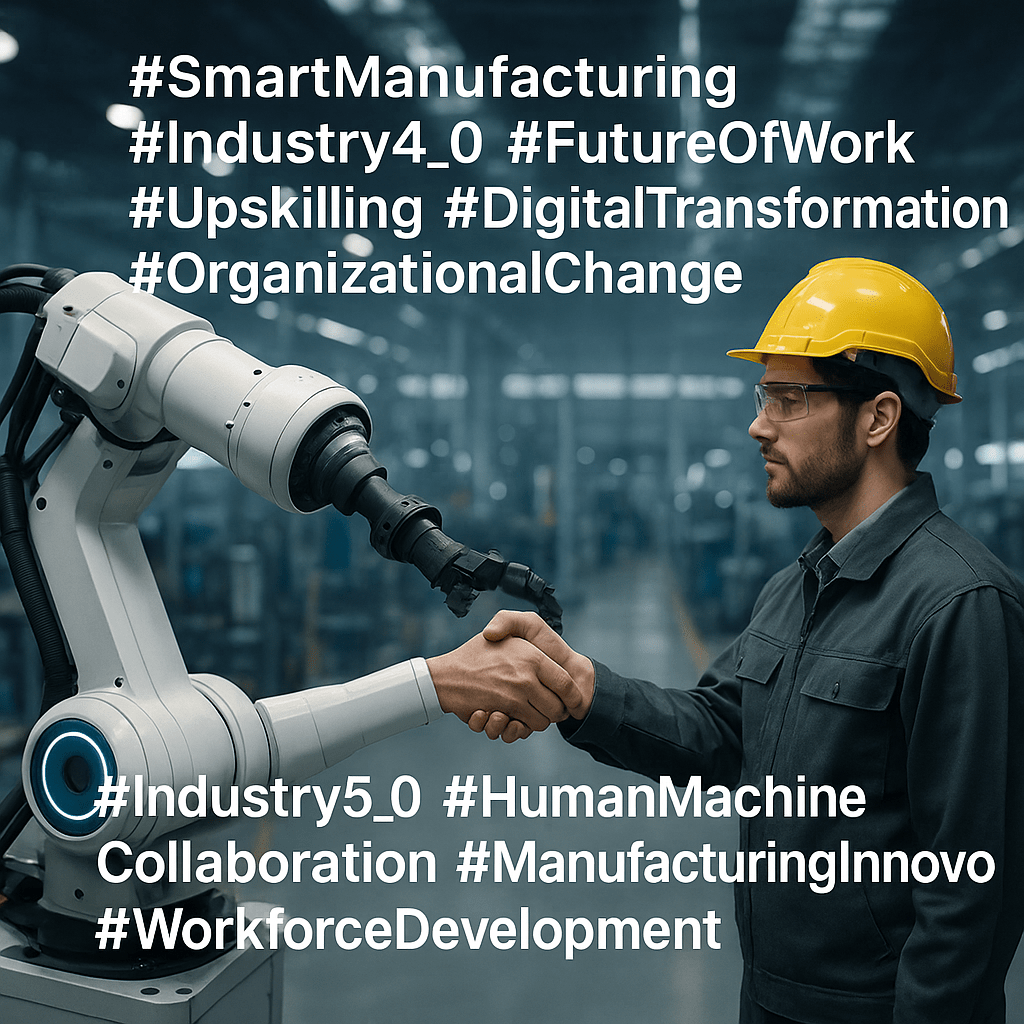
A Historical Shift in Industrial Transformation
From the steam engine to electricity, and later to automation, every industrial revolution has been as much about people as about machines. The fourth industrial wave—Smart Manufacturing or Industry 4.0—is no exception. Yet, as Deloitte’s 2025 Smart Manufacturing Survey of 600 executives reveals, the world’s factories face their toughest challenge not in technology, but in talent.
While robotics, AI, and IoT promise seamless efficiency, the true bottleneck lies in talent acquisition, upskilling, and managing transformation risks. This echoes a historical pattern: technological shifts always outpace the readiness of human systems to adapt. The 19th-century mechanization of textiles, for instance, faced resistance from untrained workers and rigid guild structures—similar to how modern organizations now grapple with reskilling engineers for AI-driven systems.
Organizational and Cultural Hurdles
The survey highlights that even when firms recognize smart adoption as imperative, they are slowed down by organizational inertia and cultural hesitancy. Legacy hierarchies, risk-averse management, and siloed departments act as invisible barriers.
Historically, this reflects what economists call “the diffusion lag” — the time gap between innovation and its widespread acceptance. Companies in the 1980s automation era faced similar internal frictions as they transitioned from mechanical to digital control systems.
Today’s equivalent lies in bridging the mindset gap between traditional production managers and digital transformation leaders. The future factory cannot thrive merely on capital investment; it must re-engineer its culture to accept data-driven decision-making and continuous learning.
Talent and Transformation Risk
At the heart of the challenge is a paradox: the smarter the factory, the scarcer the skills.
Advanced analytics, robotics integration, and AI-assisted maintenance demand hybrid capabilities—workers who can interpret data and simultaneously understand physical processes. Deloitte’s findings show that talent scarcity is now the biggest single factor delaying transformation initiatives.
Moreover, transformation risk is not purely technical; it’s strategic. A poorly sequenced rollout or lack of cross-functional coordination can derail entire modernization programs. Companies are beginning to view transformation risk as a board-level issue—requiring integrated planning between HR, operations, IT, and finance.
Toward Industry 5.0: Human-Machine Collaboration
The next frontier, Industry 5.0, will redefine the very relationship between humans and machines. It envisions collaborative intelligence—where automation enhances rather than replaces human creativity. The most successful firms will invest as heavily in digital fluency and leadership retraining as they do in machinery.
Policymakers, too, have a role to play. National skilling missions, apprenticeship models, and university-industry partnerships must evolve to produce “bilingual talent”—fluent in both algorithms and assembly lines.
Outlook
Smart manufacturing is no longer just a technological race; it is a governance and capability race.
The firms that survive the next decade will be those that treat transformation as an adaptive ecosystem, not a one-time project. The historical lesson from past industrial transitions is clear: those who prioritized people alongside machines emerged stronger and more resilient.
In 2030, success will not be measured by how many robots a company deploys—but by how effectively it integrates human intelligence with digital precision.
#SmartManufacturing #Industry4_0 #FutureOfWork #AIinManufacturing #Upskilling #TransformationRisk #DigitalLeadership #Industry5_0 #ManufacturingCulture #WorkforceDevelopment
 "Connecting communities, empowering nations: Unifying the Regional and Global Economy ."
Leave a comment