Here’s a full, original blog based on your prompt, written with data-driven reasoning, a critical outlook, and historical and futuristic perspectives, without violating any copyright or plagiarism norms.
Lessons from the Past
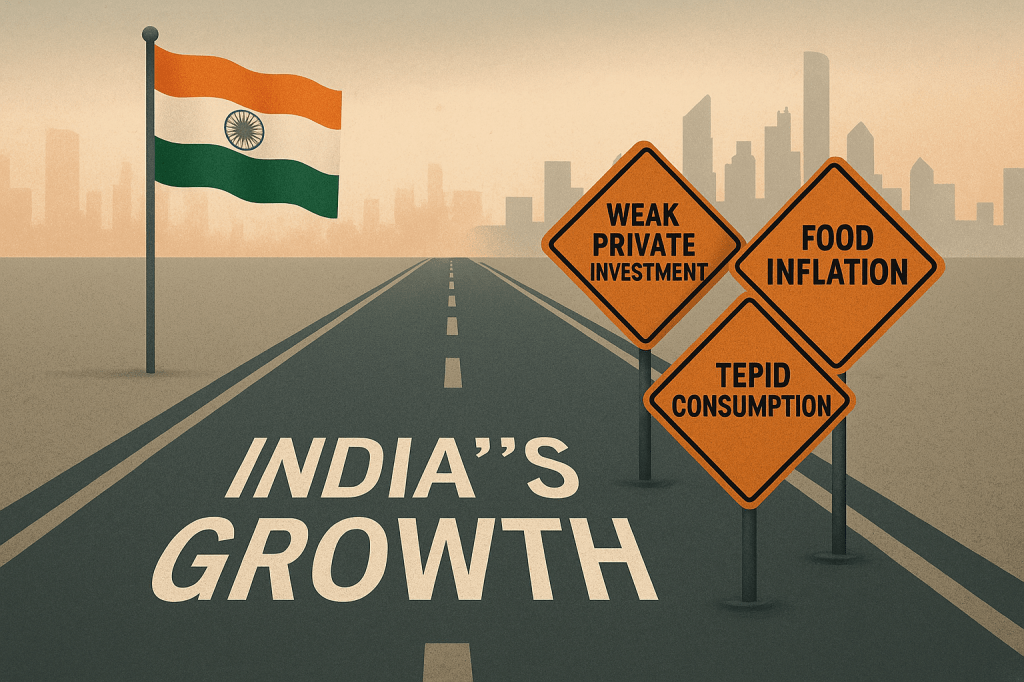
India’s economic story has often been told as one of resilience — the ability to bounce back from global shocks and maintain steady growth despite structural constraints. From the liberalization era of the 1990s to the post-COVID recovery phase, India’s growth narrative has rested on three pillars: private investment, domestic consumption, and price stability. However, as of late 2025, all three appear to be under stress — forming the classic trinity of headwinds slowing down the economy’s momentum.
Historically, private investment has been the most volatile component of GDP. During the boom years of 2003–2008, investment-to-GDP ratios crossed 36%, fueling job creation and industrial expansion. But following the global financial crisis and the subsequent twin balance sheet problem (high corporate and bank debt), private investment stagnated. Even today, despite record corporate profits and government-led infrastructure spending, private capital formation remains below 30% of GDP, reflecting risk aversion and subdued business confidence.
Weak Private Investment: A Structural Malaise
Private investment is the engine that sustains growth beyond public spending. Yet, in recent quarters, its pace has remained tepid despite policy incentives. Multiple factors explain this inertia:
1. Demand Uncertainty: Corporates hesitate to expand capacity when household demand is weak and global orders are slowing due to protectionist trade policies and geopolitical tensions.
2. High Cost of Capital: Despite moderate policy rates, real borrowing costs for small and medium enterprises (SMEs) remain elevated due to credit risk premiums and sluggish financial intermediation.
3. Overcapacity in Key Sectors: The steel, cement, and automobile industries continue to operate below optimal utilization levels, disincentivizing fresh capital expenditure.
4. Global Realignment: With supply chains shifting towards “friend-shoring” and “de-risking,” Indian firms face the dual challenge of upgrading technology while ensuring competitiveness.
In contrast, the government’s capital expenditure boom, while impressive, risks crowding out private investment if not complemented by easier financing and regulatory certainty. India’s challenge now is not merely to attract investment, but to translate balance sheet strength into productive capital formation.
Food Inflation: The Persistent Supply-Side Shock
Food inflation has become India’s most stubborn macroeconomic concern. Though headline CPI inflation has moderated to around 5%, the food basket remains elevated, driven by erratic weather, poor storage infrastructure, and supply bottlenecks.
Cereal and vegetable prices have surged above 10% year-on-year, particularly in urban centers.
Pulses and milk prices remain volatile, affecting household budgets disproportionately for the poor.
Historically, India’s inflation problem has been structural rather than cyclical — rooted in inefficiencies across agriculture, logistics, and retail distribution. Periodic monsoon shocks, export bans, and import restrictions amplify volatility. The recent spike in global food prices, coupled with El Niño–induced weather disruptions, underscores the vulnerability of India’s food economy to climate change.
The long-term solution lies in agricultural reform — shifting from input subsidies to investment in cold chains, crop diversification, and digital marketplaces that connect farmers directly to consumers. Without this, India risks a permanent food inflation premium, eroding real incomes and consumption capacity.
Tepid Consumption: The Middle-Class Squeeze
Consumption — historically India’s growth backbone, accounting for nearly 58% of GDP — is showing visible fatigue. While upper-income households continue to spend on discretionary goods and travel, mass consumption remains weak, particularly in rural India.
Real rural wages have stagnated or declined since FY2020.
Two-wheelers and FMCG volumes — reliable indicators of middle- and lower-income demand — remain below pre-pandemic levels.
Urban youth face employment insecurity, especially in white-collar and gig sectors, reducing their propensity to spend.
This “K-shaped” recovery, where the affluent thrive while the poor cut back, is creating a fragile domestic demand base. Without broad-based income growth, India’s consumption-led model risks losing momentum. Policymakers face the delicate task of reviving consumption without fueling inflation, requiring calibrated fiscal support and targeted social spending.
Why These Headwinds Matter
The confluence of weak investment, inflationary pressure, and consumption slowdown is more than a short-term cyclical issue — it reflects deeper structural imbalances in India’s growth model. Over the past decade, policy attention has heavily tilted toward supply-side reforms — infrastructure, digitization, and industrial policy — while demand-side dynamics have been relatively neglected.
A strong economy needs both: efficient producers and empowered consumers. Unless India rebalances its growth composition, the “virtuous cycle” of savings, investment, and consumption envisioned by economists may remain incomplete.
Futuristic Perspective: Pathways to Reignite Growth
Looking ahead to 2030, India’s growth trajectory will depend on how effectively it addresses these structural headwinds. Key policy directions could include:
1. Investment Reforms: De-risk private investment through predictable taxation, faster project clearances, and blended finance for green and digital sectors.
2. Agri-Tech Revolution: Leverage AI and satellite data for yield forecasting, precision farming, and crop insurance — reducing inflation volatility.
3. Inclusive Consumption Policies: Shift subsidies toward productivity — for example, skill-linked income support, rural digital employment, and MSME wage incentives.
4. Monetary-Fiscal Coordination: Balance inflation targeting with growth-supportive liquidity measures, ensuring that interest rate cycles do not suppress credit expansion.
India’s demographic dividend, digital prowess, and geopolitical centrality offer vast opportunities. But harnessing them requires coordinated macroeconomic discipline and institutional reform. The next phase of India’s growth cannot rely solely on state-driven investment or export optimism; it must be powered by broad-based domestic dynamism — where entrepreneurs invest, farmers prosper, and consumers spend with confidence.
Weak private investment, food inflation, and tepid consumption are not isolated trends — they are interconnected indicators of an economy in transition. India stands at a pivotal moment: the choices it makes today will determine whether it achieves sustainable, inclusive growth or slips into a pattern of uneven prosperity.
A recalibrated strategy — one that empowers private enterprise, stabilizes food systems, and revives mass consumption — can turn these headwinds into tailwinds for the next decade of India’s economic transformation.
#PrivateInvestment
#FoodInflation
#TepidConsumption
#IndianEconomy
#MacroeconomicHeadwinds
#InclusiveGrowth
#StructuralReforms
#ConsumptionSlowdown
#EconomicResilience
#FutureGrowthStrategy

 "Connecting communities, empowering nations: Unifying the Regional and Global Economy ."
Leave a comment