The Return of Industrial Strategy
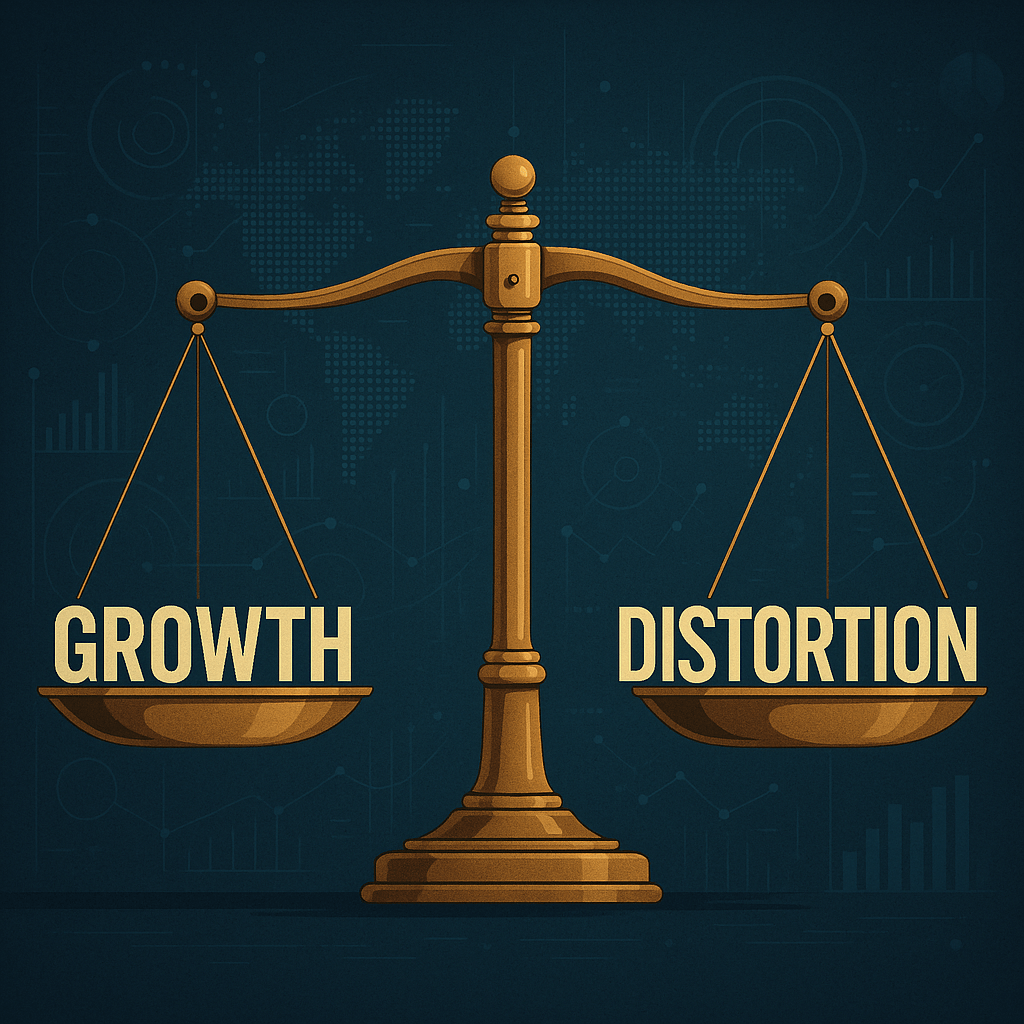
The global economy is once again witnessing a strong return of industrial policy—once dismissed as outdated interventionism. From Washington to Brussels to Beijing, governments are aggressively using subsidies, tax incentives, and state-backed financing to build technological and manufacturing strength. The IMF, in its recent assessment, acknowledges that such targeted state support can catalyze growth, but warns of inefficiencies, distortions, and rent-seeking behavior if left unchecked.
Historical Perspective: The Pendulum of State Intervention
Industrial policy has always swung between enthusiasm and skepticism.
Post-World War II era: Nations like Japan and South Korea leveraged targeted support, export promotion, and technology transfer to move from agrarian to industrial economies.
1980s-1990s neoliberal wave: Market liberalization led to a retreat from direct intervention, emphasizing competition and private sector efficiency.
Post-2008 financial crisis: Governments rediscovered industrial policy as a tool for resilience, strategic autonomy, and green transition.
The current wave—often dubbed “Industrial Policy 2.0”—is more strategic and tech-focused, aligning with national security, climate goals, and digital sovereignty.
Case Studies: Successes and Setbacks
China: Growth Through Subsidies—At a Cost
China’s massive state support—under policies like Made in China 2025—has undoubtedly propelled it into leadership positions in electronics, EVs, and renewable energy. However, IMF data suggests that such subsidies also distort resource allocation and reduce long-term productivity. Many state-owned enterprises (SOEs) enjoy preferential treatment, crowding out efficient private firms. The outcome: high growth with declining returns on investment and rising debt levels.
European Union: State Aid vs. Fair Competition
The European Union’s industrial policies—especially post-pandemic—focus on strategic autonomy in chips, energy, and defense. Yet, balancing state aid with single-market fairness remains a major challenge. Richer members like Germany and France can afford heavy subsidies, while smaller nations struggle to compete, risking fragmentation within the EU.
Brazil: The Limits of State-Led Growth
Brazil’s past experiments with state-led industrialization (notably during the 2000s) produced mixed outcomes. Protectionist barriers and poorly targeted subsidies shielded inefficiency, while export competitiveness weakened. In contrast, export-oriented models in East Asia delivered sustained growth, proving that industrial policy without performance discipline can backfire.
IMF’s Advisory: Calibrated, Conditional, and Measurable
The IMF does not reject industrial policy—it demands discipline. It recommends:
Clear performance metrics to measure the impact of subsidies and incentives.
Periodic reviews to discontinue underperforming schemes.
Regional and sectoral tailoring to prevent spillovers and duplication.
Transparency and accountability to limit rent-seeking and political capture.
In essence, industrial policy should behave more like a venture capital model—fund experiments, scale what works, and quickly exit what doesn’t.
The Risk of “Industrial Policy Overdose”
The world now risks an arms race of subsidies.
The U.S. Inflation Reduction Act alone allocates over $370 billion for green and manufacturing incentives.
The EU Green Deal Industrial Plan mirrors this trend.
India’s Production Linked Incentive (PLI) schemes span 14 sectors, aiming to localize supply chains and attract global firms.
While these may yield short-term investment booms, the long-term risk lies in global inefficiency, trade distortions, and fragmented supply chains. The IMF fears that if every country subsidizes the same sectors—chips, EVs, batteries—the global system could become redundant, unequal, and unstable.
From Industrial Policy to Innovation Ecosystems
The future of industrial policy must evolve beyond subsidies into ecosystem creation:
1. Digital Infrastructure: Data governance, AI readiness, and digital public goods as productivity enablers.
2. Green Transition: Carbon pricing and clean energy integration instead of one-off incentives.
3. Skills and R&D Networks: Investing in human capital rather than firm-specific support.
4. Global Cooperation: Developing shared standards to avoid subsidy wars and encourage technology diffusion.
By 2035, successful economies will not be those offering the biggest subsidies—but those creating adaptive, innovation-driven systems that attract private capital and global trust.
The Fine Balance of State and Market
Industrial policy is not inherently flawed—it is a double-edged instrument. Used wisely, it can catalyze new industries, foster self-reliance, and secure technological leadership. Misused, it can entrench inefficiency, erode competition, and burden future generations with fiscal strain.
The IMF’s warning thus echoes an old truth: states can guide markets, but cannot replace them. The challenge for the next decade is not whether to have industrial policy—but how to make it smarter, transparent, and globally coherent.
#IndustrialPolicy #IMF #GlobalEconomy #China #EuropeanUnion #Brazil #Subsidies #ExportCompetitiveness #GreenTransition #InnovationEcosystem
 "Connecting communities, empowering nations: Unifying the Regional and Global Economy ."
Leave a comment