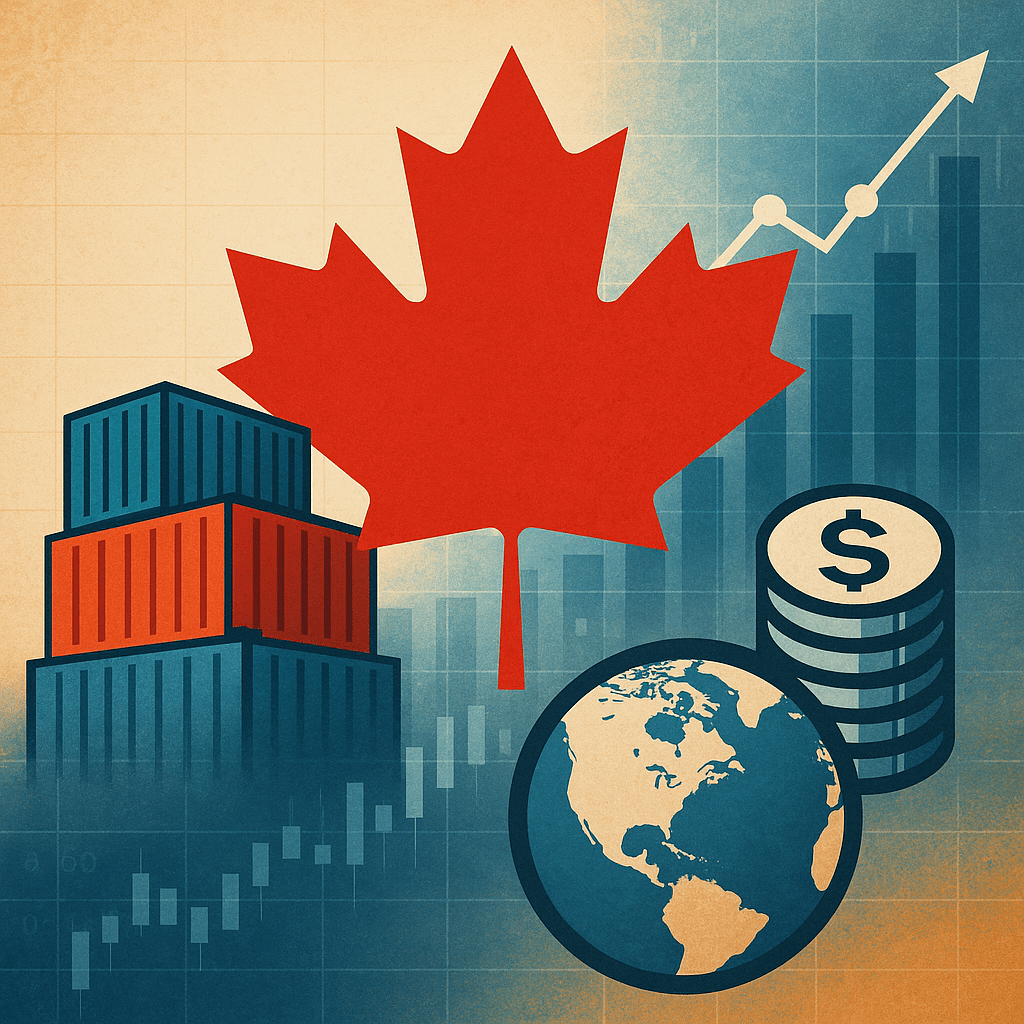
Canada’s economic prosperity has long been tied to trade and foreign capital flows. Exports account for nearly one-third of national GDP, and provinces such as Saskatchewan derive almost 45% of their GDP from commodity exports alone. This heavy reliance on external demand and foreign investment has historically fueled growth, but in today’s rapidly shifting global environment, it also leaves Canada highly exposed to volatility. The challenge now is not merely to sustain trade, but to reshape the foundations of economic resilience through diversification, innovation, and stronger capital frameworks.
Historical Roots of Canada’s Export Dependence
Canada’s reliance on trade is deeply rooted in its history. From fur and timber in the colonial era to wheat and minerals in the 20th century, the nation’s economic model has consistently leaned on natural resource exports. The North American Free Trade Agreement (NAFTA) of the 1990s further cemented dependence on the U.S. market, which today absorbs about 75% of Canadian exports.
This historical trajectory fostered prosperity but also created structural vulnerabilities—a dependence on both commodity cycles and geopolitical shifts in global trade policy.
The Provincial Dimension: Uneven Risks
While trade supports the entire national economy, certain provinces face disproportionate risks. For instance, Saskatchewan’s export-heavy GDP profile makes it a textbook case of vulnerability to external shocks. A dip in global agricultural or energy demand directly translates into provincial fiscal stress, employment instability, and slower growth.
Other provinces, like Ontario and Quebec, with stronger manufacturing and service-based economies, are comparatively better cushioned. This uneven exposure highlights the urgent need for a federal–provincial strategy that balances natural resource reliance with value-added diversification.
Slowing Global Trade: A Tectonic Shift
The world is entering an era of decelerating trade growth. Rising protectionism, fragmented supply chains, climate-related disruptions, and the reordering of global alliances have weakened the assumption that trade volumes will always expand.
For Canada, this creates three imperatives:
Market Diversification: Beyond the U.S., leveraging FTAs with the EU (CETA), Asia-Pacific (CPTPP), and emerging partners in Africa and Latin America.
Value-Added Transformation: Moving from raw commodity exports to processed and knowledge-intensive goods, supported by clean energy and advanced manufacturing.
Sustainability Integration: Embedding environmental sustainability into trade strategies to align with global ESG standards and future carbon border taxes.
Capital Flows: Canada’s Silent Vulnerability
Capital flows—whether foreign direct investment, portfolio capital, or cross-border lending—are the lifeblood of Canadian growth. They finance infrastructure, technology adoption, and job creation. Historically, Canada has benefited from its reputation as a stable, resource-rich, and investor-friendly economy.
Yet in the present climate of volatile global capital markets, risks are intensifying:
Interest Rate Volatility: Tightening global conditions may drive capital away from Canadian assets.
Investor Sentiment Shocks: Geopolitical crises or commodity price crashes can reverse flows abruptly.
Asset Market Fragility: Housing and equities are particularly sensitive to cross-border capital volatility, amplifying systemic risks.
Bank of Canada: Guardian in an Age of Flux
The Bank of Canada’s role goes beyond adjusting interest rates. It has become a stabilizer in managing the ripple effects of global volatility. Liquidity management, exchange rate interventions, and clear policy signaling are crucial tools.
But monetary policy cannot be the sole shield. Structural reforms, investment in innovation ecosystems, and coordinated fiscal strategies are equally critical to reducing dependence on volatile external flows.
Futuristic Outlook: Rethinking Canada’s Position
Looking forward, Canada must redefine its global economic positioning:
Digital and Green Economy Anchors: Invest in AI, biotechnology, renewable energy, and clean-tech exports.
Strategic Sovereignty in Critical Sectors: Build domestic resilience in food security, rare earths, and advanced manufacturing.
Rebalancing Capital Attraction: Move from passive reliance on foreign inflows to actively shaping investment through sovereign wealth strategies, green bonds, and innovation incentives.
Geopolitical Realignment: Anticipate and adapt to the fracturing of global trade blocs, securing bilateral resilience where multilateralism falters.
From Dependency to Resilience
Canada’s dependence on trade and foreign capital flows has historically been a source of growth, but in today’s uncertain global climate it is equally a source of vulnerability. The challenge is no longer about expanding volumes of exports or inflows of capital—it is about reshaping the quality, diversity, and sustainability of these engagements.
The future of Canada’s prosperity will depend on whether it can move from a resource-exporting, capital-receiving model to an innovation-driven, globally diversified, and strategically autonomous economy. History shows Canada’s adaptability. The next decade will test whether that adaptability can be scaled to meet an era of global uncertainty and fragmented trade.#CanadaTrade
#ExportDependence
#CommodityEconomy
#GlobalVolatility
#CapitalFlows
#ForeignInvestment
#EconomicDiversification
#InnovationStrategy
#BankOfCanada
#SustainableGrowth
 "Connecting communities, empowering nations: Unifying the Regional and Global Economy ."
Leave a comment