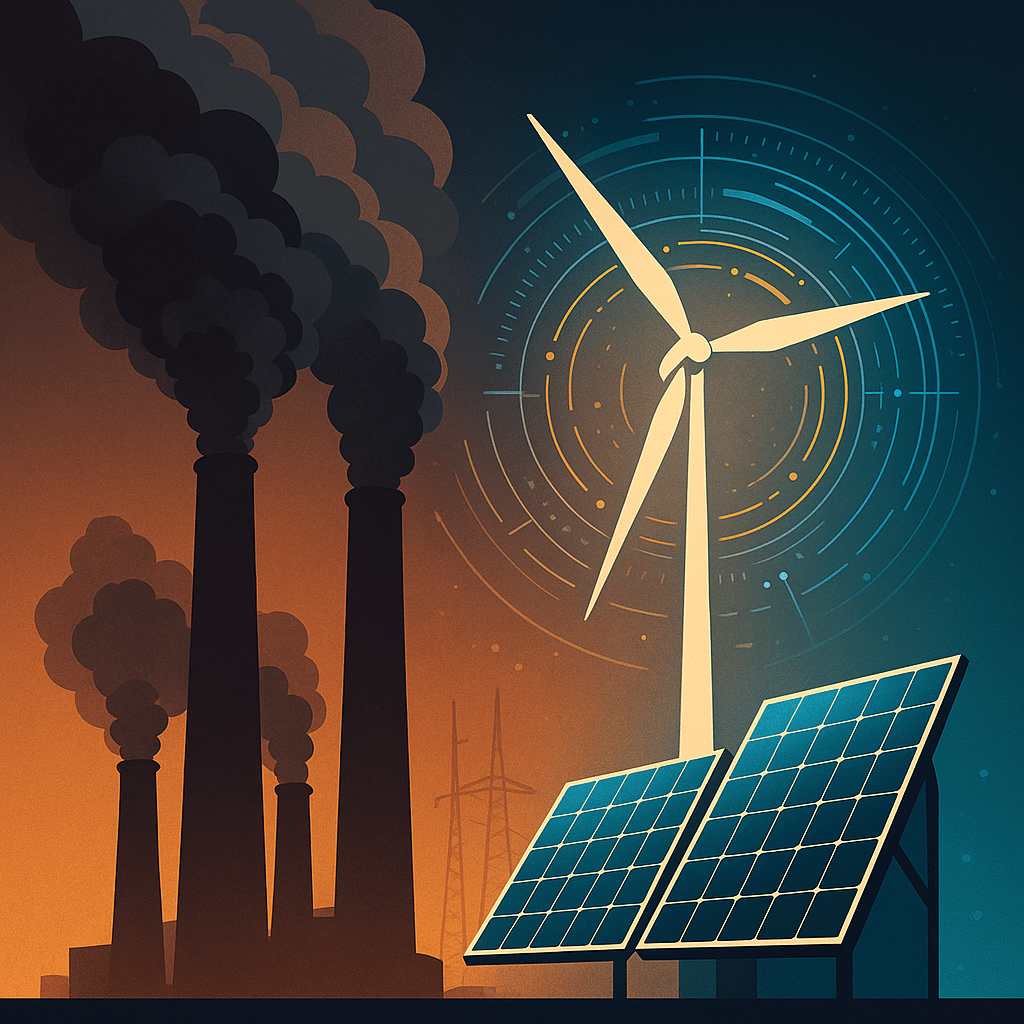
The global conversation on energy transition often carries an air of inevitability—as if the march from coal and oil to renewables is a straight path. Yet, the data tell a more sobering story. In 2024, global emissions from fossil fuels rose to about 37.4 billion tonnes, underscoring that the world is still not decarbonizing at the speed promised a decade ago.
This gap between aspiration and reality is not new. The industrial revolutions of the 19th and 20th centuries were powered almost entirely by coal and oil, and their lock-in effects are still shaping energy politics today. Coal, once the backbone of Britain’s empire and later of American industrial growth, remains deeply embedded in the energy systems of Asia. India and China—whose rapid development mirrors the West’s earlier reliance on cheap fossil energy—are now under pressure to achieve in a few decades what Europe and the U.S. took more than a century to even begin: decouple growth from carbon.
Structural Barriers in the Transition
The barriers are structural rather than technical. Renewable energy technologies—solar, wind, hydro, and increasingly green hydrogen—are advancing rapidly. Costs for solar and wind have fallen dramatically in the past decade, making them competitive with coal in many markets. Yet, several bottlenecks persist:
- Grid Infrastructure: Modern grids, designed for centralized coal and gas plants, struggle with decentralized and variable renewable flows. Without large investments in grid modernization, renewable integration will remain stunted.
- Energy Security Concerns: Nations caught in geopolitical rivalries hesitate to dismantle fossil fuel capacity that guarantees supply resilience, even if it undermines climate commitments. Europe’s scramble for natural gas after the Russia-Ukraine war is a striking reminder.
- Rising Fossil Fuel Use: Despite policy rhetoric, coal consumption remains high, especially in Asia, where it still anchors electricity generation and industrial production.
The result is a paradox: while renewables grow, fossil fuels do not decline at a matching pace. Instead, both are expanding, keeping global emissions on an upward track.
The Futuristic Imperative
The International Energy Agency (IEA) and other bodies argue that renewable growth must triple by 2030 to align with net-zero scenarios. This is not just a technical target—it is a political economy challenge. Nations will need to redesign subsidies, retrain workforces, and realign industrial policies. The transition cannot merely be about swapping energy sources; it must reshape entire production and consumption systems.
Future energy systems will likely be hybrid ecosystems—where nuclear, green hydrogen, carbon capture, and renewables interlock, supported by AI-driven grid management and digital twins for energy optimization. The promise of Industry 5.0, with its emphasis on resilience and human-centricity, could also redefine energy as not just an input but as a shared global commons requiring collective stewardship.
A Critical Outlook
History suggests that energy transitions are never smooth. The move from wood to coal took centuries, and the oil economy consolidated only after two world wars. Expecting a transition from fossil dominance to net-zero within a few decades is ambitious, but not impossible—provided we acknowledge the political, social, and infrastructural hurdles rather than glossing over them with techno-optimism.
The danger today is not the lack of solutions but the illusion of progress. Emissions rising in 2024 despite renewable growth is a warning sign. If policy frameworks continue to lag behind technological advances, the world risks building a dual system—new renewables layered on top of an old fossil foundation—rather than a transformative break.
The future of the energy transition will depend less on innovation alone and more on whether governments, businesses, and societies can make the hard political choices: phasing out subsidies for fossil fuels, investing in resilient grids, and creating equitable frameworks that ensure emerging economies do not bear disproportionate costs.
The past shows us that every major energy transition reshaped geopolitics, economics, and societies. The coming one will be no different. What remains uncertain is whether the world can achieve it fast enough to avert the worst consequences of climate change—or whether history will record our era as one where ambition fell short of necessity.
#EnergyTransition
#Decarbonization
#Renewables
#FossilFuels
#NetZero
#ClimateChange
#GridInfrastructure
#EnergySecurity
#GreenHydrogen
#Sustainability
 "Connecting communities, empowering nations: Unifying the Regional and Global Economy ."
Leave a comment