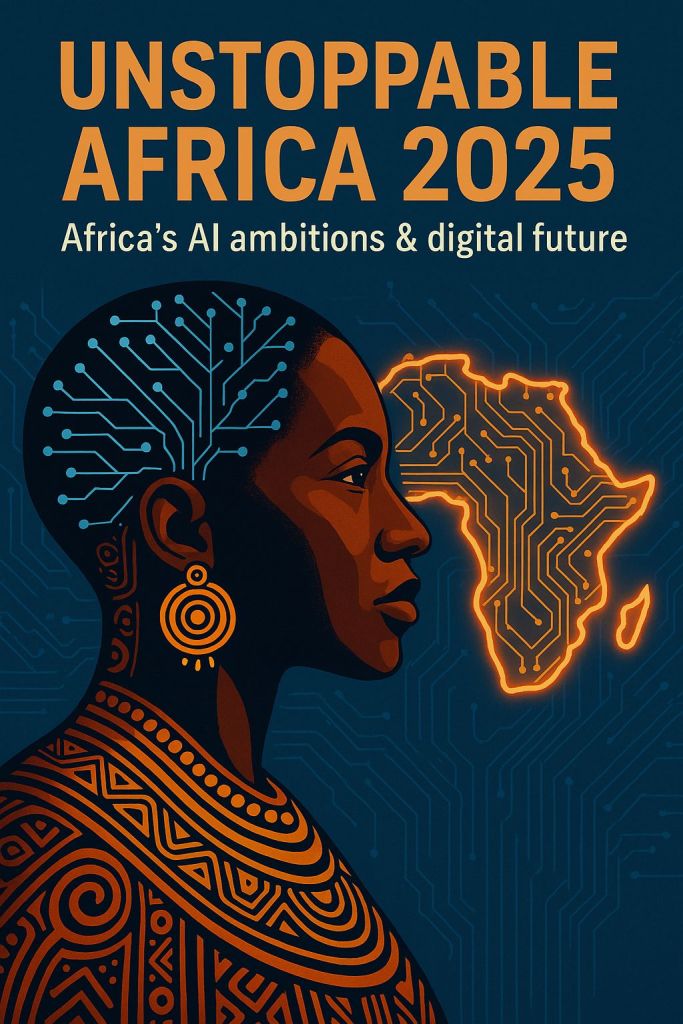
When the phrase Unstoppable Africa was coined at the 2025 summit, it was not just rhetoric. It reflected the continent’s growing determination to harness artificial intelligence (AI) as a transformative tool for economic growth, social progress, and digital sovereignty. The announcements of AI “factories” — purpose-built infrastructure across Africa to be completed by 2026 — and the commitment of global tech giants like Meta to expand investment signal that Africa is preparing to shift from being a consumer of global digital products to a producer of homegrown innovation.
Historical Perspective: From Digital Periphery to Potential Powerhouse
For decades, Africa has been viewed through the lens of the digital divide. In the 1990s and early 2000s, much of the continent lagged in internet penetration, digital infrastructure, and skills. Mobile connectivity changed that trajectory in the 2010s, with mobile banking platforms like M-Pesa in Kenya proving that African societies could leapfrog traditional infrastructure.
The same pattern may now be repeating with AI. While developed economies debate overregulation and data localization, Africa has an opportunity to adopt flexible, context-specific strategies that meet its own development goals. History shows that Africa often innovates under constraints — turning scarcity into an engine of creativity.
The AI Factories: Building Digital Infrastructure for Growth
The decision to establish AI factories by 2026 is both symbolic and practical. Symbolic, because it shows Africa wants to control its own narrative in the global tech race. Practical, because without localized data centers, training compute, and algorithmic adaptation to local languages and cultures, Africa would remain dependent on external providers.
By anchoring AI development domestically, Africa can ensure that sectors such as agriculture, healthcare, logistics, and education benefit from tailored AI solutions. Imagine precision-farming algorithms that account for African soil diversity, or AI healthcare assistants trained on regional epidemiological data. These are not futuristic luxuries — they could become lifelines.
Meta’s Investments: Opportunity or Dependency?
Meta’s renewed interest in Africa’s digital ecosystem brings both opportunities and risks. On one hand, foreign capital and expertise can accelerate ecosystem development, providing much-needed infrastructure and training. On the other hand, if such partnerships mirror historical extractive patterns — where data flows outward and value accrues to external shareholders — Africa risks repeating colonial-era dependencies in a digital form.
The challenge, therefore, is to balance foreign investment with strong regulatory frameworks, ensuring Africa’s AI ecosystem grows in alignment with continental priorities such as the African Union’s Agenda 2063.
Bridging the Digital Divide: From Ambition to Action
Bridging the digital divide requires more than infrastructure. It demands a multi-pronged approach:
Skills Development: Training a generation of African data scientists, AI ethicists, and engineers.
Regulatory Agility: Crafting policies that protect privacy and security while fostering innovation.
Public-Private Partnerships: Leveraging global expertise without undermining local ownership.
Local Language AI: Ensuring inclusivity by building systems that work across Africa’s 2,000+ languages.
Without such steps, AI risks deepening existing inequalities, creating a divide not just between Africa and the world but within African societies themselves.
Futuristic Outlook: Africa’s Role in Global AI
Looking ahead, Africa’s AI ambitions could reshape global trade, technology, and geopolitics. If the AI factories succeed, Africa could emerge as a hub for low-cost but high-impact AI applications. This would position the continent as a key player in global value chains — not merely as a supplier of raw materials, but as a producer of intellectual capital.
However, critical risks remain. Energy shortages, political instability, and the global competition for AI talent could slow momentum. Furthermore, as climate change intensifies, Africa will need to balance AI infrastructure’s energy demands with its sustainability goals.
From Vision to Reality
The Unstoppable Africa 2025 summit showcased ambition — but ambition alone is not enough. History teaches us that global technology waves often bypass those who hesitate. Africa now faces a unique window of opportunity to shape its digital destiny.
If the continent can pair bold infrastructure investments with inclusive governance and sustainable energy policies, it may well lead the next chapter of the AI revolution — not as a follower, but as a pioneer.
Africa’s AI future is not just about catching up. It is about redefining what technological progress looks like when driven by local needs, cultural richness, and developmental priorities. That is what could make Africa truly unstoppable.#UnstoppableAfrica
#AIFactories
#DigitalDivide
#HomegrownAI
#MetaInvestment
#Agenda2063
#AfricanInnovation
#DigitalSovereignty
#FutureOfWork
#InclusiveGrowth
 "Connecting communities, empowering nations: Unifying the Regional and Global Economy ."
Leave a comment