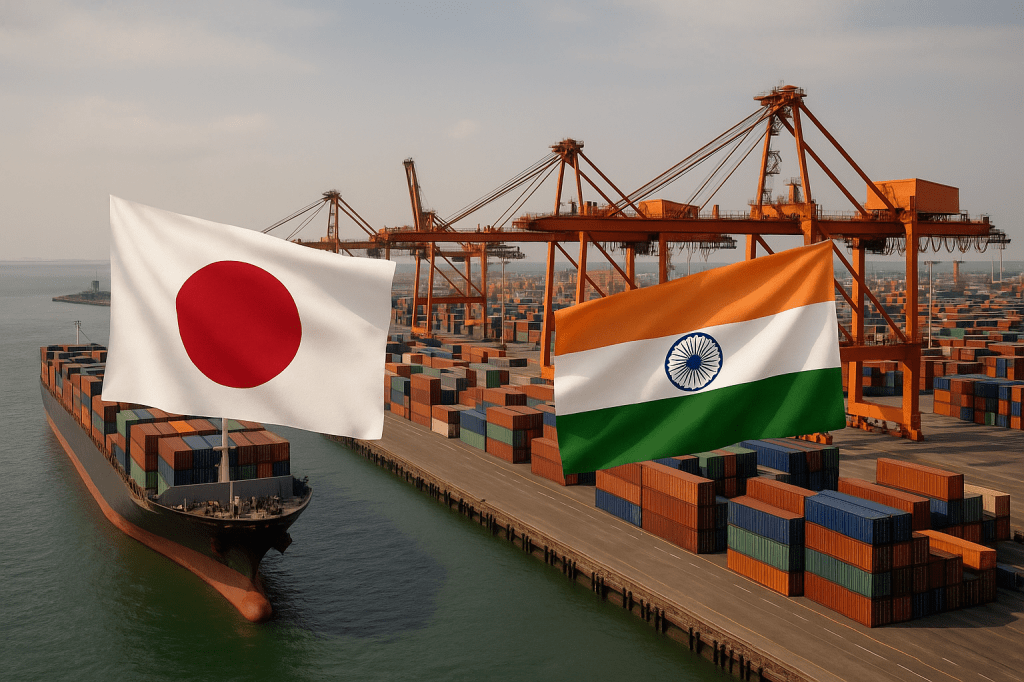
Japan’s latest trade numbers carry a warning not just for Tokyo, but for Asia’s broader economic landscape—including India. For the fourth consecutive month, Japanese exports contracted. The headline numbers are stark: automobile exports plunged 28.4%, while shipments of chipmaking equipment to the U.S. collapsed by 38.9%. Overall exports dipped only 0.1%, cushioned by gains to Asia and the EU, but the underlying signals point to deeper structural stress. Imports too declined by 5.2%, mainly on cheaper oil, and Japan’s trade surplus with the U.S. halved to its lowest since early 2023.
Even more troubling is the forward outlook. Forecasts suggest Japan’s economy may shrink at an annualized 1.1% in Q3 2025, a sharp reversal after a brief rebound. While corporate investment surged 7.6% year-on-year in Q2, consumer demand and external trade remain vulnerable under the weight of U.S. tariffs and global uncertainty.
Why India Should Care
India’s economic trajectory is deeply tied to the performance of both global demand and supply chains in Asia. Japan’s contraction in automobiles and semiconductors has three critical implications:
1. Automobile Chain Stress
Japan remains a technology and capital goods supplier to India’s auto sector. A sustained contraction in Japanese exports could mean delayed technology transfer, reduced availability of advanced components, and higher input costs for Indian automakers who are scaling up EV and hybrid production.
2. Semiconductor Equipment Disruptions
The 38.9% decline in chipmaking equipment exports highlights rising friction in global tech trade. India’s semiconductor ambitions—anchored by the India Semiconductor Mission and new fabs under Tata and Vedanta—depend heavily on Japanese machinery. Any disruption could stall India’s attempt to position itself as a reliable alternative to China, slowing timelines for domestic capacity building.
3. Currency and Trade Imbalances
Japan’s weaker trade surplus and possible Q3 contraction may push the yen lower. A depreciated yen could undermine Indian exports to Japan (making Indian goods costlier) while making Japanese imports cheaper in India. This asymmetry could widen India’s trade deficit, especially in electronics and precision equipment.
The Bigger Picture: U.S. Tariffs and Asian Economies
The U.S. tariffs driving Japan’s downturn are a warning sign for India. Washington’s escalating protectionism—seen in tariffs on Indian goods, visa fee hikes, and potential non-tariff barriers—has already begun reshaping trade flows. Japan’s struggles show that even advanced economies cannot escape the squeeze. For India, overly relying on U.S. demand for IT services, pharmaceuticals, and emerging exports like electronics could expose vulnerabilities similar to Japan’s.
A Futuristic Outlook for India
India’s path forward must be built around resilience and diversification:
Supply Chain Hedging: India must double down on ASEAN, Africa, and Latin America as counterweights to U.S.-centric demand shocks.
Technology Partnerships Beyond Japan: South Korea, Taiwan, and Europe must be actively integrated into India’s semiconductor and EV value chain.
Domestic Investment Push: Just as Japan saw corporate investments rise 7.6%, India should sustain its capital expenditure surge to insulate growth from external volatility.
Currency Diplomacy: With Japan’s yen weakening and the rupee under pressure, India must pursue currency swap agreements and bilateral trade in local currencies to avoid imported instability.
Critical Outlook
Japan’s export slump is more than a one-country story. It illustrates how global trade turbulence, U.S. tariffs, and shifting supply chains can destabilize even the most advanced economies. For India, this is both a cautionary tale and an opportunity. If India can act decisively—by diversifying markets, accelerating its self-reliance in semiconductors, and strengthening regional economic ties—it may convert global disruption into a platform for leadership in the next decade.
The real question is not whether Japan’s decline will impact India, but whether India can learn fast enough to avoid a similar trap#JapanExports
#USTariffs
#AutomobileSector
#SemiconductorEquipment
#TradeDeficit
#IndianEconomy
#GlobalSupplyChains
#CurrencyVolatility
#EconomicDiversification
#FutureOutlook.
 "Connecting communities, empowering nations: Unifying the Regional and Global Economy ."
Leave a comment