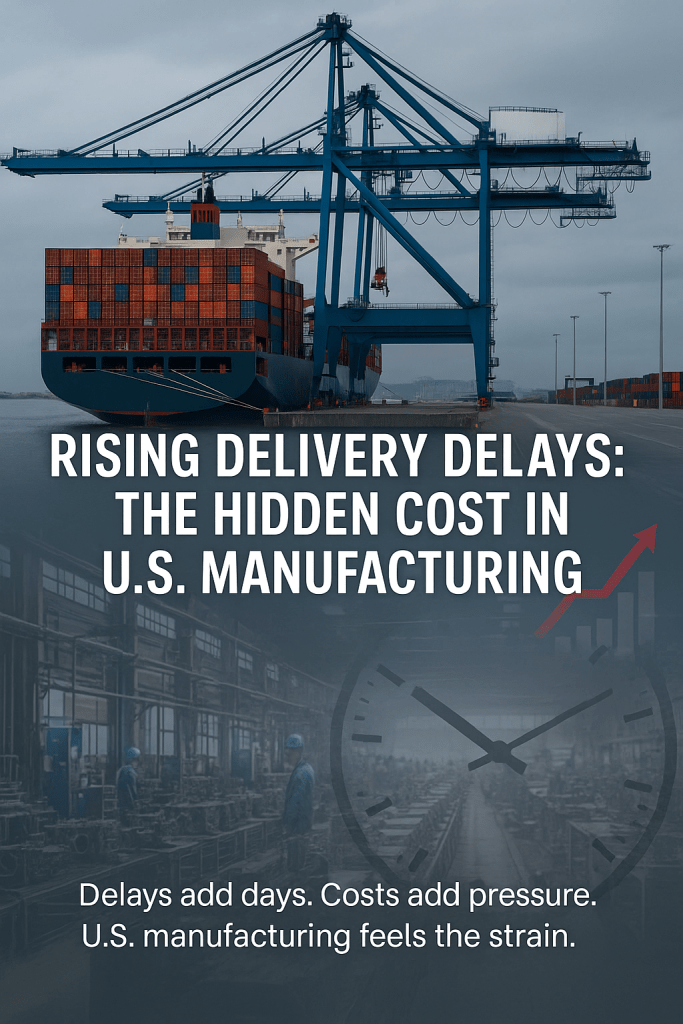
Over the past few years, the U.S. manufacturing sector has faced mounting challenges in maintaining smooth supply chains. Between 2018 and 2024, delivery delays for imported foreign inputs lengthened by an average of 21 days. This increase has not only disrupted production schedules but also forced firms to hold higher inventory-to-sales ratios, reflecting a system struggling to adapt to persistent bottlenecks.
The Scale of the Disruption
The prolonged delivery times have had measurable economic consequences. Researchers estimate an overall output loss of 7.3% in U.S. manufacturing due to these disruptions. While this figure captures multiple factors, the role of delays is particularly striking—responsible alone for 2.6% of the decline in output. This shows how logistical frictions, independent of demand shocks or raw material shortages, can undermine industrial performance.
Cost Pressures and Rising Input Prices
Delays have not only constrained production but also increased costs. The average input price rose by 1.8%, with delays directly accounting for about 0.4% of the increase. Even seemingly modest price hikes matter for an economy dependent on imported intermediate goods, as manufacturers pass these costs downstream, affecting consumer prices and competitiveness in global markets.
Why Are Delays Rising?
Several structural and cyclical reasons explain the trend:
Geopolitical shifts: Trade tensions, tariff measures, and export controls have slowed cross-border flows.
Logistics bottlenecks: Port congestion, container shortages, and uneven recovery after the pandemic worsened lead times.
Supply chain concentration: Heavy reliance on a few key sourcing hubs has made the system more vulnerable to disruptions.
Inventory strategies: Firms that previously embraced “just-in-time” systems are now keeping larger buffers, but this adjustment takes time and adds cost.
Critical Implications for U.S. Manufacturing
1. Loss of competitiveness: A 7.3% decline in output is not marginal—it reflects an erosion of productivity and market share at a time when global competition is intensifying.
2. Cost-push inflation: Rising input costs feed into higher producer prices, raising the risk of sustained inflationary pressures in key sectors.
3. Strategic rethinking: These disruptions underscore the need for supply chain diversification, nearshoring, and investment in logistics infrastructure.
4. Policy response: Trade agreements, infrastructure modernization, and targeted incentives for domestic input production could mitigate long-term risks.
Looking Ahead
The U.S. faces a difficult balance. On one hand, global supply chains remain indispensable for efficiency and scale. On the other, prolonged delays and rising costs expose vulnerabilities that could undermine industrial recovery. A strategy built on resilience—through diversification, technology adoption, and stronger trade frameworks—will be critical to ensuring U.S. manufacturing regains stability in the coming years.#USManufacturing
#SupplyChainDelays
#ImportCosts
#InventoryManagement
#LogisticsBottlenecks
#OutputLoss
#InputPrices
#TradeDisruptions
#GlobalCompetitiveness
#IndustrialResilience
 "Connecting communities, empowering nations: Unifying the Regional and Global Economy ."
Leave a comment