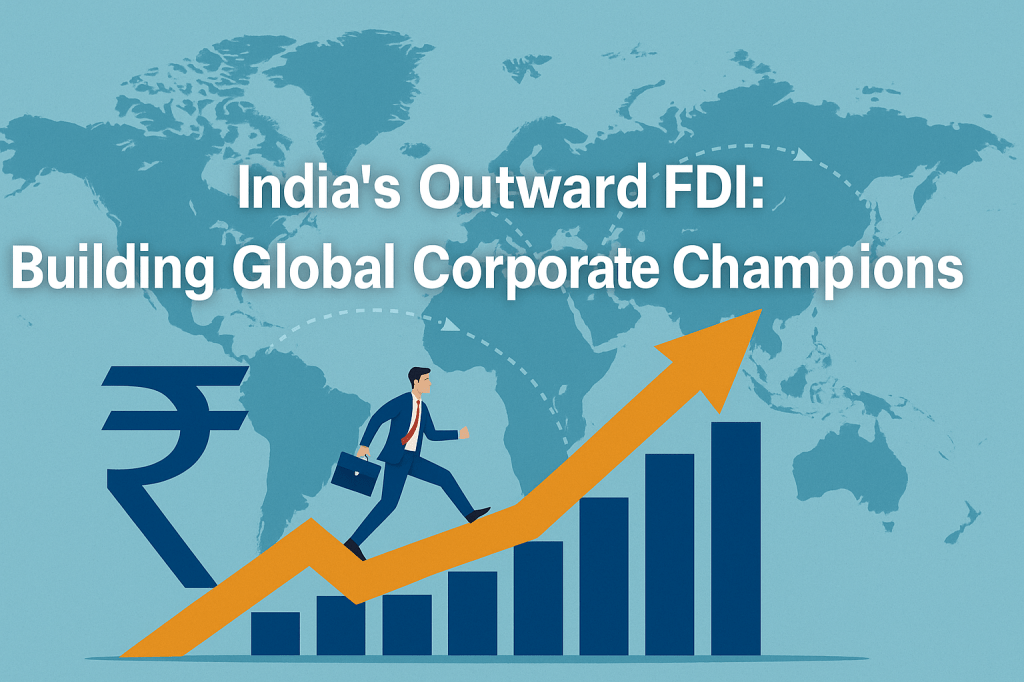
India’s outward foreign direct investment (OFDI) has accelerated sharply in recent years, signaling a new phase of globalization for Indian enterprises. In FY2024–25, outward FDI rose by more than 67%, reaching US$41.6 billion—a surge that underlines how Indian firms are moving beyond domestic consolidation to carve out an international footprint. This momentum is not just about capital flows; it reflects a deep structural transformation in corporate strategy, sectoral priorities, and India’s engagement with the global economy .
Traditional gateways like Singapore, Mauritius, UAE, United States, and the Netherlands continue to dominate, absorbing over three-quarters of Indian OFDI. Their enduring appeal lies in tax efficiency, robust financial systems, and ease of capital repatriation. Yet, the landscape is diversifying: Luxembourg and Switzerland have emerged as non-traditional destinations, buoyed by investor-friendly regulations, innovation ecosystems, and ESG-oriented policies. This pivot suggests Indian companies are not only chasing markets but also aligning with sustainability norms and global tax reforms .
Sectoral Drivers and Strategic Acquisitions
The investment surge spans financial services, IT and technology, manufacturing, pharmaceuticals, energy, and hospitality. Resource-hungry conglomerates like ONGC Videsh and the Adani Group continue to secure energy and mining assets abroad, while IT majors and auto companies expand into high-tech hubs to bypass non-tariff barriers. The pharmaceutical industry, in particular, leverages acquisitions in developed markets to accelerate drug approvals and gain regulatory footholds .
Motives Behind the Push
Indian OFDI is shaped by four major imperatives: market diversification, access to critical resources, cost competitiveness, and leverage of free trade agreements. The India-UAE CEPA, for instance, has catalyzed expansions in finance, logistics, and fintech. For service-sector giants, overseas presence is increasingly a regulatory necessity—banks and fintechs need a global base to scale operations, comply with host-country rules, and deepen customer engagement .
Recent Trends and the Scale of Growth
The pace of growth is striking. In April 2025 alone, Indian firms committed US$6.8 billion in outward FDI—almost double the amount in April 2024. Leading the charge were Tata Communications, LIC, JSW Neo Energy, and Havells, with guarantees and loan commitments dominating the surge. Beyond headline numbers, a structural shift is visible: Indian firms are establishing overseas manufacturing and service hubs in North America, ASEAN, and Eastern Europe, strategically positioning themselves within global supply chains .
Toward a Global Corporate Identity
Looking ahead, outward FDI will be shaped by global tax reforms, evolving FTAs, and changing regulatory landscapes. The movement toward diversified jurisdictions reflects a conscious strategy to mitigate risk and seize opportunities in innovation-driven economies. More importantly, Indian OFDI has become a central pillar of India’s international economic engagement, signaling the rise of Indian firms as global corporate champions. This not only enhances India’s soft power but also ensures a deeper integration into the world economy
 "Connecting communities, empowering nations: Unifying the Regional and Global Economy ."
Leave a comment