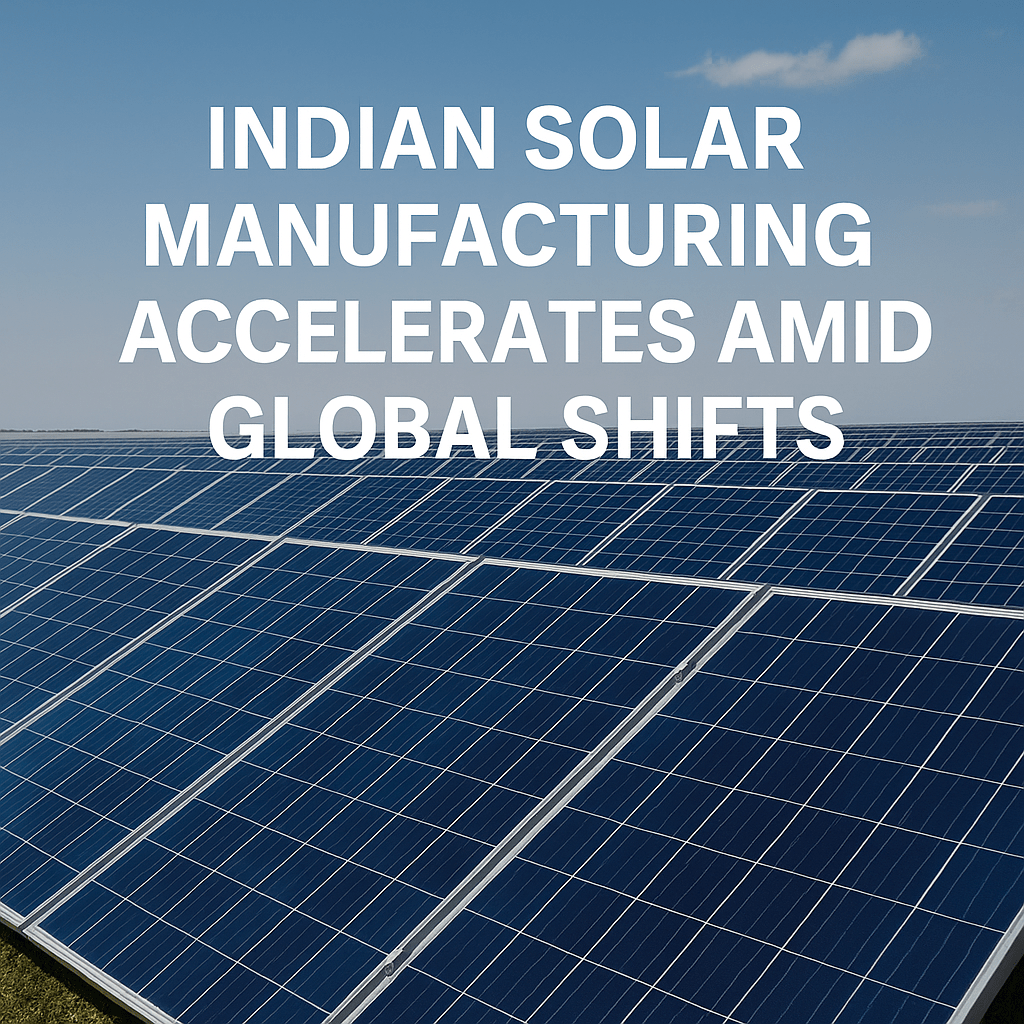
India’s solar manufacturing sector is experiencing a dramatic surge, marking FY 2024-25 as a turning point for clean energy. The country’s domestic manufacturing capacity for solar modules has more than doubled, while capacity for solar cells has tripled. This transformation is not just a story of growth—it reflects how strategic interventions, global shifts, and persistent challenges converge to shape the nation’s renewable energy ambitions.
A Sector on Fast-Forward
The doubling of module production capacity and tripling of cell output is more than a statistical leap. It signifies India’s transition from a heavy dependence on imported photovoltaic components toward building a self-reliant supply chain. For years, Indian developers leaned on cheaper imports, especially from China. This cost advantage, however, created vulnerabilities, ranging from supply disruptions to currency fluctuations. The current acceleration demonstrates how policy nudges and market realignments can catalyze domestic manufacturing.
The ReNew Jaipur Example
One of the most visible milestones in this journey is ReNew’s Jaipur facility. With a production capacity of 4 GW annually, the plant has become both a technological asset and a source of livelihood, employing nearly 1,000 people. Such plants are more than factories—they serve as regional anchors for employment, local vendor networks, and skill development ecosystems. If replicated at scale, these facilities can reduce India’s technology gap and foster innovation in solar efficiency and storage solutions.
Policy Push: Subsidies, Mandates, and Tariffs
The rapid growth is inseparable from government intervention. Subsidies under production-linked incentive (PLI) schemes, clean energy mandates, and favorable policy frameworks have pushed firms to expand. Moreover, the deliberate reduction in imports, combined with high U.S. tariffs on Chinese solar exports, has created an opening for Indian manufacturers. By positioning itself as an alternative supplier in the global market, India is attempting to turn trade disruptions into domestic opportunity.
Yet, this momentum is not without caveats. Subsidy-driven growth can sometimes mask structural weaknesses—such as limited R&D investment, high cost of domestic finance, and delays in project approvals. Unless these bottlenecks are addressed, India risks building capacity without building resilience.
Global Shifts and Their Double-Edged Impact
While global tariff wars and clean energy transitions in advanced economies create space for India, they also expose vulnerabilities. U.S. tariffs on Chinese solar exports reduce competition for Indian producers, but they also squeeze overall export opportunities if India cannot compete on cost. Meanwhile, Europe’s energy transition opens markets, but demands strict compliance with sustainability standards, which could strain less-prepared Indian firms.
Thus, India’s solar rise is not a straight path upward—it must navigate shifting sands of international trade, environmental compliance, and technology innovation.
The Critical Gap: Planning vs. Execution
Despite the impressive numbers, the sector faces risks from negligence and lack of planning. For example:
Supply Chain Concentration: Many component inputs, including wafers and polysilicon, are still imported. Without backward integration, India’s solar industry remains exposed to external shocks.
Grid Readiness: Manufacturing capacity does not automatically translate into energy transition. If transmission infrastructure and grid balancing mechanisms lag, surplus panels could pile up instead of powering homes.
Financing and Affordability: High interest rates and long gestation periods for manufacturing plants can deter sustained private investment. Without careful financial structuring, the current boom may prove unsustainable.
These gaps underline a sobering reality: building factories is the easier part. Ensuring integration, competitiveness, and long-term sustainability requires far deeper planning.
Employment, Growth, and the Bigger Picture
On the brighter side, solar manufacturing’s expansion is feeding into India’s employment and industrial growth agenda. Plants like ReNew’s Jaipur unit create jobs not only within factories but across logistics, component supply, and maintenance networks. Moreover, they help position India as a credible global supplier of clean technology, aligning with its climate commitments under the Paris Agreement.
However, policymakers must ensure that this growth does not remain concentrated in a few corporate giants. Without deliberate inclusion of small and medium enterprises (SMEs), regional clusters, and public-private R&D centers, the benefits may remain narrow and fragile.
Growth at a Crossroads
India’s solar manufacturing acceleration is a remarkable story of ambition meeting opportunity. The doubling and tripling of capacity in FY 2024-25 prove that the country can scale rapidly when policies align with market needs. Yet, critical challenges remain: dependence on imported inputs, risks of subsidy dependence, and fragile execution frameworks.
The sector now stands at a crossroads. With foresight, planning, and a focus on resilience, India can transform into a solar powerhouse. Without these, the current boom risks becoming a short-lived spurt in a volatile global energy landscape.
The path forward is clear: growth must be matched with strategy, capacity must be matched with resilience, and ambition must be matched with execution. Only then can India’s solar story truly illuminate the future.#SolarEnergy
#RenewableIndia
#CleanTech
#GreenGrowth
#SolarManufacturing
#EnergyTransition
#Sustainability
#ClimateAction
#SelfReliance
#GlobalShift
 "Connecting communities, empowering nations: Unifying the Regional and Global Economy ."
Leave a comment