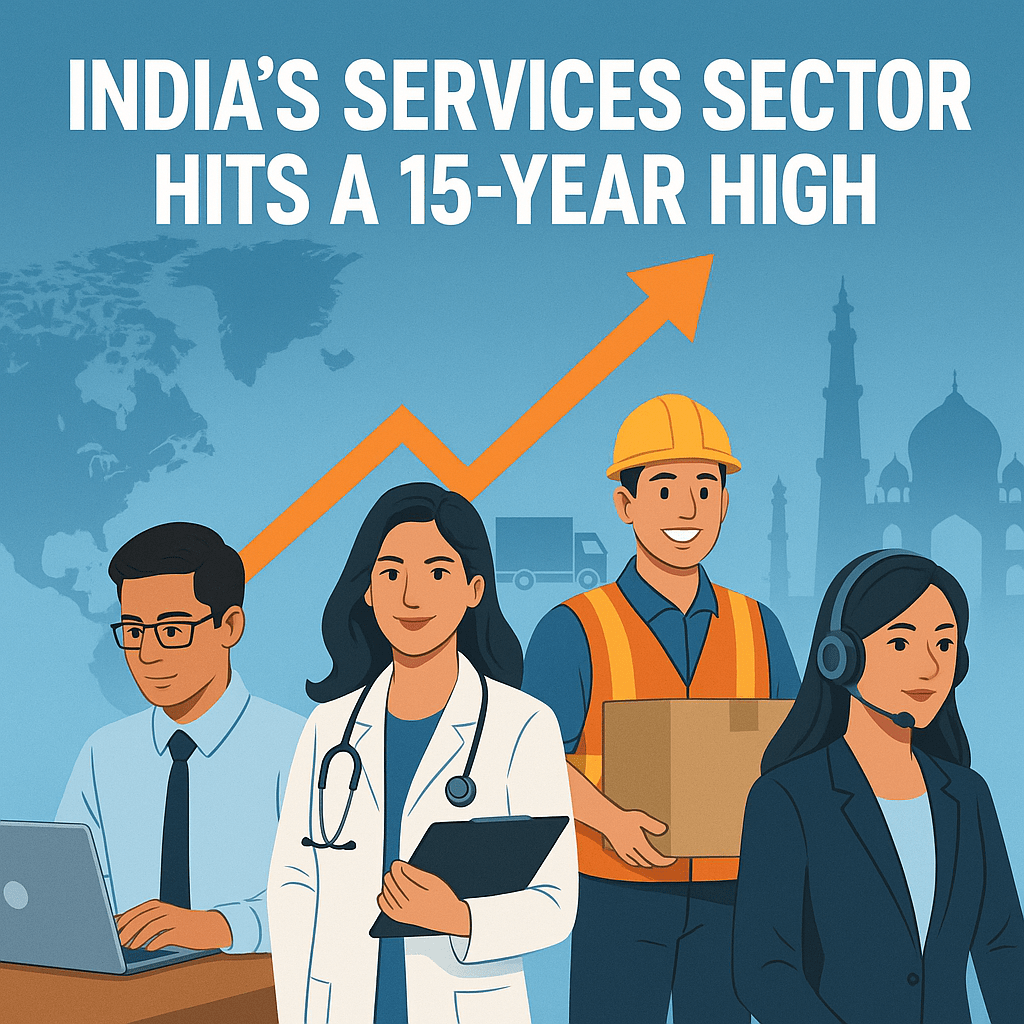
India’s services sector has reached a milestone—hitting its highest level of activity in the last 15 years. According to a recent survey, robust new orders, strong export performance, and rising business confidence are fueling this growth momentum. For an economy like India, where services account for more than 50% of GDP and employ millions, this surge is more than just a statistical uptick—it’s a signal of resilience and opportunity.
The Driving Forces Behind the Surge
1. New Orders and Domestic Demand
The Indian middle class continues to expand, with rising disposable incomes and digital penetration. Demand for services such as financial technology, healthcare, education, and logistics has accelerated. Companies are reporting stronger order books, reflecting consumer optimism.
2. Exports on the Rise
IT services, business process outsourcing (BPO), and consultancy remain India’s strongest export segments. Recent global shifts toward outsourcing and digital transformation have given India’s service providers a competitive edge. Countries in North America and Europe are increasingly turning to India not just for cost efficiency, but also for skilled expertise.
3. Business Confidence at Elevated Levels
A surge in sentiment among service providers indicates optimism about future demand. This is partly supported by government reforms, stable inflation, and expectations of continued growth in both domestic and international markets.
Why This Matters for India’s Growth Story
The services sector has long been the backbone of India’s economic expansion. Unlike manufacturing or agriculture, which are often more exposed to supply shocks and global volatility, services are more resilient and adaptable. A 15-year high signals three critical outcomes:
Boost to GDP Growth: With services contributing over half of national income, this surge could push India closer to its ambitious growth targets.
Employment Opportunities: Rising demand for healthcare workers, IT professionals, and digital service providers means more jobs—especially for the educated youth.
Export Competitiveness: As global economies look for efficiency and digital transformation, India’s service exports can fill a strategic gap.
The Global Context
Globally, services are becoming a key driver of trade, even overtaking goods in many advanced economies. The World Trade Organization (WTO) has noted that services exports are growing faster than merchandise exports worldwide. India, with its established IT ecosystem and English-speaking workforce, is well-positioned to capture a greater share of this expanding market.
Critical Challenges Ahead
While the surge is encouraging, sustaining it will require addressing several challenges:
Skill Mismatch: The demand for highly skilled digital professionals is outpacing supply. Without continuous upskilling, India may face a bottleneck.
Global Risks: Protectionist policies in key markets, such as the U.S. and Europe, could restrict outsourcing opportunities.
Infrastructure Needs: For non-IT services like logistics, healthcare, and tourism, infrastructure gaps remain a constraint.
Inequality in Growth: The benefits of service-led growth often concentrate in urban centers, leaving rural regions behind.
What Lies Ahead
The record-high activity in India’s services sector underscores a crucial truth: India’s future growth story will likely be service-led. If supported by targeted policy reforms—such as digital skilling programs, incentives for export diversification, and investment in infrastructure—the momentum can translate into sustainable, inclusive growth.
The world is moving toward a service-oriented economy, and India’s latest milestone shows it is not just keeping pace but setting benchmarks. The challenge now is to ensure that this growth is broad-based, resilient, and future-ready.
 "Connecting communities, empowering nations: Unifying the Regional and Global Economy ."
Leave a comment