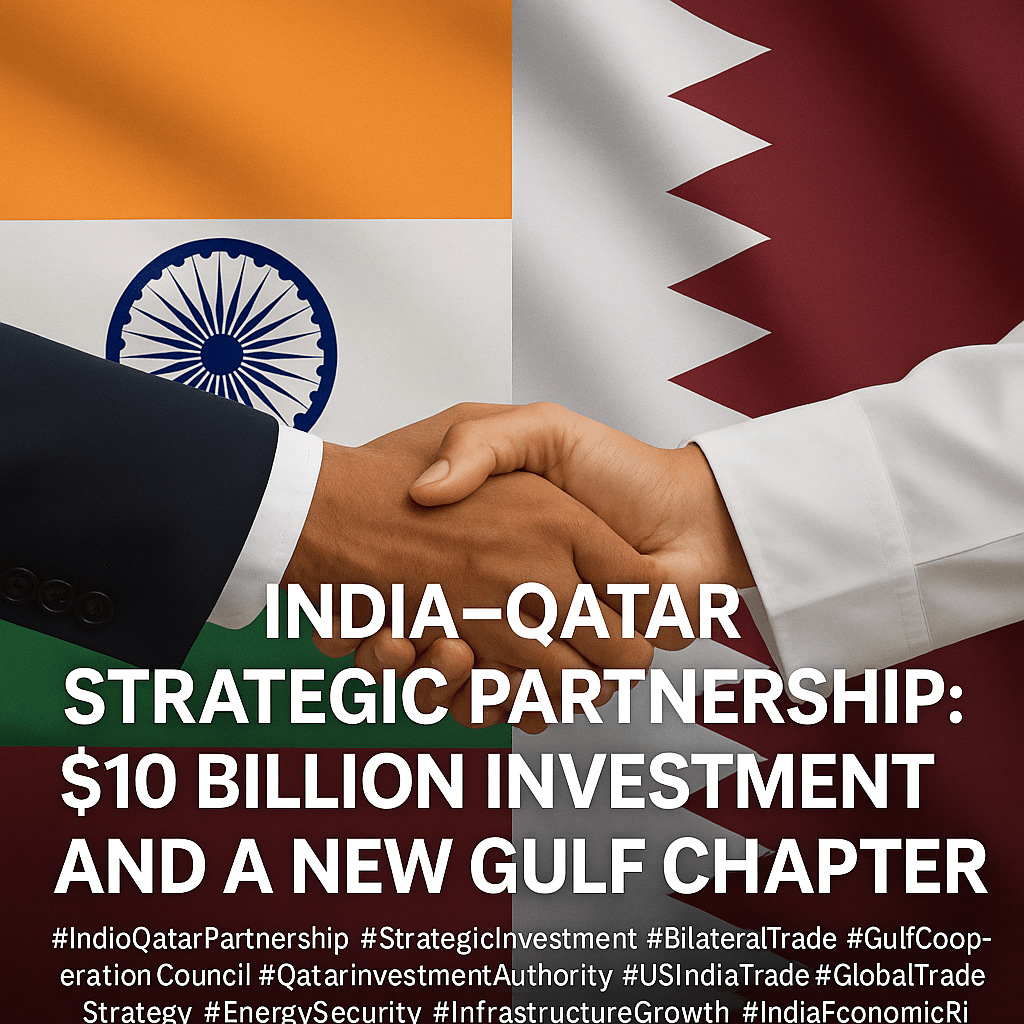
The groundwork for India–Qatar trade negotiations was laid during the historic state visit of the Emir of Qatar to India on February 17–18, 2025. The two nations signed an Agreement on Establishment of Bilateral Strategic Partnership, marking a decisive step in elevating their relationship from energy-centric cooperation to a broad-based strategic alliance. With this move, Qatar joins the UAE, Saudi Arabia, Oman, and Kuwait as India’s strategic partners within the Gulf Cooperation Council (GCC) framework—a clear indication of India’s deepening engagement with West Asia [1][2].
What makes this partnership significant is its timing. India has been actively recalibrating its trade and foreign policy to secure long-term energy supplies, attract capital for infrastructure, and strengthen regional connectivity. Qatar, on the other hand, has been diversifying its global investment footprint beyond hydrocarbons. By aligning with India, one of the fastest-growing large economies in the world, Doha finds a stable and lucrative destination for its sovereign wealth.
During the visit, Qatar announced a commitment to invest $10 billion in India. The proposed investments span multiple high-growth areas—infrastructure, technology, manufacturing, food security, logistics, and hospitality. Each of these sectors not only addresses India’s development priorities but also aligns with Qatar’s strategy of diversifying its sovereign assets. For instance, investments in infrastructure and logistics will boost India’s $5 trillion economy roadmap, while collaboration in food security and technology responds directly to Qatar’s domestic needs for supply resilience and innovation .
A particularly important outcome was the decision by the Qatar Investment Authority (QIA) to open an office in India. This is more than a symbolic gesture; it signals Qatar’s intent to institutionalize its investment presence in the country. Having an on-the-ground office facilitates faster deal-making, improved monitoring of investments, and deeper coordination with Indian public and private stakeholders. For India, this creates a direct channel to one of the world’s most influential sovereign wealth funds, giving Indian enterprises—from infrastructure developers to startups—greater access to global capital .
Broader Trade Strategy Context
This development fits into a much wider trade recalibration being pursued by New Delhi. Commerce Minister Piyush Goyal highlighted that Qatar’s interest in negotiating a trade pact comes at a moment when India is actively diversifying its trade partnerships in response to heightened US tariffs. The minister noted that a Free Trade Agreement (FTA) with Oman is close to conclusion, talks with Saudi Arabia are also underway, and negotiations with the European Union are progressing at an accelerated pace
Goyal stressed that despite global headwinds and the “unilateral actions of a country”—a clear reference to the United States’ decision to impose 50 percent tariffs on several Indian exports—India’s trade outlook remains resilient. In fact, about 40 percent of India’s total exports to the US fall outside the tariff bracket, allowing exporters to sustain momentum. This shows that India is not only managing immediate trade shocks but is also strategically positioning itself for long-term stability by building parallel trade channels across the Gulf, Europe, and Asia.
Strategic and Geopolitical Significance
The partnership also carries geopolitical weight. Qatar has often been seen as a balancing actor within the Gulf, maintaining relations across regional divides. By entering into a strategic partnership with India, it strengthens New Delhi’s foothold in West Asia at a time when energy markets are shifting and global trade corridors are being redefined. For India, which imports nearly 55% of its LNG from Qatar, securing a long-term energy partner while expanding cooperation into new sectors reflects a smart strategy of hedging against volatility in global energy prices.
From a critical standpoint, however, the effectiveness of this partnership will depend on execution. India must ensure that regulatory hurdles, land acquisition delays, and bureaucratic bottlenecks do not slow down Qatar’s investment momentum. At the same time, Qatar’s long-term returns will hinge on India’s ability to maintain macroeconomic stability and sustain its growth trajectory. The $10 billion commitment is ambitious, but whether it translates into on-ground transformation will depend on project selection, governance, and risk management.
Looking Ahead
Still, the signals are clear: India and Qatar have moved beyond a transactional buyer–seller dynamic into a strategic relationship that blends diplomacy, trade, and investment. If the announced investments materialize as planned, this partnership could serve as a template for India’s broader engagement with the Gulf, where capital from energy-rich economies can accelerate India’s development goals while offering Gulf nations sustainable returns.
Viewed against the backdrop of US tariffs and ongoing global uncertainties, the India–Qatar agreement stands as a timely demonstration of India’s capacity to forge resilient, forward-looking trade partnerships. It is not just a bilateral deal—it is a statement of intent that the Gulf will remain central to India’s rise as a global economic power.
 "Connecting communities, empowering nations: Unifying the Regional and Global Economy ."
Leave a comment