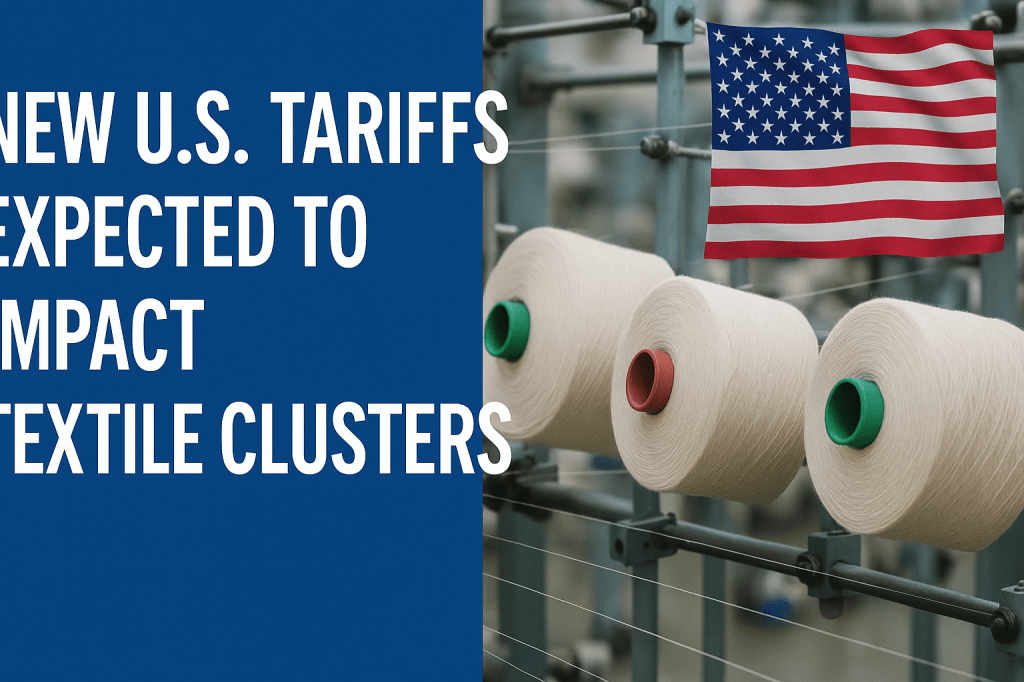
India’s ready-made garments (RMG) sector was already poised for a slowdown, with Crisil forecasting a growth dip to just 3–5% in FY26—about half of earlier projections—due to rising U.S. tariffs . But the game changed dramatically on August 27, 2025, when the U.S. escalated tariffs to 50%. This shift is sending shockwaves across major textile hubs from Gujarat to Tirupur, Bhadohi, and Surat.
Gujarat: Textile Engine Hits Turbulence
As one of India’s largest textile export engines—accounting for 30% of the nation’s textile exports—Gujarat is now facing a potential one-third drop in orders following the tariff hike .
Industry leaders have urged the government for urgent relief, including Textile Employment Protection Schemes (TEPS), export-linked soft loans, moratoriums on credit repayment, subsidies on FOB value, and interest rebates to cushion the blow .
Bhadohi–Mirzapur Carpet Cluster: Heritage Under Threat
The handmade carpet industry in the Bhadohi–Mirzapur region is in crisis mode. 85% of U.S. carpet orders have been suspended, jeopardizing exports valued at ₹9,600 crore—around 60% of total carpet shipments from the area .
This cluster supports the livelihoods of 1.3 million rural artisans and weavers, many of whom now face economic uncertainty .
Ready-Made Garments: Growth Halved, Credit Impact Looms
Crisil’s latest analysis underscores the severity: Indian RMG manufacturers, together generating ₹45,000 crore in revenues, are projected to see revenue growth halved due to the 50% tariffs, with credit profiles weakening for those with over 40% exposure to the U.S. market .
Nationwide Measures: Relief & Diversification in Action
In a bid to stabilize the sector, the Indian government has temporarily removed the 11% import duty on cotton (from August 19 to September 30, 2025) to reduce input costs amid the tariff crunch .
Long-term strategy also includes launching outreach programs across 40 key markets, including the UK, Japan, South Korea, the EU, and others—markets with $590 billion in annual textile and apparel imports—to diversify export destinations and reduce overdependence on U.S. demand .
Critical Analysis: What This Means for the Sector
Structural Risks Exposed
The 50% tariff is more than a cost shock—it’s a structural threat to the competitiveness of Indian textiles in its largest export market. Without immediate relief, clusters like Tirupur, Noida–Gurugram, Surat, and Bhadohi risk widespread shutdowns and job losses.
Governmenting Response: A Double-Edged Sword
While the cotton duty exemption is a welcome short-term buffer, it may not sustain momentum. Diversifying to new markets is critical—but building brand credibility and trade relations will take time, strategic investment, and regulatory support.
Possible Sectoral Shift
Clusters may be forced to accelerate shifts toward higher-value segments—technical textiles, sustainable products, and digital branding—where price is less of a deciding factor. This aligns with long-term “Make in India” ambitions but demands technological and infrastructural upgrades.
India’s textile industry, already facing a contraction to 3–5% growth in FY26, now grapples with a 50% U.S. tariff that threatens to disrupt entire production hubs and rural livelihoods. Key emergencies include:
Gujarat: Expected one-third drop in orders, with calls for subsidies and relief.
Bhadohi–Mirzapur: Massive order cancellations endangering artisan livelihoods.
RMG Sector: Crisil flags revenue halving and weakened credit outlook.
Policy Responses: Cotton duty exemption and global market diversification initiated, but long-term stability still uncertain.
 "Connecting communities, empowering nations: Unifying the Regional and Global Economy ."
Leave a comment