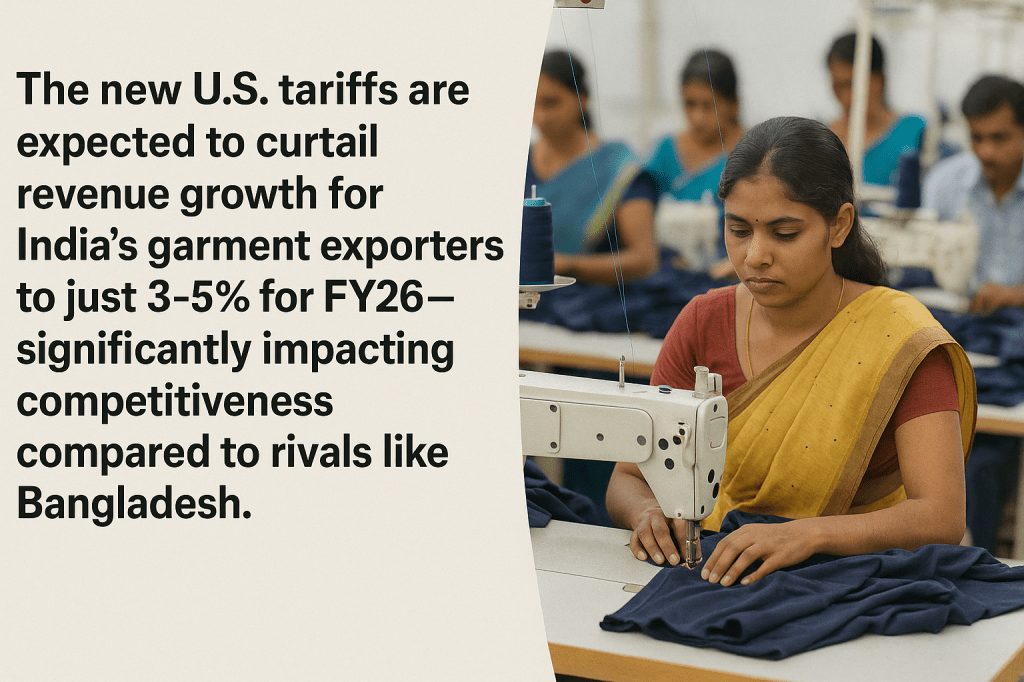
India’s ready-made garments (RMG) sector—long a vital contributor to export earnings and employment—is bracing for a sharp slowdown. According to a recent forecast by Crisil, revenue growth is expected to shrink to just 3–5% in FY26, nearly halving from previous levels. The primary reason: new U.S. tariffs that are set to dent India’s price competitiveness in its largest apparel market.
The timing could not be more critical. The U.S. accounts for nearly 27% of India’s apparel exports, making it the single most important market for Indian manufacturers. For decades, India’s strength in cotton garments, embroidery, and value-added textiles has allowed it to retain a foothold despite rising competition. However, with higher tariff walls, Indian shipments are likely to become more expensive compared to rival exporters such as Bangladesh and Vietnam—both of which enjoy preferential trade agreements or lower tariff exposure.
From a structural perspective, this tariff escalation exposes the vulnerabilities of India’s garment sector. Unlike Bangladesh, which has aggressively positioned itself under duty-free access through the EU’s Generalised Scheme of Preferences (GSP), or Vietnam, which leverages free trade agreements with both the U.S. and EU, India has lagged behind in securing preferential market access. This policy gap translates directly into cost disadvantages for exporters. For instance, a 5–10% tariff differential can be decisive in large-volume orders, pushing global buyers to relocate supply chains to cheaper destinations.
Another layer of challenge comes from India’s cost structure. Crisil’s analysis suggests that rising input prices—ranging from cotton and synthetic yarn to logistics—are squeezing margins. The tariff shock compounds this pressure, leaving manufacturers with limited room to absorb costs without eroding profitability. Small and medium-sized exporters, who form the backbone of India’s garment ecosystem, are especially vulnerable. Many of them operate on thin margins and are highly dependent on orders from U.S. retailers.
This slowdown has broader implications for India’s economic goals. The garment sector is a key generator of employment, particularly for women in rural and semi-urban areas. A revenue growth halved to 3–5% risks not only slowing foreign exchange inflows but also dampening job creation in a labor-intensive industry at a time when India is seeking to expand manufacturing to 25% of GDP.
Yet, this is not merely a story of setbacks. The disruption also underscores the urgent need for strategic recalibration. First, India must accelerate its trade negotiations, particularly the long-pending Free Trade Agreement with the European Union and the U.K., to offset tariff disadvantages in the U.S. Second, diversification of export markets—towards Latin America, Africa, and West Asia—can reduce overdependence on the American market. Third, investments in technology, compliance, and sustainability could help Indian exporters move up the value chain, offering differentiated products that are less price-sensitive.
While the U.S. tariffs may narrow India’s immediate growth prospects in garments, they also act as a wake-up call. Without policy agility and industry innovation, India risks losing ground to more nimble competitors. But with timely reforms and a push towards market diversification, the sector can still remain a cornerstone of India’s export engine.
 "Connecting communities, empowering nations: Unifying the Regional and Global Economy ."
Leave a comment