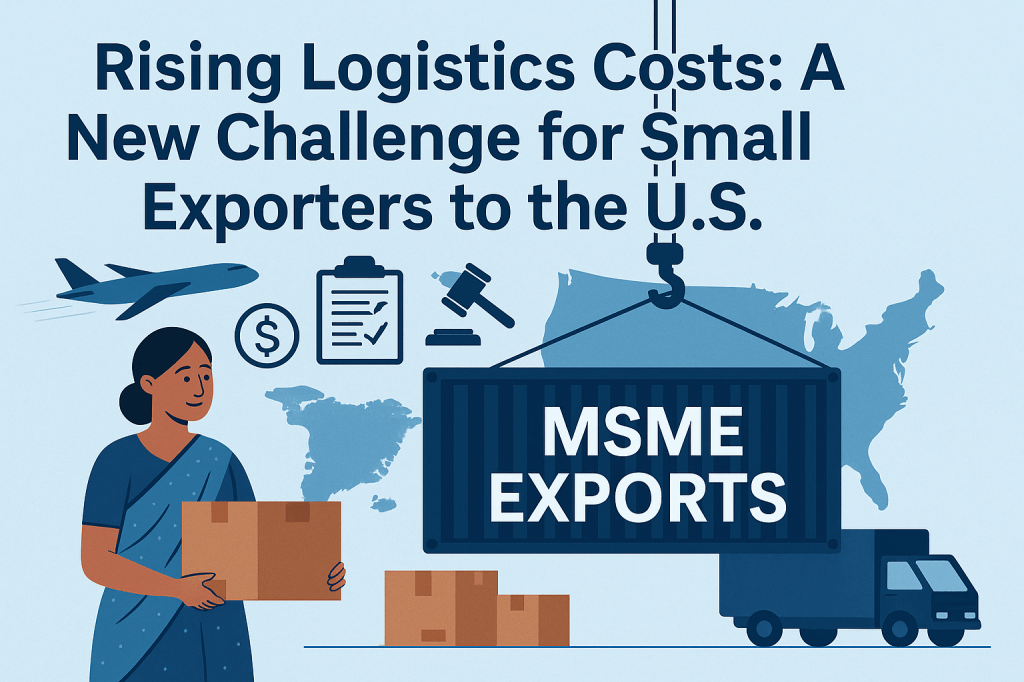
The abolition of the U.S. de minimis exemption has reshaped the landscape for small exporters and MSMEs shipping to America. Once a lifeline for e-commerce-driven trade, the de minimis rule allowed packages valued under $800 to enter the U.S. duty-free, with minimal customs paperwork. For thousands of Indian MSMEs and global small exporters, this meant smoother access to the U.S. consumer market through low-cost, high-frequency shipments. With the rule now dismantled, logistics costs have surged, leaving small exporters scrambling to adapt.
Pre-Abolition: The Advantage of De Minimis
Before its removal, de minimis gave small exporters a cost edge:
Duty-free clearance kept landed costs low.
Simplified compliance reduced paperwork, enabling even micro-entrepreneurs to sell via online platforms.
Air freight flexibility meant exporters could send lightweight shipments at rates of around $5/kg for parcels under 150 kg, or $3/kg for slightly larger consignments.
This model perfectly suited sectors like textiles, handicrafts, jewelry, and electronics—where exporters often relied on frequent, small shipments rather than bulk consignments.
Post-Abolition: Sharp Escalation in Costs
The policy shift has created ripple effects across the logistics chain:
1. Cost escalation – Exporters now face an 8–15% increase in landed costs. Customs duties, brokerage fees, and clearance charges—once exempt—apply even to the smallest parcels.
2. Decline in volumes – Higher per-shipment costs are forcing many MSMEs to scale back, with volumes expected to drop by 15–25% in the near term.
3. Compliance burden – Each shipment must now be accompanied by detailed HS codes, invoices, and supporting documentation, increasing the risk of delays.
4. New fee structures – Brokerage, disbursement, and clearance fees have emerged as standard, eating into exporters’ already thin margins.
The impact is especially stark for e-commerce sellers who built their business models around frequent, small-value exports.
Sector-Wise Impact
Certain industries are hit harder than others:
Textiles and Apparel – Earlier reliant on low-cost, small-batch shipments, apparel exporters must now rethink inventory strategies, shifting to bulk shipments or regional consolidation.
Handicrafts and Jewelry – With products often priced under $800, these sectors lose their competitive advantage in the U.S. market.
Electronics – Small electronic components, previously shipped in high frequency, are now burdened with duty and compliance costs, reducing cost competitiveness.
For many of these exporters, margins were already narrow. The added 8–15% in logistics costs can mean the difference between profit and loss.
Emerging Strategies: Adapting to the New Reality
MSMEs are exploring new approaches to remain competitive:
Bulk and Consolidated Shipping – Instead of frequent small shipments, exporters are moving towards larger consignments that reduce per-unit shipping costs.
Nearshore Fulfillment – Some businesses are considering warehousing in hubs closer to U.S. markets, such as Mexico or Canada, to cut compliance friction.
Market Diversification – Exporters are eyeing alternative destinations like Vietnam or the Middle East, where tariff structures may offer relative cost advantages.
Digital Tools and Advisory Services – Automated shipping platforms, customs brokers, and trade consultants are becoming indispensable for navigating the complex compliance environment.
While these strategies involve upfront investment, they may help cushion long-term competitiveness.
Perspective
The end of de minimis reflects a broader global trend toward tighter customs regulation, driven by domestic protectionism and concerns over revenue leakage. However, the brunt of this shift is borne not by large corporations—who can adapt with scale—but by small exporters and MSMEs.
For India, the timing is particularly critical. MSMEs account for nearly 45% of India’s exports, and their access to global markets is central to sustaining export-led growth. The added cost burden risks marginalizing smaller firms, consolidating trade in the hands of larger players, and undermining India’s broader MSME export strategy.
If policymakers and industry bodies do not step in with supportive measures—such as logistics subsidies, trade facilitation services, or negotiated relief mechanisms—the damage could be long-lasting.
The abolition of the U.S. de minimis exemption has upended the logistics equation for small exporters. What was once a cost-efficient gateway to the world’s largest consumer market has now become a high-barrier route with higher costs, longer lead times, and greater risks. For Indian MSMEs in textiles, handicrafts, jewelry, and electronics, this means restructuring export models, embracing bulk and consolidated shipping, and investing in compliance capabilities.
In the short term, the adjustment will be painful. But in the longer run, it may also drive MSMEs toward building more resilient, technology-enabled, and diversified export strategies.
 "Connecting communities, empowering nations: Unifying the Regional and Global Economy ."
Leave a comment