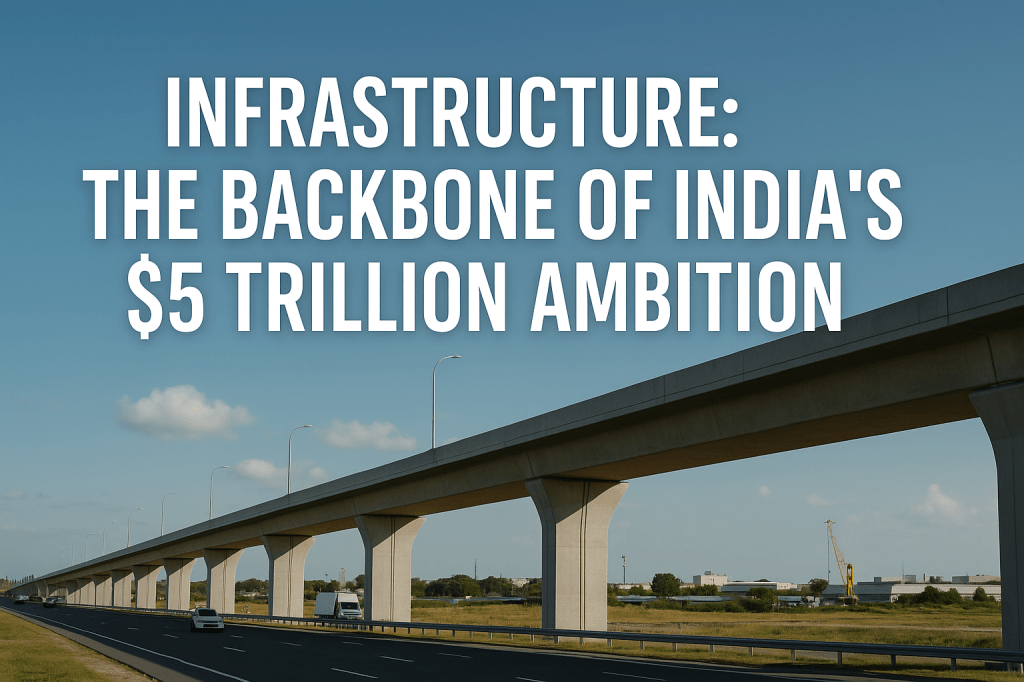
India’s aspiration to become a $5 trillion economy is more than a numerical target—it is a vision of transforming the country’s production, consumption, and connectivity patterns to match global benchmarks. At the recent ET World Leaders Forum, Road Transport Minister Nitin Gadkari reiterated a crucial truth: infrastructure development is not just a facilitator but the backbone of this growth story.
Why Infrastructure Matters
Infrastructure, particularly in road transport and connectivity, acts as a multiplier for economic growth. When highways reduce travel time by 20–30%, logistics costs decline, industrial supply chains speed up, and farmers gain better access to markets. India’s logistics costs currently hover around 13–14% of GDP—significantly higher than the global average of 8–9%. By building world-class infrastructure, India can bridge this gap, making exports more competitive and domestic supply chains more resilient.
Government’s Push and Road Transport’s Role
The government has launched ambitious programs like Bharatmala Pariyojana, the expansion of expressways, and the modernization of National Highways. According to official estimates, India plans to build 60,000 km of national highways by 2025, while expressways such as Delhi–Mumbai and Bengaluru–Chennai corridors are expected to transform both passenger and freight mobility.
Road transport’s contribution is critical because over 60% of freight and 85% of passenger traffic in India still relies on roads. Thus, every rupee spent on better highways and logistics infrastructure carries ripple effects across manufacturing, services, agriculture, and exports.
Economic Reasoning: Infrastructure as a Growth Lever
Investment Multiplier Effect: Every ₹1 spent on infrastructure creates demand for cement, steel, labor, and machinery, generating an estimated ₹2.5–₹3 of additional output in the economy.
Employment Generation: Construction activity and related services generate large-scale employment opportunities, particularly for semi-skilled and unskilled workers.
Regional Balance: New highways and expressways connect Tier-2 and Tier-3 cities, spreading economic growth beyond metropolitan clusters.
Challenges Ahead
While progress is visible, challenges remain:
Funding Gaps: Infrastructure financing needs exceed ₹111 lakh crore by 2025, according to the National Infrastructure Pipeline (NIP). Mobilizing private investment through public-private partnerships (PPP) is critical.
Sustainability Concerns: Rapid construction must align with green standards. India’s commitments under COP28 highlight the need for eco-friendly materials, electric mobility corridors, and low-carbon infrastructure.
Implementation Bottlenecks: Land acquisition delays and bureaucratic hurdles often slow projects, eroding economic efficiency.
Infrastructure cannot be viewed as a standalone project—it is the bedrock on which India’s competitiveness, social equity, and productivity rest. Without lowering logistics costs and ensuring seamless connectivity, the $5 trillion dream risks becoming aspirational rather than achievable.
To succeed, India must not only accelerate construction but also institutionalize reforms in project execution, financing models, and sustainability frameworks. If this balance is achieved, infrastructure will indeed serve as the strongest pillar in India’s economic ascent.
#Infrastructure
#EconomicGrowth
#5TrillionEconomy
#Connectivity
#LogisticsCosts
#Highways
#BharatmalaPariyojana
#EmploymentGeneration
#PublicPrivatePartnership
#SustainableDevelopment
 "Connecting communities, empowering nations: Unifying the Regional and Global Economy ."
Leave a comment