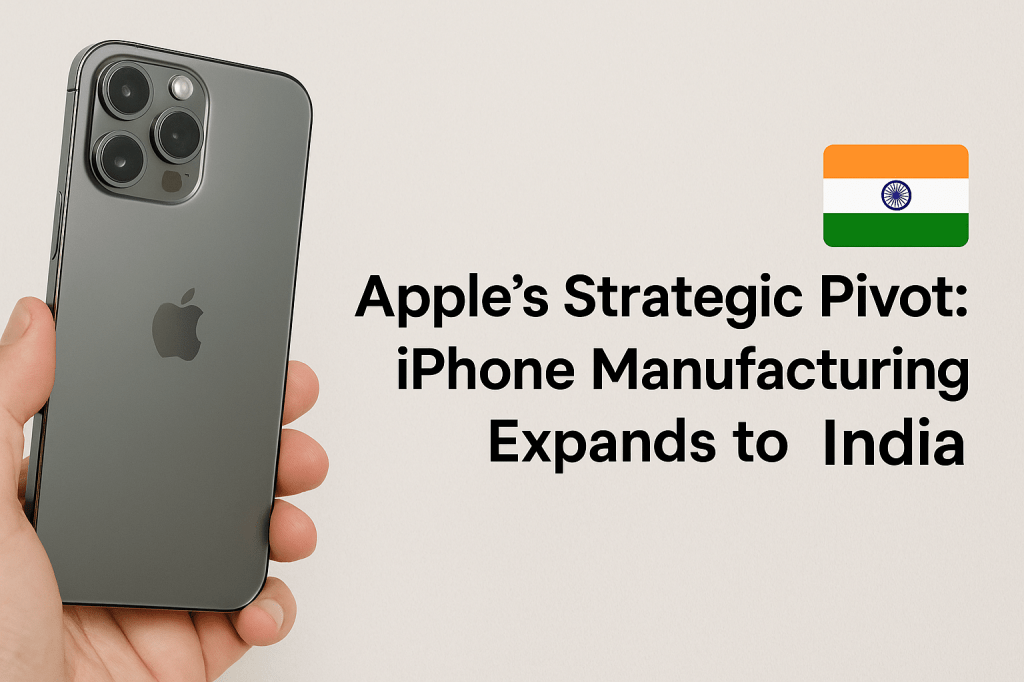
Apple’s decision to assemble all four models of the upcoming iPhone 17 in India marks a historic shift in the global electronics supply chain. For the first time, the tech giant is set to roll out its flagship device entirely from Indian production lines, spanning five facilities, including Tata Group’s Hosur plant in Tamil Nadu and Foxconn’s new hub near Bengaluru airport. According to Bloomberg, this move ensures that every variant of the iPhone 17, including the premium Pro models, will ship from India from day one of its anticipated September launch.
The scale and timing of this expansion signal Apple’s determination to recalibrate its manufacturing ecosystem amid a changing geopolitical landscape. With the Trump administration intensifying tariff pressures and trade disputes with China, Apple is diversifying its assembly base to mitigate risks. India, offering both cost advantages and policy incentives, is emerging as a key beneficiary of this strategic realignment. Beyond hedging against geopolitical uncertainty, the shift also positions Apple closer to one of the fastest-growing smartphone markets in the world.
Critically, the expansion reflects more than just a tactical relocation of assembly lines. It underscores India’s growing capabilities in high-tech manufacturing. For decades, China dominated global electronics exports, supported by world-class infrastructure, tightly integrated supply chains, and massive labor pools. By choosing India to produce not just entry-level models but also the Pro series, Apple is effectively testing whether India can replicate China’s depth of manufacturing sophistication. Success here would mark a milestone in India’s “Make in India” initiative and could accelerate the country’s climb up the global value chain.
However, the shift is not without challenges. India still faces structural hurdles such as uneven logistics networks, high import dependence on semiconductor components, and regulatory frictions. Building an ecosystem comparable to Shenzhen will require sustained investment in R&D, supplier development, and workforce skills. Moreover, global electronics manufacturing is sensitive to policy uncertainty—making long-term stability in trade, taxation, and technology regulation crucial for India to consolidate its gains.
From a global trade perspective, Apple’s pivot is emblematic of broader supply chain reconfigurations. U.S. tariffs on Chinese exports, rising costs in China, and an increasing push for “China+1” strategies are forcing multinationals to rethink production footprints. India’s combination of a vast consumer base, competitive labor costs, and proactive government incentives gives it an edge, but the sustainability of this advantage will depend on whether it can evolve into a hub for component manufacturing and innovation rather than remaining a final-assembly location.
In conclusion, Apple’s iPhone 17 production strategy is both a vote of confidence in India’s manufacturing potential and a calculated response to escalating geopolitical and economic pressures. If successful, this move could not only reduce Apple’s vulnerability to trade shocks but also establish India as a credible alternative to China in the global electronics industry. Yet, the true test will come in the years ahead—when scaling production, ensuring quality, and building deep supplier networks will determine whether India can truly claim the mantle of the next big manufacturing powerhouse.
#AppleManufacturing
#iPhone17
#MakeInIndia
#SupplyChainShift
#FoxconnIndia
#TataElectronics
#GeopoliticsAndTrade
#ChinaPlusOneStrategy
#TechManufacturing
#GlobalValueChain
 "Connecting communities, empowering nations: Unifying the Regional and Global Economy ."
Leave a comment