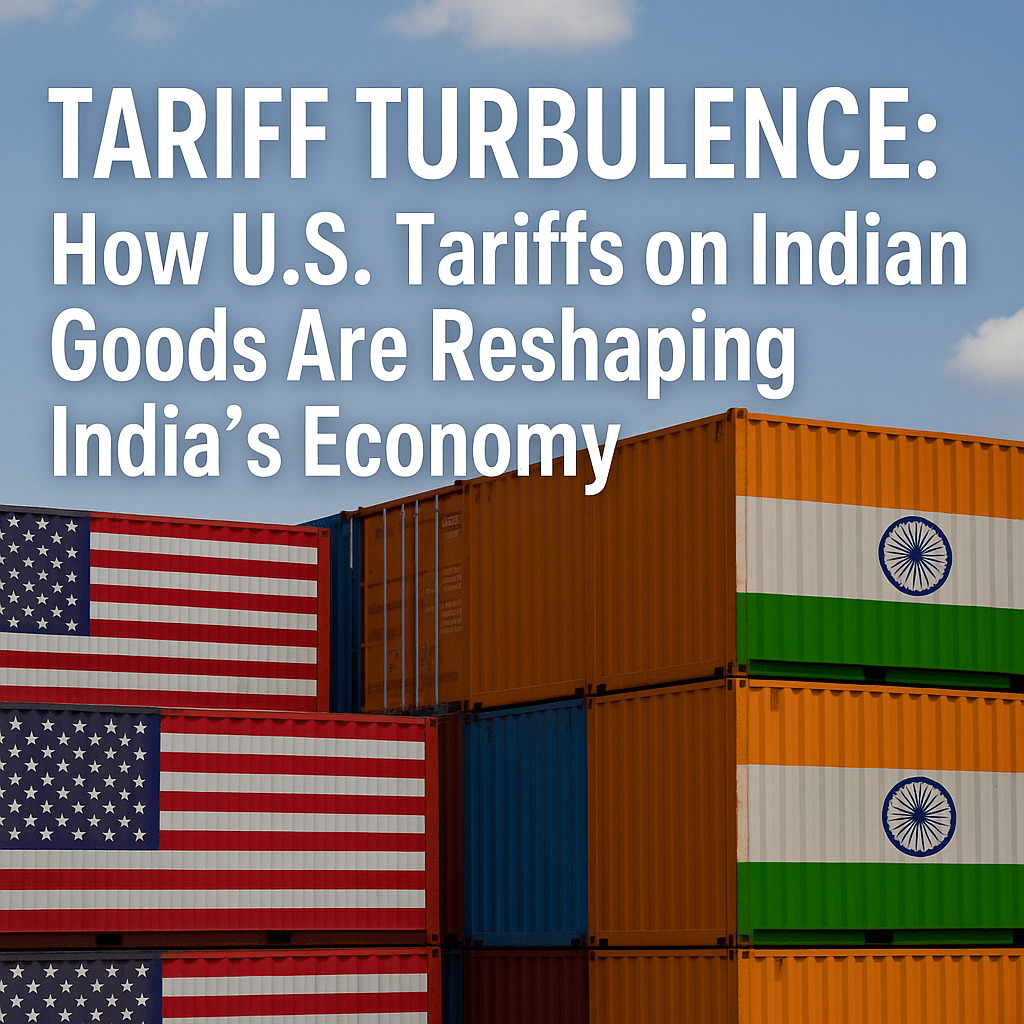
On 7–8 August 2025, the United States sharply escalated its trade dispute with India. President Donald Trump announced an additional 25-percentage-point duty on Indian goods because New Delhi continued to buy discounted Russian oil. Added to a 25 % levy imposed in April, this raised the total tariff on several Indian exports to
50 %
This unprecedented tariff hike has thrown India’s exporters into turmoil, with immediate effects on GDP projections, trade relationships, and the political tone of U.S.–India ties.
Why These Tariffs Matter
India’s exposure to the U.S. market is significant in sectors like textiles, gems and jewelry, seafood, and engineering goods. While overall export dependence on the U.S. is about 18 % of total shipments, certain industries rely on the U.S. for more than half of their overseas sales.
The diamond industry, for example, already struggling with lower global demand, faces a potential shutdown of several cutting and polishing units in Gujarat’s Surat. This is because the 50 % levy makes Indian stones uncompetitive compared to suppliers in Africa and Southeast Asia.
Economic Impact
Reuters analysis suggests the tariff shock could shave 60–80 basis points off India’s GDP growth. While headline growth might still hover above 6 %, this is a meaningful loss in an environment where every fraction of a percentage point is hard-fought.
The most vulnerable segments are:
Labour-intensive exports: Apparel, leather goods, and seafood.
High-value artisanal sectors: Gems, jewelry, carpets.
Mid-tech manufacturing: Auto components, engineering tools.
Political & Diplomatic Dimensions
The tariff escalation is not just an economic story—it’s a geopolitical gambit. The U.S. move is directly linked to India’s energy policy, especially its purchase of Russian oil. New Delhi’s official stance is that such purchases are essential for energy security and inflation control.
However, Washington views them as undermining its sanctions regime against Moscow, creating a diplomatic standoff where trade tools are being used for political pressure.
India’s Possible Response
India has several levers to respond to or mitigate the tariff impact:
1. Diversifying Export Markets
Increase engagement with ASEAN, Africa, and Latin America to offset U.S. dependency.
2. Targeted Fiscal Support
Provide short-term relief to severely hit exporters via credit guarantees, duty drawback enhancements, and GST refunds.
3. Domestic Market Substitution
Redirect export-quality goods to the domestic market with marketing incentives.
4. Strengthening Trade Alliances
Expedite pending trade agreements with the EU, UK, and Gulf countries to open alternative high-value markets.
Strategic Takeaway
The current tariff turbulence underscores the fragility of over-reliance on a single market, especially one as politically dynamic as the U.S. For India, this is a moment to double down on economic resilience—through market diversification, trade diplomacy, and industrial upgradation.
While the shock is real, it also presents an opportunity: to rethink export strategy, focus on higher value-addition, and build a trade portfolio that is less vulnerable to political winds.#USTariffs
#IndiaExports
#TradeWar
#GDPImpact
#DiamondIndustry
#ExportDiversification
#FiscalSupport
#TradeDiplomacy
#RussianOil
#EconomicResilience
 "Connecting communities, empowering nations: Unifying the Regional and Global Economy ."
Leave a comment