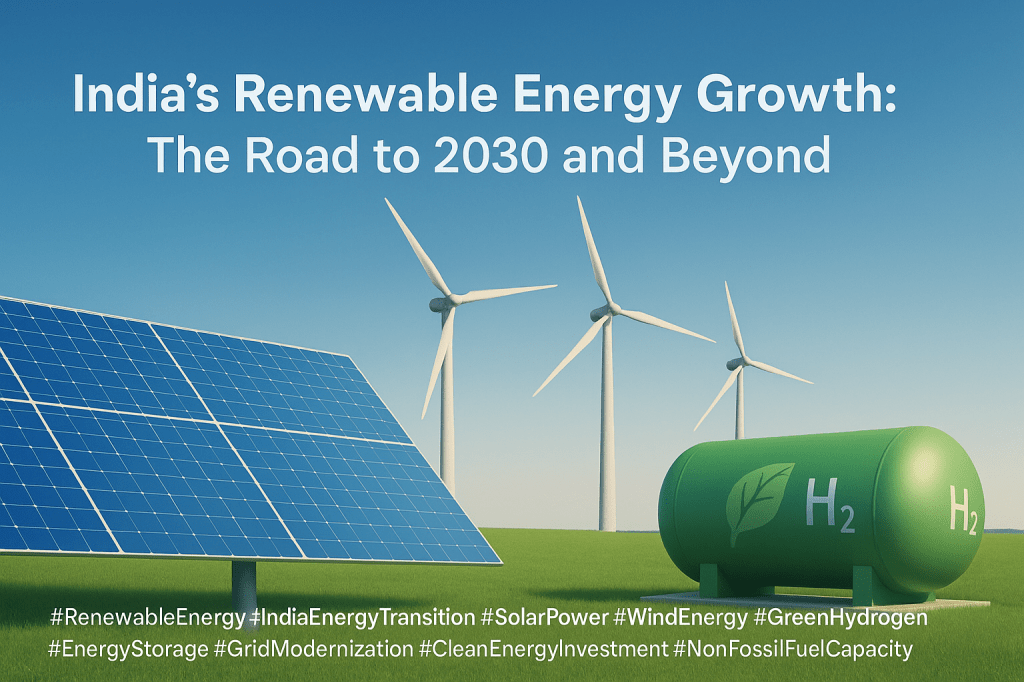
India’s renewable energy sector is entering an unprecedented phase of expansion, with the next five years set to define its global standing as a clean energy leader. The country has already crossed critical milestones ahead of schedule, and if the current pace continues, it may well surpass its 2030 targets. Central to this journey is the ambitious goal of achieving 500 gigawatts (GW) of non-fossil fuel capacity by the end of the decade—an achievement that will reshape India’s energy landscape, strengthen its climate commitments, and position it as a frontrunner in sustainable development.
Rapid Capacity Expansion and Early Milestones
As of March 2025, India’s total installed renewable energy capacity had risen to approximately 220 GW, a sharp increase from 198.75 GW the previous year. More significantly, by July 2025, the share of non-fossil fuel sources in the country’s total electricity capacity surpassed the 50% mark—five years ahead of its Paris Agreement commitment. This early achievement reflects not only robust capacity additions but also a strategic shift in the country’s energy mix, away from coal and toward solar, wind, hydropower, and other renewables.
Solar and Wind: The Twin Growth Engines
Solar power has been the most prominent driver of this transformation. In FY 2024–25 alone, India added a record 23.8 GW of solar capacity, bringing the total to 105.65 GW. Large-scale solar parks, rooftop installations, and innovative floating solar projects are all contributing to this rapid buildout. Wind energy, while growing at a steadier pace, has also crossed 47 GW in installed capacity. Together, these two sources form the backbone of India’s renewable power push, complemented by significant contributions from hydropower, biomass, and small hydro projects.
Financing the Green Transition
Reaching 500 GW of non-fossil capacity by 2030 will require an estimated investment of ₹33 lakh crore (about $400 billion). Roughly one-third of this is expected to come from public sector banks, while the remaining share will depend on private capital, both domestic and foreign. Government incentives—ranging from tax rebates to subsidies—are creating a favorable investment climate, while policy stability is giving long-term confidence to developers. However, timely financial flows will be critical to avoid project delays, especially in high-capital segments like offshore wind and green hydrogen.
Green Hydrogen: The Next Frontier
Launched in 2023, the National Green Hydrogen Mission represents a bold step in India’s clean energy transition. The aim is to produce 5 million metric tons of green hydrogen annually by 2030, with combined government and private sector commitments already pushing potential capacity toward 10 million metric tons. Investments in this space are projected to reach $34 billion, covering electrolyzer manufacturing, hydrogen storage, and transport infrastructure. Pilot projects, such as port-based hydrogen plants, are demonstrating proof of concept and paving the way for large-scale adoption.
Strengthening the Grid and Storage Infrastructure
A clean energy system is only as strong as its ability to deliver power reliably. With variable sources like solar and wind dominating capacity additions, grid modernization has become an urgent priority. Investments in battery storage, pumped hydro, and smart grid systems are ramping up, ensuring the grid can handle fluctuating supply without compromising stability. Energy storage will also be key to maximizing renewable utilization during peak demand hours and maintaining resilience against extreme weather disruptions.
Employment and Economic Co-Benefits
Beyond environmental gains, the renewable sector is emerging as a major job creator. Green hydrogen alone is projected to generate hundreds of thousands of new jobs by 2030, while solar and wind projects offer employment in manufacturing, installation, operations, and maintenance. This aligns with India’s broader economic objectives of fostering industrial growth, reducing import dependence, and expanding its role in global clean energy supply chains.
Outlook for 2030 and Beyond
With clean energy already accounting for half of India’s electricity capacity, the country appears well-positioned to meet, if not exceed, its 2030 targets. Yet, sustaining this momentum will require consistent policy support, accelerated technology adoption, and efficient capital deployment. The success of this transition will also depend on integrating energy equity into the equation—ensuring that the benefits of renewable expansion reach all sections of society, from rural households to industrial hubs.
India’s renewable energy journey is more than just a technological shift—it is a strategic economic transformation with far-reaching global implications. By combining policy ambition, market opportunity, and innovation, India is not only securing its own energy future but also setting a model for other emerging economies navigating the path to decarbonization.
#RenewableEnergy
#IndiaEnergyTransition
#SolarPower
#WindEnergy
#GreenHydrogen
#EnergyStorage
#GridModernization
#CleanEnergyInvestment
#NonFossilFuelCapacity
#SustainableDevelopment
 "Connecting communities, empowering nations: Unifying the Regional and Global Economy ."
Leave a comment