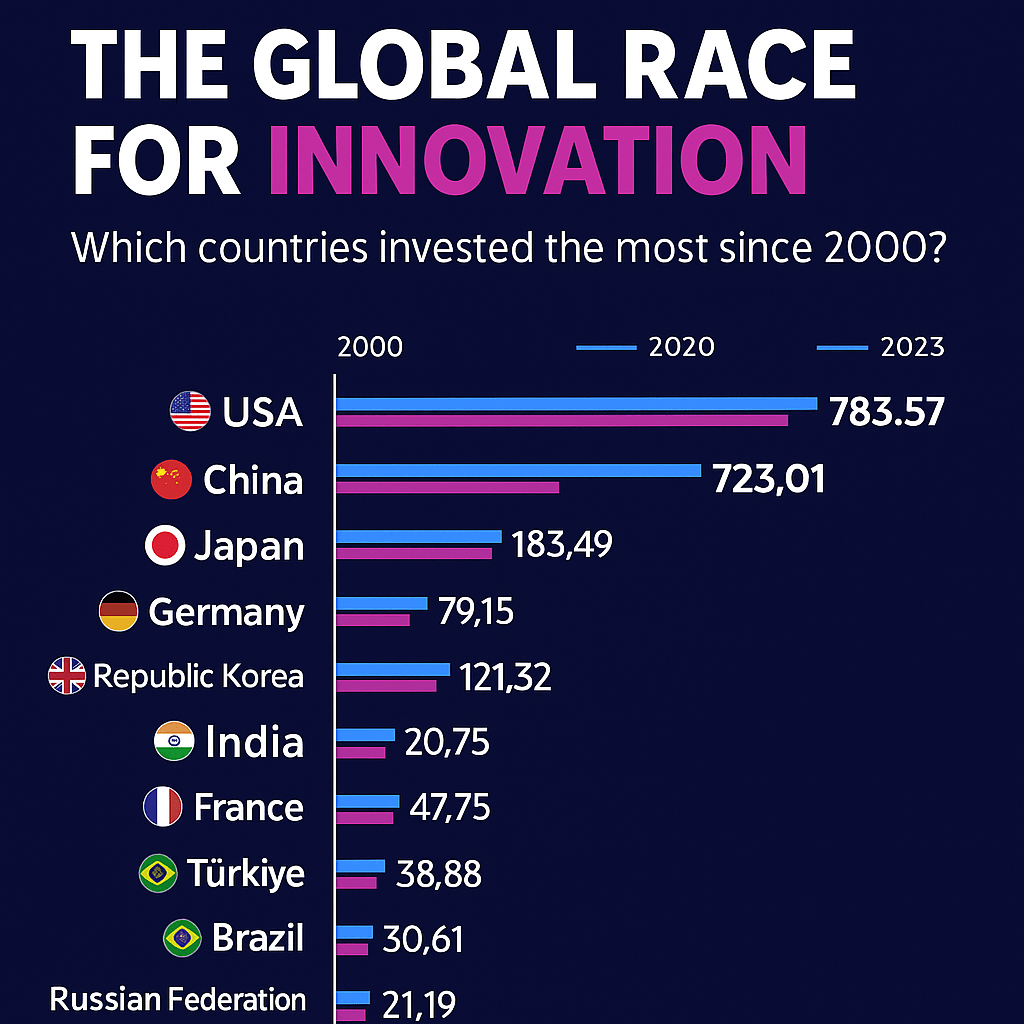
In the twenty-first century, the ability of nations to drive innovation is directly tied to their commitment to research and development (R&D). A recent analysis of gross R&D expenditure (in constant PPP terms) from 2000 to 2023 reveals some striking patterns in the global innovation landscape. The data reflects how certain economies have surged ahead in creating knowledge-driven growth, while others are still catching up despite rapid advances.
The United States continues to dominate, with R&D spending rising from $359.38 billion in 2000 to $783.57 billion in 2023. This more than doubling of investment underscores America’s sustained leadership in technology, advanced manufacturing, defense, healthcare, and artificial intelligence. The U.S. advantage lies not just in financial outlay but also in its strong ecosystem of universities, private enterprises, and venture capital networks that convert research into market-ready solutions.
China’s rise, however, is perhaps the most transformative story. From $40.75 billion in 2000 to $723.01 billion in 2023, China has moved from being a technology follower to a formidable global innovator. This dramatic growth reflects state-led industrial policies, heavy investment in strategic sectors like semiconductors and renewable energy, and an expanding base of high-tech enterprises. If current trends continue, China’s R&D expenditure could soon rival — or even surpass — the U.S., signaling a potential shift in the global technology power balance.
Japan, Germany, and South Korea remain strong contenders, each with a well-established industrial base and focus on high-value manufacturing. Japan’s investment rose from $133.31 billion to $183.49 billion, while Germany’s increased from $79.15 billion to $131.49 billion. South Korea’s leap from $22.39 billion to $121.32 billion is particularly impressive, reflecting its aggressive push into electronics, digital innovation, and biotech. These nations have maintained high R&D-to-GDP ratios, ensuring that innovation remains central to their economic models.
Among other developed economies, the United Kingdom expanded R&D spending from $34.87 billion to $88.18 billion, and France grew from $47.75 billion to $64.69 billion. While these figures indicate steady progress, they also reveal that Europe faces challenges in matching the pace of the U.S. and Asia, particularly in scaling up innovation to commercial success.
For emerging economies, India stands out with growth from $20.75 billion in 2000 to $71.3 billion in 2023. While the increase is significant, India’s R&D spending as a share of GDP remains relatively low compared to global innovation leaders. This gap signals an urgent need for stronger industry-academia collaboration, greater private-sector participation, and policy incentives to encourage high-tech entrepreneurship.
Countries like Türkiye, Brazil, Russia, Italy, Canada, Spain, and Israel show mixed performance. For instance, Israel’s rise from $6.99 billion to $24.83 billion is backed by its vibrant startup ecosystem, while Canada’s modest increase from $22.15 billion to $31.03 billion reflects both stable investment and a need for stronger industrial application. Türkiye’s sharp jump from $4.51 billion to $38.88 billion is noteworthy, indicating growing ambition in defense technology and manufacturing.
The broader trend is clear: innovation leadership is no longer concentrated in a handful of nations. While the U.S. still leads, Asia’s rapid rise — particularly China, South Korea, and India — is redefining global R&D dynamics. Countries investing consistently and strategically are building the foundation for future competitiveness, while those lagging may find themselves increasingly dependent on foreign technology.
In the coming years, global economic power will be shaped not merely by natural resources or manufacturing scale, but by the ability to convert knowledge into economic value. Nations that balance high R&D spending with effective commercialization will dominate the industries of the future — from artificial intelligence to clean energy and advanced materials. The global race for innovation is, therefore, not just about money spent, but about how effectively it is used to create lasting technological advantage.
#Innovation
#ResearchAndDevelopment
#GlobalEconomy
#TechnologyLeadership
#ChinaRise
#USADominance
#EmergingMarkets
#KnowledgeEconomy
#RDFunding
#FutureCompetitiveness
 "Connecting communities, empowering nations: Unifying the Regional and Global Economy ."
Leave a comment