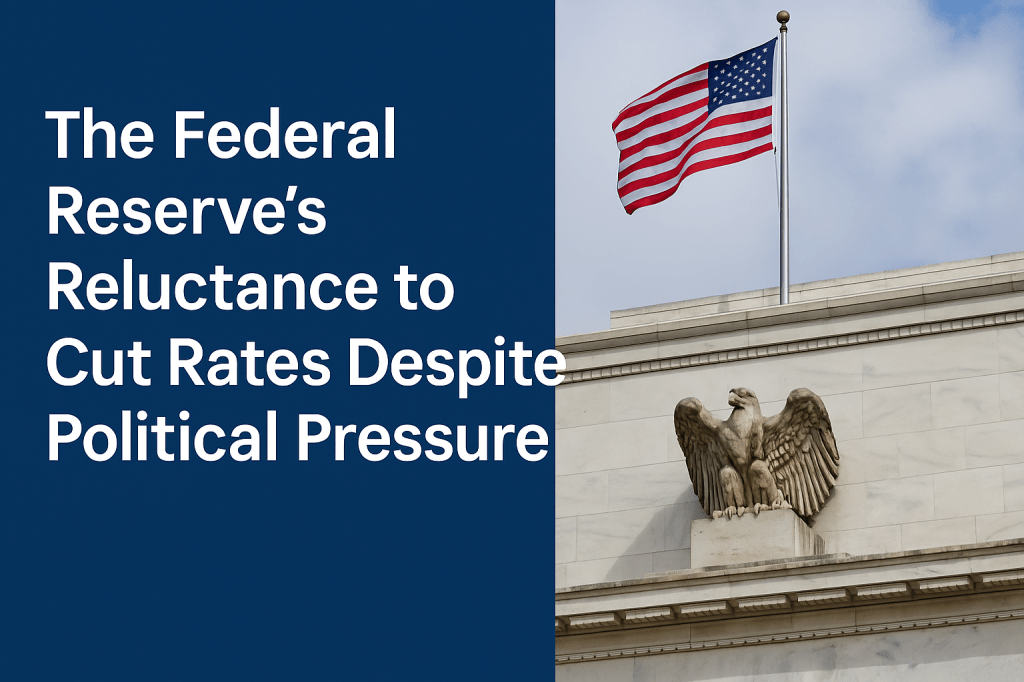
The U.S. Federal Reserve appears poised to maintain its current interest rate levels, resisting calls for cuts from President Donald Trump. This divergence between political rhetoric and monetary policy reflects deeper institutional and economic considerations. While Trump has argued that lower rates could stimulate investment, reduce borrowing costs, and bolster short-term economic growth, the Federal Reserve is bound by its mandate of ensuring price stability, maximum employment, and long-term financial stability — not political expediency.
The key factor behind the Fed’s cautious stance lies in the current macroeconomic environment. U.S. inflation, though moderating from the post-pandemic highs of over 9% in mid-2022, remains above the Fed’s 2% target. As of mid-2025, core inflation — which excludes volatile food and energy prices — is still hovering around 2.8–3.0%, a level policymakers see as uncomfortably high. Cutting rates prematurely risks re-igniting inflationary pressures, especially in an economy where consumer demand remains resilient and unemployment is historically low at around 4%.
Moreover, financial markets have already priced in a “higher for longer” rate scenario, and a sudden pivot could undermine the Fed’s credibility. Central banks operate on forward guidance as much as on actual rate changes, and signaling a shift before inflation is fully under control might trigger volatility in bond and equity markets. In addition, the U.S. dollar — which has remained relatively strong against major currencies — could weaken sharply with a rate cut, potentially increasing import prices and feeding inflation again.
There is also a longer-term strategic consideration. The Fed, under Chair Jerome Powell, has worked to reinforce the perception of its independence from political influence. Yielding to public or presidential pressure could set a precedent that undermines confidence in the central bank’s autonomy. Investors and global markets closely watch this independence as a key factor in the stability of U.S. financial policy.
From a political economy perspective, this standoff is not new. Past presidents, including Lyndon B. Johnson and Richard Nixon, have pressured the Fed for accommodative policies, often with short-term economic gains but longer-term inflationary consequences. The difference today is that the U.S. is emerging from one of the most aggressive tightening cycles in four decades, making policymakers wary of repeating mistakes from the 1970s, when rate cuts amid high inflation led to a damaging “stop-go” monetary policy cycle.
In essence, the Fed’s reluctance to cut rates is a balancing act between the political push for immediate economic growth and the economic necessity of ensuring sustainable stability. While Trump’s argument for rate cuts may find resonance among borrowers, the central bank’s measured approach underscores a broader truth: short-term economic boosts should not come at the cost of long-term credibility and price stability.
If inflation continues to trend downward into the 2% range and economic growth shows signs of sustained slowing, the Fed may have room to adjust policy in late 2025 or early 2026. Until then, markets and the administration will have to accept that monetary policy is being guided less by political will and more by the discipline of economic fundamentals.
 "Connecting communities, empowering nations: Unifying the Regional and Global Economy ."
Leave a comment