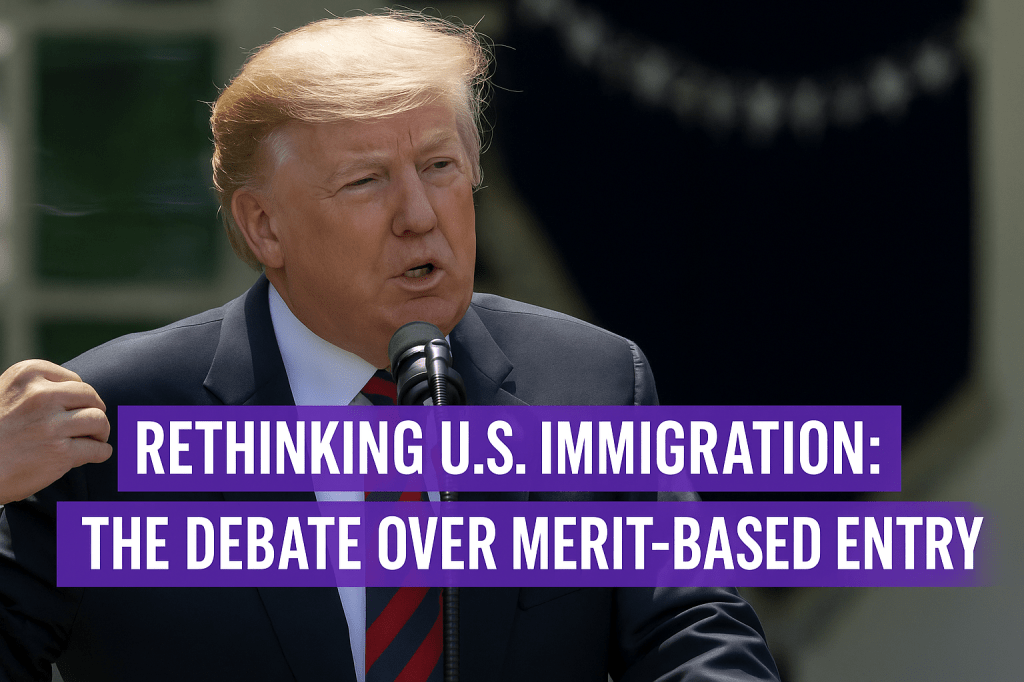
The question of how the United States selects its legal immigrants has gained renewed attention amid global shifts in immigration trends, labor shortages, and domestic policy debates. A viral social media post—featuring former President Donald Trump—claims that “only 12% of legal immigrants in the U.S. are selected based on skill or merit.” The statement is provocative and raises important questions about how the U.S. immigration system actually works—and whether it truly aligns with national economic and strategic goals.
Fact or Misconception: Is It Really 12%?
The claim that only 12% of legal immigrants are selected on the basis of skill or merit is rooted in data from the U.S. Department of Homeland Security and older immigration studies. According to these sources, the vast majority of legal immigration to the U.S. is family-based, meaning individuals are granted green cards because they are spouses, children, or relatives of U.S. citizens or lawful permanent residents. The employment-based category—which includes H-1B visa holders, researchers, entrepreneurs, and other high-skilled immigrants—does make up a relatively small share.
For instance, in Fiscal Year 2019, out of approximately 1.03 million people granted lawful permanent residence, only about 140,000 were in the employment-based category. That’s roughly 13.6%—close to the 12% figure cited. However, this number does not fully capture the skill level of all immigrants, as some family-based immigrants may also possess high qualifications, and many skilled temporary visa holders (like those on H-1B) transition to permanent residency through employer sponsorship.
Why the Numbers Matter
In an era of global competition, especially in advanced technologies, science, and innovation, attracting top talent has become a strategic national priority. Countries like Canada, Australia, and the United Kingdom have moved towards points-based immigration systems that emphasize education, job offers, language skills, and work experience. In contrast, the U.S. remains heavily reliant on family reunification, a reflection of its long-standing commitment to social and cultural integration.
Critics argue that the U.S. system needs reform to better align immigration flows with labor market needs. With a growing shortage in sectors such as STEM, healthcare, and high-end manufacturing, failing to prioritize merit-based immigration could mean missed economic opportunities. According to the National Foundation for American Policy (NFAP), over 70% of full-time graduate students in electrical engineering and computer science at U.S. universities are international students. Yet, many face long waits for green cards or choose to take their talent elsewhere.
The Economic Imperative for Reform
Economists have long supported immigration as a driver of economic growth, innovation, and demographic balance. High-skilled immigrants not only fill labor shortages but also contribute to entrepreneurship and job creation. Studies show that immigrants founded more than 50% of U.S. startups valued at over $1 billion. Furthermore, many of the top executives in Fortune 500 companies were either immigrants or children of immigrants.
The U.S. economy is also facing demographic challenges: an aging population, declining birth rates, and a shrinking workforce. Increasing the share of merit-based immigrants could help offset these trends, support Social Security and Medicare systems, and stimulate long-term productivity.
Striking the Right Balance
While merit-based immigration has clear economic advantages, a purely skills-based system could undermine America’s historic role as a refuge for families and asylum seekers. The family-based system contributes to social cohesion, helps new immigrants integrate, and builds strong community networks. Moreover, not all skills are captured through formal qualifications; many family-based immigrants also contribute meaningfully to the economy through entrepreneurship and essential services.
A reformed immigration system could maintain America’s commitment to families and humanitarian values while also enhancing its competitiveness by increasing the share of high-skilled immigrants. Proposals such as increasing green card caps for employment-based categories, expediting visa pathways for STEM graduates, or adopting a hybrid points-based model similar to Canada’s could help achieve this balance.
A Choice for the Future
The debate over how immigrants are selected is not just about numbers—it’s about national priorities. As the global race for talent intensifies, the U.S. must decide whether its immigration system reflects an economy of the past or the future. While the “12%” figure may serve as a stark reminder of current limitations, the broader challenge is to develop an immigration policy that is fair, forward-looking, and economically rational.
#MeritBasedImmigration
#USImmigrationPolicy
#SkilledImmigrants
#FamilyBasedImmigration
#GlobalTalentRace
#ImmigrationReform
#EconomicGrowth
#STEMImmigrants
#GreenCardSystem
#WorkforceShortage
Without thoughtful reform, the U.S. risks falling behind in the global talent race—a race that will define economic leadership for decades to come.
 "Connecting communities, empowering nations: Unifying the Regional and Global Economy ."
Leave a comment