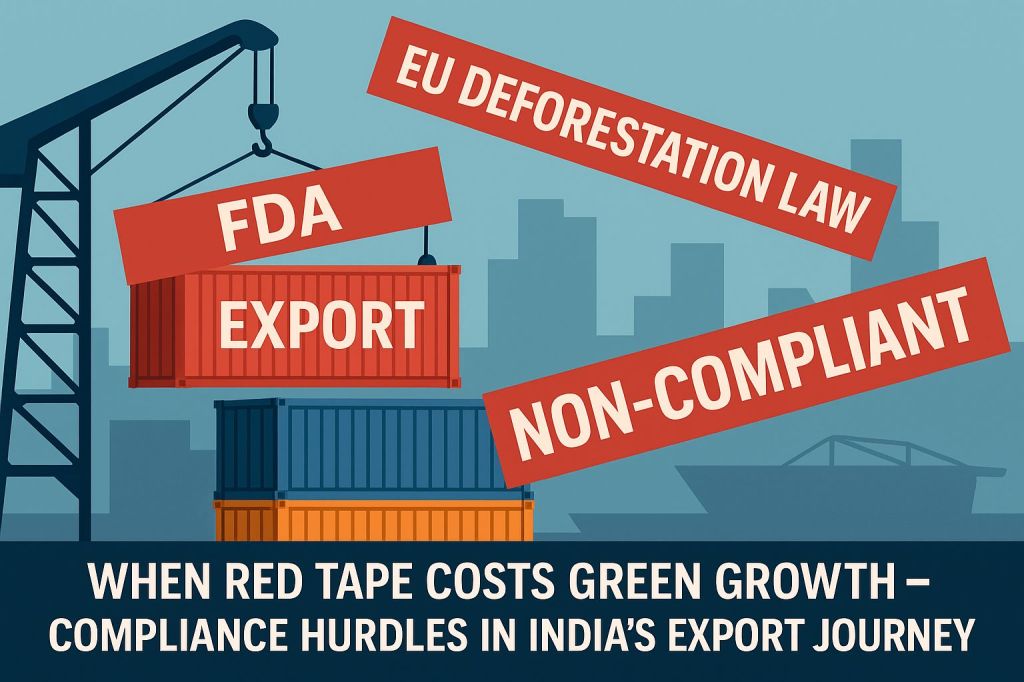
In today’s fast-paced and highly regulated global trade environment, compliance has become a double-edged sword for Indian exporters. While adherence to international standards is necessary to access high-value markets, the increasing complexity, cost, and variability of compliance frameworks are beginning to act as structural barriers to competitiveness—particularly for small and medium enterprises (SMEs).
Rising Tide of Regulations: An Uneven Playing Field
Indian exporters face a growing burden of adapting to dynamic and often fragmented compliance norms laid out by different countries and regions. Regulatory demands imposed by bodies like the European Union and the U.S. Food and Drug Administration (FDA) are not just evolving—they are becoming more stringent and granular. Recent shifts include sustainability-related traceability under the EU Deforestation Regulation (EUDR), more robust food safety checks, and stricter documentation and labelling requirements for sectors ranging from textiles to agri-exports and pharmaceuticals .
Unlike countries that have centralized trade facilitation frameworks and preemptive government-to-government compliance negotiations, Indian exporters often fend for themselves. The compliance architecture in India remains fragmented, leaving many exporters scrambling to keep up with international mandates.
The Cost of Compliance: Delays, Rejections, and Sinking Margins
One of the most immediate impacts of compliance overload is the sharp rise in export costs. From acquiring certifications, ensuring traceability, and conducting laboratory testing, to simply meeting evolving documentation needs—each step inflates operational overhead. This is compounded by delays at ports and customs due to documentation errors or pending approvals, further eating into profit margins .
Even more damaging are the market access risks. Exporters who fall short of specific regulatory benchmarks face outright rejection of shipments, cancellation of contracts, or even blacklisting. For instance, exporters who fail to meet the EU’s sustainability benchmarks risk losing access to a market valued at over $500 billion .
Resource Diversion: Innovation Takes a Backseat
Compliance isn’t just a cost—it’s a distraction. Exporters often find themselves diverting critical manpower, time, and financial resources to navigate compliance demands. This reduces their ability to focus on innovation, improving product quality, expanding into new markets, or even upgrading production technologies. The effort to remain compliant can be so consuming that it stunts the natural business growth cycle .
For example, a medium-sized spice exporter from Kerala might have to allocate an entire team just to track changes in EU pesticide residue norms and U.S. food labeling standards. Instead of investing in marketing or value addition, they are stuck managing regulatory volatility.
Pricing Pressures: Losing the Competitive Edge
Indian exporters also suffer from declining price competitiveness. When compliance costs rise—without government subsidies, tax breaks, or infrastructure support—exporters are often forced to pass on those costs to buyers. This weakens their position against competitors from nations like Vietnam, Indonesia, or Bangladesh, where more streamlined compliance processes or state support help absorb such costs .
In sectors like textiles, where global buyers are highly price-sensitive, even a 2–3% increase in costs due to compliance can shift contracts away from Indian firms to other low-cost producers.
The MSME Squeeze: Small Players, Big Struggles
Micro, Small, and Medium Enterprises (MSMEs)—which account for nearly 48% of India’s exports—are the hardest hit. Unlike large corporations, MSMEs typically lack dedicated compliance teams or legal advisors. Their limited financial bandwidth means that even a single failed shipment or regulatory penalty can cripple operations. Many avoid entering new markets altogether due to the fear of non-compliance .
This exclusion of MSMEs from global trade restricts India’s export diversification and curtails inclusive economic growth. A digitally savvy handicraft exporter from Rajasthan or a natural cosmetics producer in Himachal may find it easier to sell on domestic platforms like Amazon India than to navigate the maze of international compliance norms.
The Way Forward: Building a Compliance Ecosystem
India must recognize that export competitiveness in the 21st century is as much about compliance readiness as it is about product quality or pricing. A few steps that could help bridge the gap include:
Centralized Compliance Support Portals offering country-wise regulatory updates, sample documents, and e-learning tools for exporters.
Subsidized Compliance Costs for MSMEs, including testing labs, certifications, and international audits.
Negotiated Mutual Recognition Agreements (MRAs) through trade diplomacy to ease documentation and certification duplication.
Training and Digital Tools for exporters to adopt traceability, product tracking, and documentation software in cost-effective ways.
Reimagining India’s Export Framework
As global regulatory landscapes evolve toward greater emphasis on sustainability, traceability, and digital compliance, Indian exporters will have no choice but to adapt or risk irrelevance. But adaptation should not come at the cost of survival. A national compliance facilitation strategy that levels the playing field for all exporters—especially SMEs—can unlock India’s true export potential and enable its businesses to compete globally not just on price, but on trust, quality, and speed.
#ExportCompliance
#IndianExporters
#TradeBarriers
#GlobalMarkets
#MSMEChallenges
#SustainabilityRegulations
#EUDR
#PriceCompetitiveness
#NonTariffBarriers
#RegulatoryBurdens
 "Connecting communities, empowering nations: Unifying the Regional and Global Economy ."
Leave a comment