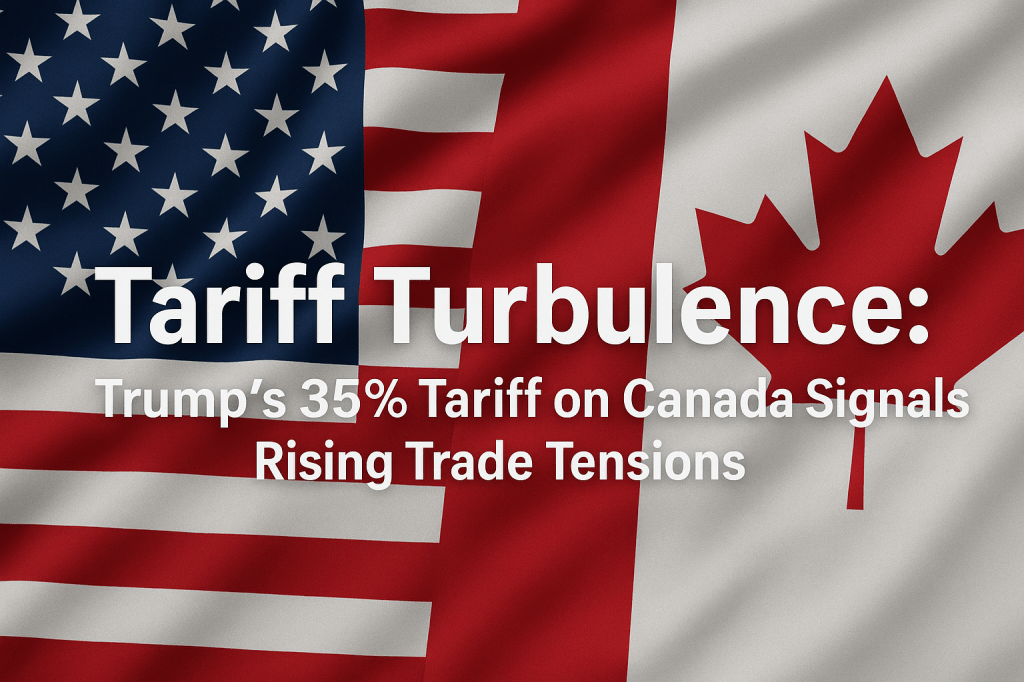
In a stunning development that has sent ripples through North American markets, former US President Donald Trump has announced the imposition of a 35% tariff on Canadian imports, effective August 1, 2025. The declaration marks a new chapter in the already complex trade relationship between the two neighbors, rekindling anxieties around protectionism and global economic stability.
The decision, conveyed through an official letter to Canadian Prime Minister Mark Carney and made public via social media, has sparked widespread concern across both political and business communities. Trump cited Canada’s retaliatory tariffs and broader trade disagreements as the catalysts for this unilateral move. He described Ottawa’s recent trade maneuvers as leaving the US with “no choice,” claiming that the tariff is a necessary response to what he views as economic aggression.
However, the reasoning doesn’t end at trade. Trump’s statement also invoked cross-border fentanyl concerns, suggesting that Canada’s alleged failure to cooperate effectively on stemming the illicit drug flow played a part in the decision-making process. This mixing of public health issues with trade policy is unusual, reflecting Trump’s characteristic approach of tying multiple grievances into a single retaliatory action.
Crucially, the new tariff is not just symbolic—it is in addition to existing sector-specific duties and does not stem from any active trade agreement revisions. This indicates that it is more of a punitive political instrument than a product of structured economic negotiation. Trump has also issued a stern warning: if Canada chooses to retaliate again, the US is prepared to increase the tariff rate even further, potentially escalating the situation into a full-fledged trade war.
The implications are immense, particularly for key Canadian export sectors such as automobiles, metals, lumber, and dairy. These industries heavily rely on the US market, and a sudden 35% cost hike makes their goods far less competitive. For example, Canada’s auto sector—already grappling with rising production costs and the global transition to EVs—may face severe disruption as cross-border trade slows down. Similarly, the lumber industry, which plays a vital role in US housing and construction, might see price hikes and project delays.
From an economic standpoint, the move could trigger a tit-for-tat spiral, disrupting North American supply chains that have taken decades to build under frameworks like NAFTA and its successor, the USMCA. These agreements were meant to promote regional integration, not unravel it through aggressive tariff shocks.
Moreover, this development comes amid ongoing negotiations for a new trade framework between the two countries. Analysts believe the tariff announcement could be a strategic bargaining chip aimed at pressuring Canada into concessions. Yet, such pressure tactics might backfire, pushing Canada closer to alternative markets like the EU or Asia, and damaging long-term trust in bilateral ties.
The global reaction has also been cautious. Investors fear broader implications for trade stability, particularly if Trump’s tariff strategy is extended to other major trading partners. The Dow Jones dipped following the news, and commodity markets, especially in aluminum and lumber, showed signs of volatility.
In conclusion, Trump’s 35% tariff on Canadian imports is not just a policy decision—it is a loud political signal. It blends trade protectionism, border security, and strategic maneuvering into a single dramatic act. Whether this will yield any economic benefit for the US or merely inflict collateral damage on both sides remains to be seen. But what is clear is that the era of quiet diplomacy and structured trade dialogue between Canada and the US has once again been upended. The coming months will reveal whether cooler heads prevail or whether North America is heading toward another prolonged period of economic turbulence.
#TariffTensions #USCanadaTrade #TrumpTariffs #TradeWar #CanadianExports #Protectionism #NorthAmericaTrade #AutoIndustry #FentanylTradeLink #EconomicVolatility
 "Connecting communities, empowering nations: Unifying the Regional and Global Economy ."
Leave a comment