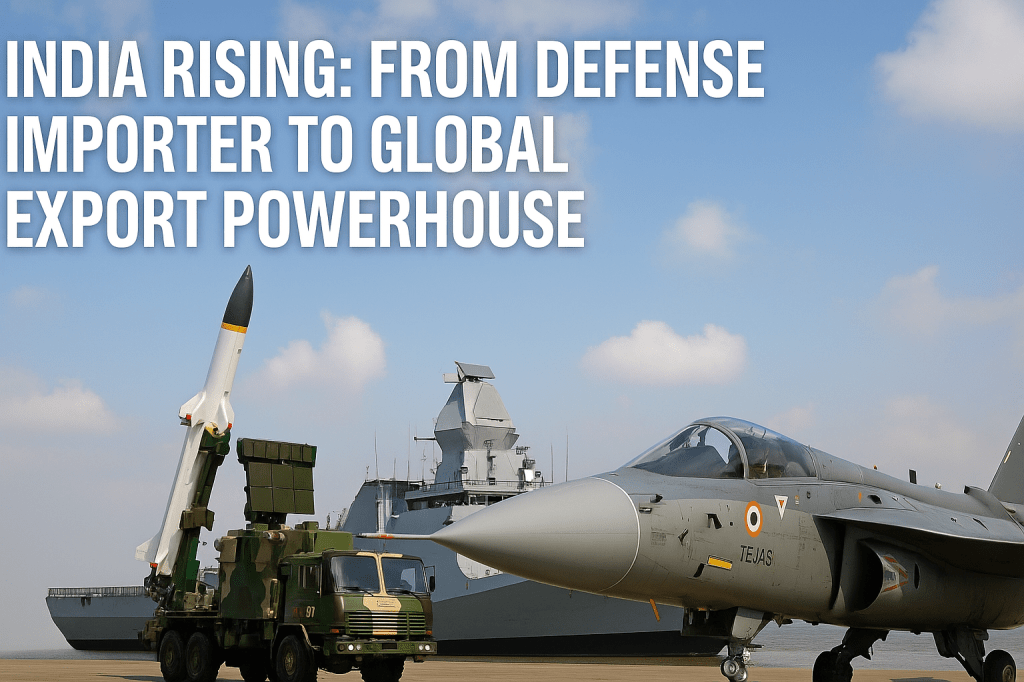
India’s defense industry is undergoing a strategic transformation. Once heavily reliant on imports, the country is now emerging as a credible global exporter of defense equipment. Powered by policy-driven reforms, indigenization mandates, MSME participation, and growing global demand, India’s defense export landscape is poised for a significant leap forward.
At the heart of this momentum is the government’s bold export vision—targeting $5 billion in annual defense exports by 2025 and ambitiously scaling this to ₹50,000 crore by 2029. These figures not only reflect aspiration but also echo India’s broader geopolitical ambition to become a self-reliant, technology-driven defense hub with a foothold in the global military-industrial complex.
A Diversified Export Portfolio with Global Reach
India’s defense exports now extend to over 100 countries, showcasing its broadening influence. In 2023-24, prominent importers included the United States, France, and Armenia, signifying a rising trust in Indian defense technology even among technologically advanced countries. This global reach is driven by a portfolio that is no longer limited to support equipment or spare parts but includes advanced systems such as:
Akash Surface-to-Air Missile systems
Advanced Towed Artillery Gun Systems (ATAGS)
Naval patrol vessels and fast-attack crafts
Light Combat Aircraft (Tejas) and ALH Dhruv helicopters
Assault rifles, radar systems, sonar systems, and guided rockets
India’s ability to deliver such a diversified range of products is the result of sustained investments in R&D and an ecosystem that supports both state-run giants like HAL and DRDO and a growing number of private players.
Policy Reforms: The Backbone of Export Growth
The rise in defense exports is not incidental. It is anchored in critical policy reforms and structural facilitation:
Positive Indigenization Lists have restricted imports of hundreds of defense items, pushing domestic manufacturers to scale up their capacities and capabilities.
Simplified export licensing, digitized authorizations, and extended export permission timelines have made the system more navigable for businesses.
FDI liberalization up to 74% via the automatic route has opened doors to foreign capital and technology partnerships, enhancing the competitiveness of Indian manufacturers.
Defence Industrial Corridors in Uttar Pradesh and Tamil Nadu are playing a pivotal role, attracting investment from major players and fostering local manufacturing ecosystems.
These corridors, supported by state and central incentives, have catalyzed the emergence of defense-focused industrial clusters. For instance, Lucknow, Kanpur, and Aligarh in UP and Chennai, Hosur, and Coimbatore in Tamil Nadu are now bustling centers for defense innovation and production.
MSMEs and Innovation: Strengthening the Supply Chain
An often-overlooked strength of India’s defense export growth is the active participation of Micro, Small, and Medium Enterprises (MSMEs). With support from schemes like Innovations for Defence Excellence (iDEX), MSMEs are contributing critical components, sub-systems, and prototypes. These firms bring agility, cost-effectiveness, and innovation, often acting as the backbone of larger defense platforms.
Regulatory Clarity with Strategic Intent
India’s defense export procedures are underpinned by well-defined Standard Operating Procedures (SOPs), encompassing licensing, technology demonstration, and end-user compliance. This ensures that exports remain within the framework of global non-proliferation norms and ethical military trade practices.
Yet, a critical challenge remains: the absence of a comprehensive legal framework that aligns India’s exports with international humanitarian standards. As India’s defense footprint grows, it must balance market ambition with moral responsibility, ensuring that exports do not inadvertently fuel regional instability or human rights violations.
Roadblocks on the Path Forward
Despite encouraging numbers and strong policy support, the Indian defense export sector must address several enduring challenges:
Technology Gaps: While progress is evident, India still lags behind in cutting-edge domains such as electronic warfare, cyber-defense, AI-enabled military systems, and autonomous platforms.
Dependence on Public Sector Units (PSUs): The export ecosystem remains dominated by PSUs, while the private sector continues to face barriers in scaling up.
Geopolitical Risks: India must navigate complex global politics and avoid over-dependence on any one export partner to maintain diplomatic balance.
Export Readiness: Many products developed domestically lack the testing and certification needed for export in competitive markets, especially NATO-aligned countries.
The Strategic Outlook
India’s defense export narrative is no longer aspirational—it is actionable. The rapid rise in defense exports is proof of India’s evolving industrial capabilities and growing credibility in international markets. With structured policy incentives, active MSME involvement, and strategically located industrial clusters, India is on a path to becoming not just a self-reliant defense producer but a net security provider in the global order.
To sustain this momentum, future strategies must address ethical exporting, quality control, deeper R&D investments, and greater private sector inclusion. As global defense spending continues to rise amid regional tensions and new-age threats, India’s export-oriented defense model could become a cornerstone of its economic diplomacy.
#DefenseExports #MakeInIndia #AtmanirbharBharat #IndianDefenseIndustry #TejasAircraft #AkashMissile #DefenseCorridors #MSMEsInDefense #iDEXInnovation #DefenseManufacturingIndia
 "Connecting communities, empowering nations: Unifying the Regional and Global Economy ."
Leave a comment