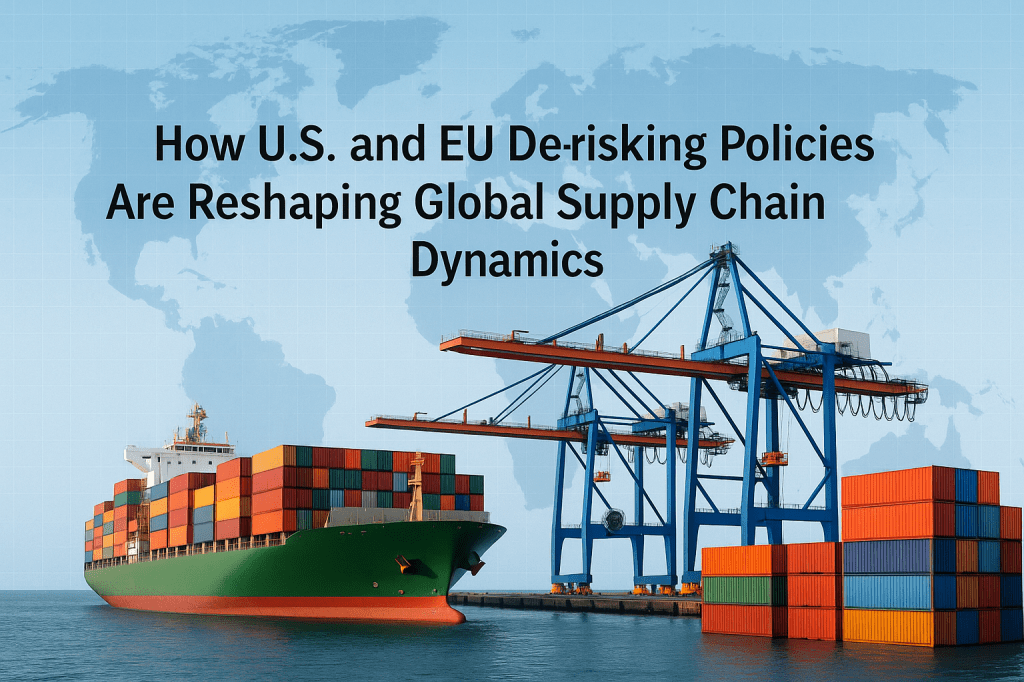
The evolving global trade landscape is witnessing a fundamental shift as the United States and European Union adopt de-risking policies aimed at minimizing critical dependencies without abandoning open markets. These policies, often misunderstood as decoupling, focus instead on selective diversification, resilience-building, and risk mitigation—particularly in sectors deemed vital for national security and economic sovereignty. As a result, global supply chains are undergoing a profound transformation, moving away from decades of cost-optimization and hyper-globalization toward more strategic and secure configurations.
One of the most visible impacts of these de-risking efforts is the accelerated diversification of supply chains. Traditionally dominated by China due to its manufacturing scale and logistical efficiency, supply networks are now being reconfigured geographically. The EU and U.S. are increasingly investing in regional hubs through “friendshoring” and onshoring initiatives. For instance, the EU is redirecting trade flows toward countries with existing bilateral agreements, thereby reducing exposure to non-aligned or politically sensitive economies. In critical sectors like pharmaceuticals, the EU is taking concrete steps such as incentivizing antibiotic production within Europe to address existing supply vulnerabilities. Simultaneously, the U.S. is reshoring manufacturing, particularly in semiconductors and clean energy technologies, to reclaim control over essential production capabilities.
But diversification alone does not equal resilience. Both regions are adopting multi-dimensional approaches to redesign their supply systems. Beyond material flows, there is a newfound emphasis on securing financial, informational, and human capital flows—acknowledging that future supply disruptions may not be purely physical but also digital or systemic in nature. Strategic stockpiling of critical raw materials, especially rare earth elements essential for green technologies, has become a common strategy. Furthermore, supply chain visibility tools and advanced mapping techniques are being deployed to identify vulnerabilities and ensure smoother crisis responses.
Of course, these changes are not without cost. In the short term, the move away from optimized global networks toward resilient ones involves significant capital investment. Building domestic semiconductor plants, for instance, is vastly more expensive than outsourcing to established facilities abroad. These investments lead to higher operational costs and, inevitably, consumer price inflation. However, proponents argue that the long-term payoff lies in the stability and predictability of supply chains, especially during crises. The EU’s notion of “open strategic autonomy” captures this trade-off well—seeking independence in critical areas without abandoning the global trading system entirely.
Geopolitically, de-risking has triggered ripple effects beyond the West. China, perceiving these moves as threats, is doubling down on its “dual circulation” strategy—promoting domestic consumption while deepening trade ties with non-Western allies such as Russia and nations across the Global South. This growing bifurcation in global trade risks fracturing long-standing supply chains into parallel blocs. At the same time, countries like India, Mexico, and Southeast Asian nations are emerging as attractive alternatives for manufacturing investment, particularly in electronics, textiles, and automotive parts. However, the extent to which they can capitalize on this opportunity is constrained by infrastructure, workforce skill gaps, and regulatory challenges.
There are also significant uncertainties surrounding the long-term impact of de-risking. A lack of coherence among EU member states in their national-level responses could lead to fragmented and inefficient outcomes, undercutting the collective strength of the bloc. Moreover, stringent export controls—such as U.S. restrictions on advanced semiconductor sales to China—could backfire by accelerating China’s push for technological self-sufficiency, potentially eroding the West’s competitive edge in the medium to long term.
In essence, U.S. and EU de-risking strategies are fragmenting the global supply chain into regionalized, resilience-focused networks. While this shift may bring greater national security and autonomy, it also challenges the very foundation of integrated global trade. To avoid the pitfalls of economic bifurcation, policymakers must ensure that de-risking does not devolve into protectionism. Success will depend on careful calibration—balancing national interest with international cooperation, especially in transnational issues like climate action and technology standards. Without this balance, the world risks entering an era of fragmented innovation, increased volatility, and uneven economic development.
#DeRisking
#GlobalSupplyChains
#Friendshoring
#StrategicAutonomy
#ResilientEconomy
#GeopoliticalRealignment
#SupplyChainDiversification
#SemiconductorPolicy
#RareEarthSecurity
#ManufacturingShift
 "Connecting communities, empowering nations: Unifying the Regional and Global Economy ."
Leave a comment