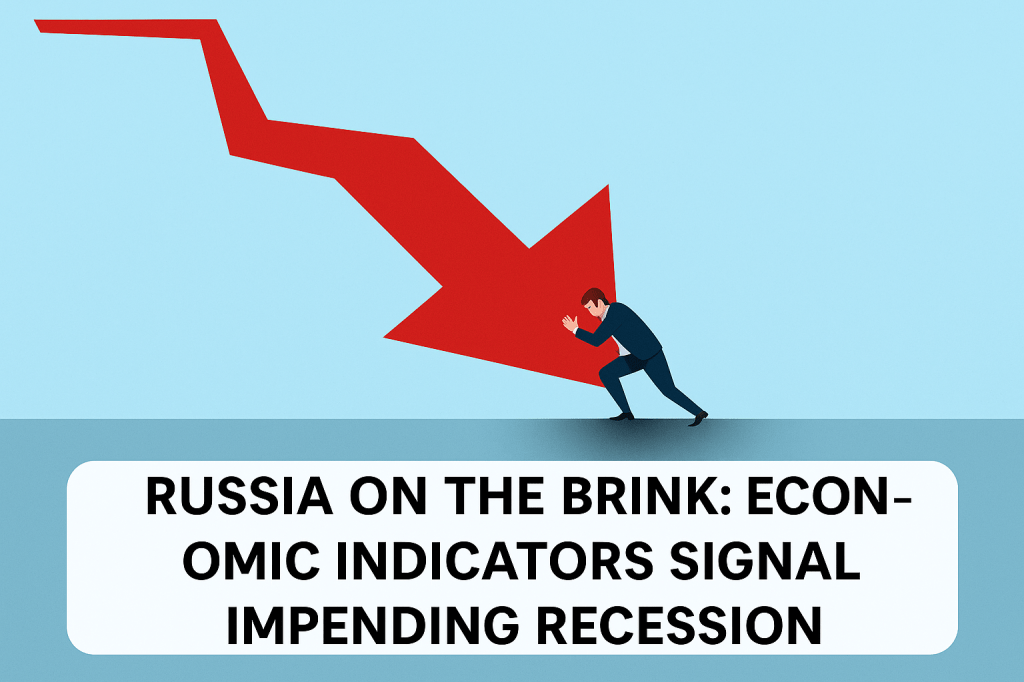
Russia’s economic landscape is showing troubling signs of an imminent downturn, as confirmed by its Economy Minister, Maxim Reshetnikov, during his remarks at the St. Petersburg International Economic Forum. With a rare degree of candor, he acknowledged that the nation is on the cusp of a recession, citing declining business sentiment and deteriorating economic indicators as warning signs. This statement, coming from a senior government official, marks a significant shift in public acknowledgment of the country’s economic fragility.
The symptoms are increasingly clear. Russia’s central bank recently cut its benchmark interest rate from 21% to 20%—the first such move since 2022. In conventional economic theory, central banks lower interest rates to stimulate investment and spending when an economy is cooling. But in Russia’s case, this move reflects more than just standard macroeconomic management. It is a signal that the government recognizes the pressures mounting beneath the surface—pressures driven by shrinking consumer demand, sluggish industrial production, geopolitical isolation, and capital outflows.
The root causes of this economic vulnerability are manifold. Since 2022, Russia has faced comprehensive sanctions imposed by Western nations following its conflict escalation in Ukraine. These sanctions have disrupted trade flows, restricted access to foreign technology and capital, and led to a significant realignment of its export markets, particularly in energy. Although Russia has pivoted towards Asian buyers like China and India for its oil and gas exports, the revenue shortfall due to discounted pricing and logistical inefficiencies has strained fiscal balances.
At the same time, domestic demand is weakening. Inflation remains stubborn, eroding purchasing power and limiting real income growth. The business environment is marred by uncertainty, with many enterprises reporting low investor confidence and reduced long-term planning capabilities. Reshetnikov’s reference to “current feelings of businesses” is a veiled but crucial insight—economic health is not just a matter of numbers but of sentiment. When entrepreneurs and investors lose faith in future growth, the economy risks falling into a self-reinforcing spiral of stagnation.
Furthermore, the labor market in Russia is under pressure. Military mobilization and demographic challenges have shrunk the working-age population, tightening labor supply and dampening productivity. Simultaneously, brain drain continues as skilled professionals seek stability and opportunity abroad.
It’s important to contextualize the current developments within Russia’s broader macroeconomic history. The Russian economy has weathered crises before—from the 1998 default to the 2014 sanctions shock. In many instances, it has relied on strong energy exports and foreign reserves to cushion the impact. However, the present crisis is distinct in that it is prolonged, politically entangled, and structurally constraining. A single interest rate cut, while symbolically important, may not be sufficient to counteract the deeper malaise affecting the economy.
In the months ahead, global observers will be watching key indicators: GDP growth trends, inflation rates, central bank decisions, and consumer sentiment indices. Recession is technically defined as two consecutive quarters of negative growth, but the underlying trends in Russia suggest a more chronic stagnation—an erosion of economic potential that may last far longer unless substantial reforms or geopolitical realignments occur.
For international investors and policymakers, the Russian case is a cautionary tale of how geopolitical tensions, structural dependencies, and business pessimism can converge to push an economy toward contraction. It also underscores the limits of monetary policy as a tool when broader confidence in the system begins to falter.
#RussiaEconomy
#RecessionWarning
#InterestRateCut
#MaximReshetnikov
#BusinessSentiment
#SanctionsImpact
#EconomicIndicators
#CentralBankPolicy
#GeopoliticalRisks
#ConsumerDemand
 "Connecting communities, empowering nations: Unifying the Regional and Global Economy ."
Leave a comment