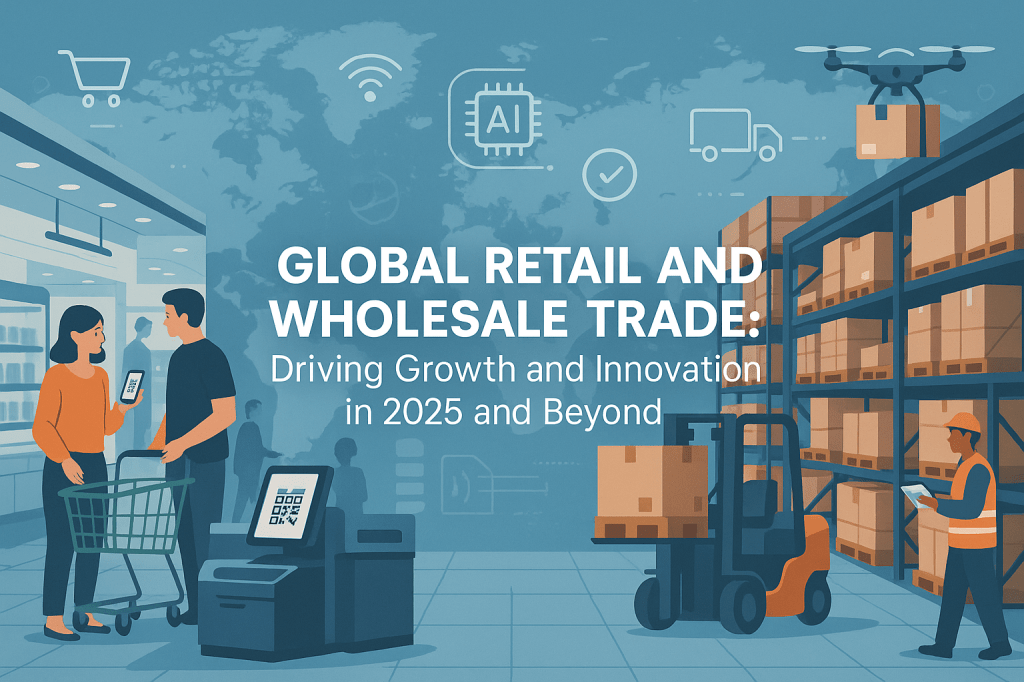
The retail and wholesale trade industry, a cornerstone of the global economy, is projected to see significant growth in the coming years. In 2025, the combined global market for retail and wholesale is valued at approximately $92.6 trillion, up from $85.8 trillion in 2024, reflecting a compound annual growth rate (CAGR) of 8%. As we look ahead, the market is expected to reach $119.9 trillion by 2029, with a moderate growth rate of 6.7%, and further expand to $126.4 trillion by 2034, growing at a CAGR of 8.4%. This growth trajectory signifies a robust and resilient industry that is adapting to dynamic market conditions and evolving consumer needs.
One of the key segments driving this overall growth is the wholesale market, which alone is valued at $57.7 trillion in 2025, with a growth rate of 7.3%. The wholesale sector plays a vital role in supporting the global supply chain, connecting manufacturers with retailers and facilitating the flow of goods worldwide.
Several factors are propelling the retail and wholesale industry forward. One of the most significant drivers is population growth and urbanization. As the global population increases and more people move into urban areas, the consumer base expands, resulting in greater demand for goods and services. Economic growth, particularly in emerging markets, is another crucial driver. These regions are experiencing rising incomes, a growing middle class, and increased access to products, all contributing to higher retail consumption.
E-commerce has emerged as a major catalyst for growth in the retail sector. With the continued rise of online shopping and digital platforms, consumers are shifting toward more convenient, accessible, and personalized shopping experiences. Technology adoption, including data analytics, artificial intelligence (AI), automation, and digital transformation, is reshaping retail and wholesale operations, improving efficiency, reducing costs, and enhancing customer satisfaction. This technological revolution is helping businesses optimize inventory management, streamline logistics, and personalize customer service.
Another driving force behind the industry’s expansion is shifting consumer preferences. Today’s consumers are more interested in convenience, local shopping experiences, and sustainable products. Retailers are responding to these demands by offering eco-friendly products, enhancing customer experience, and integrating omnichannel strategies that blend online and offline shopping experiences.
In terms of major trends, the retail and wholesale sectors are embracing digital transformation with investments in advanced technologies such as robotics, smart shelf solutions, and AI-powered analytics. The rise of omnichannel retailing, which combines both physical and online shopping experiences, is enabling businesses to meet the needs of modern consumers. Automation and robotics are playing a pivotal role in inventory management, logistics, and customer service, ensuring faster delivery times and reducing operational costs. Sustainability is also a growing focus, with retailers prioritizing environmentally friendly products and eco-conscious supply chains.
Innovation continues to be a driving force in the industry, with the adoption of new technologies such as drone deliveries, unmanned convenience stores, and predictive analytics. These innovations are reshaping how products are delivered and how retailers engage with customers.
Regionally, North America remains a dominant player in the retail and wholesale market, particularly in e-commerce, with major retailers like Walmart, Amazon, and Costco leading the way in both digital and physical retail expansion. Europe is undergoing a digital revolution, particularly in the online grocery and retail sectors, as digital platforms gain traction. The Asia-Pacific region is experiencing the highest growth rates, driven by the rapid expansion of internet and mobile commerce. Meanwhile, the Middle East, Africa, and South America are seeing significant investment in grocery chains and modern retail, as the demand for consumer goods continues to rise.
In conclusion, the retail and wholesale trade industry is poised for continued growth in the coming years. Driven by factors such as population growth, urbanization, economic expansion, and technological advancement, the sector is adapting to new consumer preferences and market demands. The future of retail and wholesale is shaped by digital transformation, sustainability, and omnichannel strategies, with the Asia-Pacific region leading the way in growth and North America maintaining dominance in digital retail.
This dynamic evolution presents numerous opportunities for businesses that can innovate and adapt to these emerging trends, making the retail and wholesale trade industry a vital part of the global economy for years to come.
#RetailIndustry
#WholesaleTrade
#EcommerceGrowth
#DigitalTransformation
#ConsumerTrends
#UrbanizationImpact
#SupplyChainInnovation
#SustainableRetail
#GlobalMarketTrends
#OmnichannelRetailing
 "Connecting communities, empowering nations: Unifying the Regional and Global Economy ."
Leave a comment