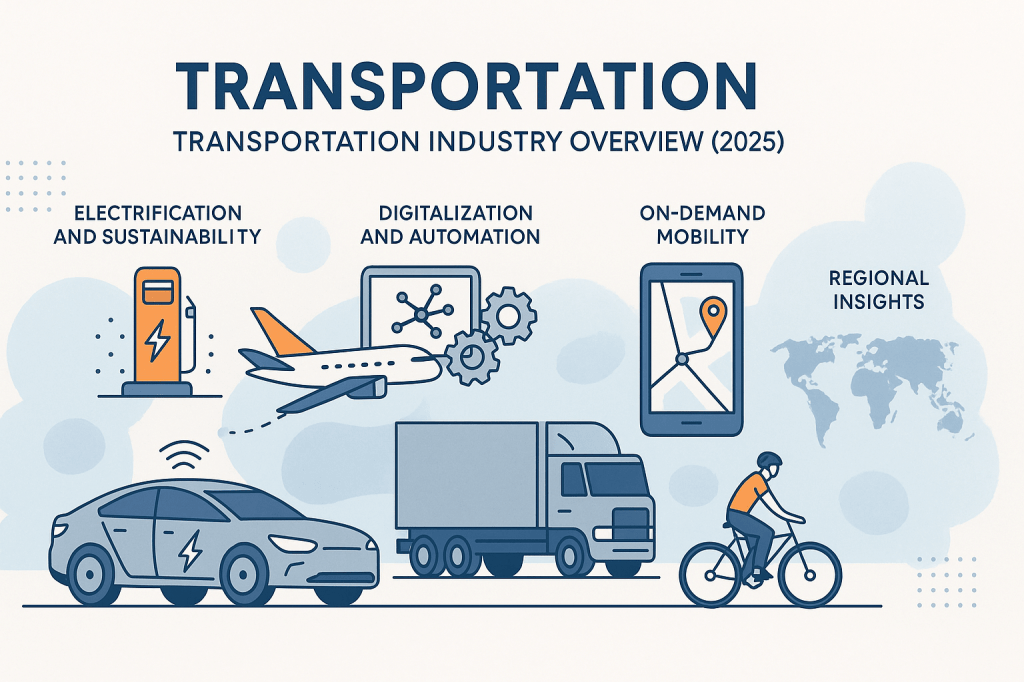
The global transportation industry in 2025 is a massive and dynamic sector, with its market size estimated between $7.52 trillion and $9.77 trillion, depending on the scope of inclusion—whether transport services alone or in combination with transport equipment and operational infrastructure. Looking ahead, this sector is projected to surge to a size between $11 trillion and $17 trillion by 2033–2034, growing at a compound annual growth rate (CAGR) ranging from 5% to 8%. This growth is being propelled by transformative shifts in technology, sustainability, urbanization, and changing consumer behaviors.
Among the key developments shaping the future of transportation is the remarkable rise of on-demand mobility. The on-demand transportation segment, including ride-hailing, car-sharing, and app-based commuting services, is poised for exponential growth—from $268 billion in 2025 to an estimated $1.33 trillion by 2034. This represents a striking CAGR of 19.4%, signifying a fundamental shift in how people access and consume transportation services, especially in urban environments.
Modal Dynamics and Segmentation
Transportation services are broadly categorized by mode—road, rail, air, maritime, pipeline, intermodal, courier and parcel delivery, and other specialized formats. Of these, road transport commands the largest share, driven by its dominance in both passenger and freight movement. Additionally, transportation is analyzed by application—ranging from large-scale passenger transit and freight logistics to last-mile delivery and ride-hailing—and by service type, such as third-party logistics (3PL), warehousing, express delivery, and data-driven logistics analytics.
Global and Regional Trends
Across all geographies, electrification and sustainability are redefining industry practices. The increasing adoption of electric vehicles (EVs), hydrogen fuel-powered transport, and the integration of renewable energy sources for freight and passenger systems mark a paradigm shift. Governments and companies alike are investing heavily in clean transport infrastructure to meet emissions targets and customer expectations.
In parallel, digitalization and automation are proving to be the backbone of modern logistics. Technologies like artificial intelligence (AI), the Internet of Things (IoT), machine learning, and predictive analytics are revolutionizing route optimization, fleet tracking, and predictive maintenance. The industry is rapidly moving toward autonomous logistics operations and data-driven decision-making, with significant efficiencies unlocked in cost, delivery time, and environmental footprint.
The Growth of On-Demand Services
Urban populations are embracing convenience and flexibility. This has led to the rise of on-demand transportation, where services are tailored, dynamic, and often app-driven. Whether it’s hailing a car for a short urban commute, subscribing to a scooter-sharing service, or leveraging pooled rides for eco-efficiency, the on-demand model is becoming an integral part of urban mobility ecosystems. The scalability and adaptability of this model are making it particularly attractive in fast-growing urban centers.
Building Supply Chain Resilience
Another critical trend is the strengthening of supply chain resilience. The disruptions caused by geopolitical tensions, pandemics, and environmental events have underlined the importance of robust logistics networks. Companies and governments are now investing in resilient supply chains through better infrastructure, integrated transport corridors, and digital solutions to mitigate risks and maintain continuity.
Regional Insights
Asia-Pacific leads the transportation market by size, powered by rapid industrialization, urban expansion, and e-commerce penetration, especially in countries like China, India, and Southeast Asia. The region’s focus on smart cities and EV infrastructure is expected to amplify growth further.
North America and Europe are spearheading the push toward automation, digital platforms, and decarbonization. These regions are characterized by high adoption of intelligent transport systems, autonomous vehicles, and widespread EV usage supported by mature policy frameworks.
Outlook for 2025 and Beyond
The transportation sector in 2025 stands at a pivotal moment. As urbanization accelerates and global trade volumes expand, the need for efficient, sustainable, and technology-driven transport systems becomes more urgent. Infrastructure investment—especially in roads, ports, and clean energy logistics—is likely to be a key driver of inclusive growth.
While road transport retains its dominant role, emerging segments like green aviation, maritime electrification, and urban air mobility are beginning to gain attention. The confluence of digital innovation and environmental consciousness is giving rise to a more agile, responsive, and future-ready transportation industry.
The transportation industry is not just moving people and goods; it is moving economies forward. With a multi-trillion-dollar valuation, rapidly evolving technologies, and a growing emphasis on sustainability and consumer-centricity, the transportation sector is poised to be a cornerstone of global development for the coming decade.
#Transportation2025 #OnDemandMobility #ElectricVehicles #DigitalLogistics #SupplyChainResilience #UrbanTransport #RideHailing #SustainableTransport #SmartMobility #LogisticsInnovation
 "Connecting communities, empowering nations: Unifying the Regional and Global Economy ."
Leave a comment