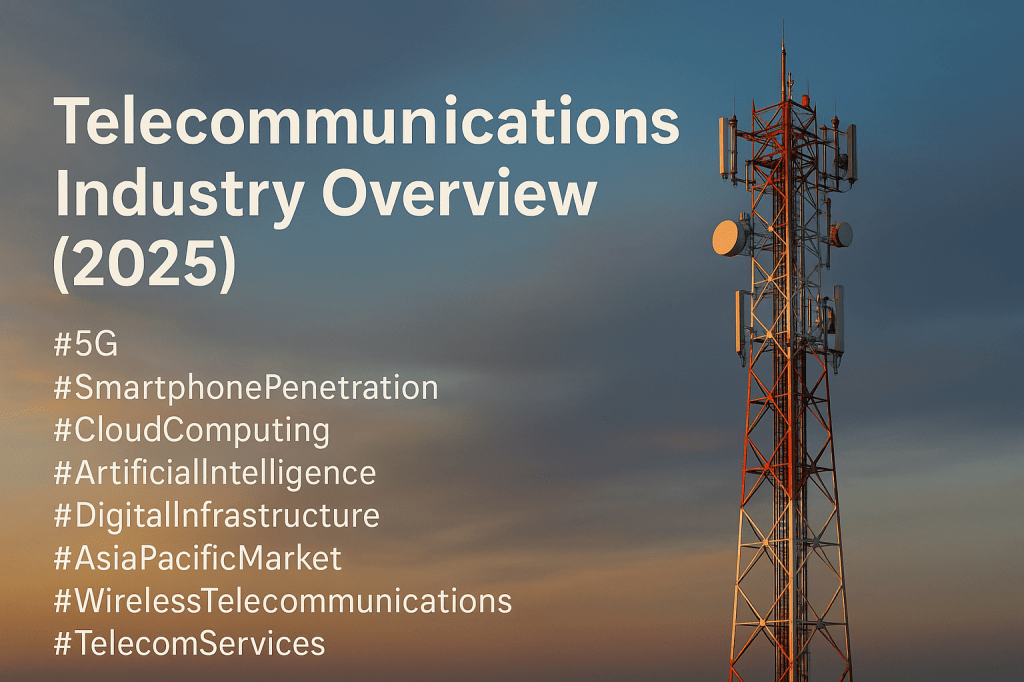
The global telecommunications industry is undergoing a transformative phase in 2025, characterized by robust growth, technological evolution, and deepening regional penetration. With an estimated market valuation ranging from $2.46 trillion to $3.16 trillion depending on the scope of services and hardware included, the sector remains central to global digital infrastructure. This dynamic growth trajectory is expected to continue, with projections indicating that the market could reach $4.21 trillion by 2034, expanding at a compound annual growth rate (CAGR) of 6.1%.
A key segment driving this growth is telecom services, which alone are valued at approximately $2.10 trillion in 2025. These services are forecasted to expand to $3.24 trillion by 2034, underscoring their foundational role in the industry’s future. The growth is being powered by several intersecting trends and drivers that are reshaping not only how telecommunications operate but also how they serve both individual consumers and enterprise clients.
Foremost among these drivers is the rapid global deployment of 5G networks and the explosive growth of Internet of Things (IoT) devices. These technologies are revolutionizing connectivity standards and enabling high-speed, low-latency communication across sectors ranging from healthcare and manufacturing to smart cities and autonomous vehicles. As 5G and IoT mature, they are creating new revenue models and service categories for telecom providers, compelling them to evolve their infrastructures to stay competitive.
Smartphone penetration continues to rise globally, expanding the base of digital consumers. This trend is especially strong in emerging markets where increasing affordability of mobile devices is accelerating access to digital services. The consequent surge in data consumption is pushing telecom firms to enhance their network capacities and innovate with bundled data plans, thereby deepening consumer engagement and retention.
Simultaneously, the integration of cloud computing and artificial intelligence (AI) into telecom operations is enabling smarter network management, predictive maintenance, improved customer support, and heightened cybersecurity. These technologies are not only enhancing operational efficiency but are also positioning telecom companies as critical enablers of digital transformation across other industries.
Government initiatives and growing urbanization further amplify this momentum. Around the world, governments are recognizing the strategic importance of digital connectivity in economic growth and social inclusion. Public investments in broadband infrastructure, digital literacy programs, and regulatory reforms are paving the way for more inclusive access and competitive service delivery.
From a regional standpoint, the Asia-Pacific region holds the lion’s share of the global telecommunications market. With its massive population, aggressive rollout of 5G, and widespread digital adoption, Asia-Pacific serves as both a volume and innovation hub. Countries like India, China, South Korea, and Japan are leading in subscriber base expansion, network development, and digital applications. In India, players like Reliance Jio and Bharti Airtel have disrupted traditional telecom models by offering affordable data plans and investing in rural connectivity.
North America and Europe remain vital markets, albeit more mature. These regions are heavily investing in upgrading existing 4G networks to 5G, expanding fiber-optic broadband, and developing satellite-based communication services to ensure connectivity in remote regions. The U.S. telecom landscape, led by giants such as AT&T, Verizon, and T-Mobile, is focusing on enterprise-grade 5G, cloud networks, and spectrum optimization.
Segment-wise, wireless telecommunications dominate the industry, representing the fastest-growing area due to the ubiquity of mobile phones and increasing mobile data traffic. This segment includes both voice and data services delivered over cellular networks. Wired telecommunications, while growing at a slower pace, continue to play a critical role in providing reliable broadband and fixed-line services to households and businesses. Communications hardware and satellite services are also expanding, driven by rising demand for global connectivity, defense communication systems, and space-based internet services.
Major global players like China Mobile, Vodafone, and T-Mobile are complementing traditional telecom offerings with digital content, fintech solutions, and enterprise services to diversify revenue streams. Meanwhile, in emerging markets, the focus is also on affordability, multilingual interfaces, and digital financial inclusion to tap into underserved populations.
In summary, the telecommunications industry in 2025 is marked by dynamic expansion, with 5G, IoT, AI, and cloud computing forming the backbone of innovation. The industry’s evolution is not only creating new economic opportunities but also redefining how individuals, businesses, and governments communicate, operate, and deliver services. Asia-Pacific continues to lead the charge in both market size and innovation, but transformative investments across North America and Europe ensure that global competition remains intense. As digital connectivity becomes a cornerstone of the modern economy, the telecommunications sector’s influence on future growth will be deeper and more far-reaching than ever before.
 "Connecting communities, empowering nations: Unifying the Regional and Global Economy ."
Leave a comment