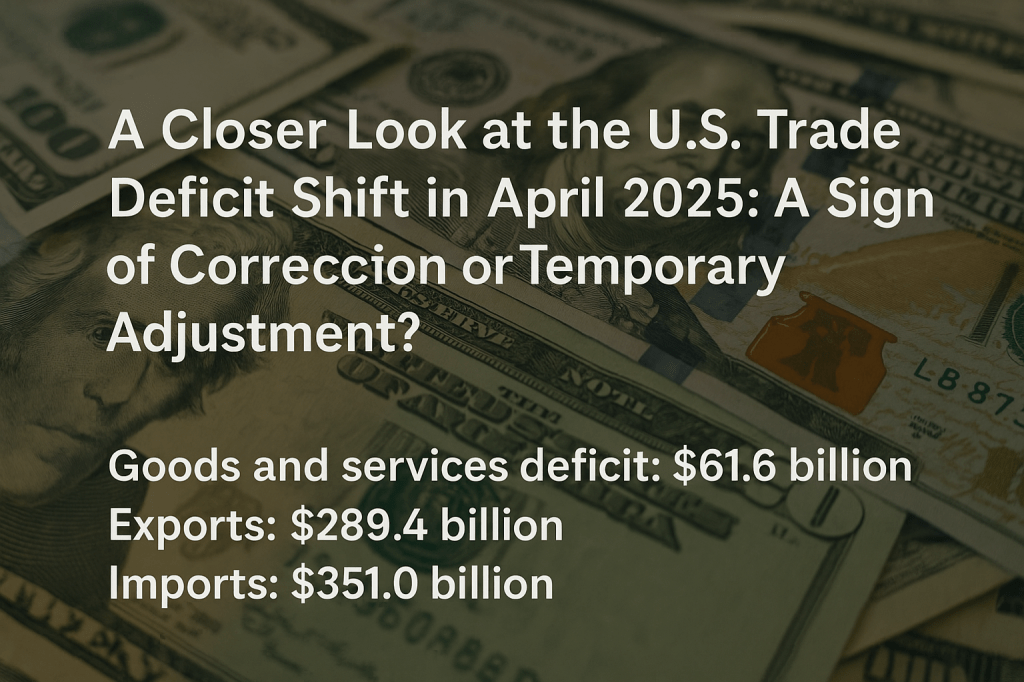
The United States’ international trade landscape experienced a significant shift in April 2025, as reported by the U.S. Census Bureau and the Bureau of Economic Analysis (BEA). The country’s goods and services trade deficit narrowed sharply to $61.6 billion, a dramatic decline of $76.7 billion from March’s revised figure of $138.3 billion. This notable reduction in the trade deficit invites a closer examination, not only for what it indicates about short-term trade activity but also for its broader economic implications.
April’s trade data reveals that total exports increased to $289.4 billion, marking an $8.3 billion rise from March. Simultaneously, imports saw a significant drop to $351.0 billion—down by $68.4 billion compared to the previous month. This combination of rising exports and falling imports led to a $75.2 billion decrease in the goods deficit, bringing it down to $87.4 billion. Additionally, the services sector showed resilience, with the services surplus rising by $1.5 billion to reach $25.8 billion.
The April improvement in the trade balance was largely driven by the decline in imports, the sharpest monthly reduction observed in recent times. Several factors could explain this contraction in import volume. One possible reason is a softening in domestic demand, potentially indicating that U.S. consumers and businesses have become more cautious in their spending. Another possibility is inventory adjustment by firms that may have overstocked in the first quarter of the year and are now rebalancing their supply chains. Furthermore, global supply chain shifts and seasonal factors might have contributed to the decline in import activity.
On the export front, the modest gain could be attributed to recovering demand in key global markets, a relatively weaker U.S. dollar that makes American goods more competitively priced, and favorable seasonal trends in sectors like agriculture and energy. While the growth in exports is encouraging, the increase remains moderate compared to the drastic fall in imports.
Meanwhile, the services sector has continued to play a critical role in supporting the U.S. trade balance. The rise in the services surplus reflects sustained global demand for American services, including travel, education, financial services, and technology. This sector has proven more stable than goods trade and continues to reinforce the United States’ comparative advantage in intangible, high-value offerings.
However, beneath the surface of this positive monthly data lies a more concerning year-to-date (YTD) trend. From January to April 2025, the overall goods and services deficit rose by $179.3 billion, representing a 65.7 percent increase compared to the same period in 2024. During this period, exports increased by $58.4 billion, or 5.5 percent, while imports surged by $237.8 billion, or 17.8 percent. This disproportionate growth in imports relative to exports highlights the structural trade imbalances that continue to characterize the U.S. economy.
Such trends may reflect an ongoing dependence on imported manufactured goods, persistent weaknesses in U.S. export competitiveness in traditional sectors, and earlier strong consumer demand that boosted import volumes. While April’s data provides some short-term relief, the long-term concern remains that the U.S. trade deficit is widening at a worrying pace.
From a policy standpoint, a sustained reduction in the trade deficit could help ease inflationary pressures, improve the current account balance, and support domestic industries. However, if the April correction proves temporary, it could renew concerns about the U.S. economy’s external vulnerabilities. Rising deficits can affect currency stability, influence Federal Reserve monetary policy, and fuel political debates around trade agreements, tariffs, and reshoring strategies.
In conclusion, while April 2025 brought a significant and welcome narrowing of the U.S. trade deficit, driven by a sharp fall in imports and a modest rise in exports, this should be viewed with cautious optimism. The year-to-date data underscores that deeper structural issues persist, and the trade imbalance is still growing rapidly overall. Policymakers must consider this a timely reminder to revisit strategies for export promotion, industrial competitiveness, and economic resilience.
#USTradeDeficit
#ImportsAndExports
#GoodsAndServicesBalance
#USBEA
#April2025TradeData
#ExportGrowth
#ImportDecline
#ServicesSurplus
#TradePolicy
#EconomicIndicators
 "Connecting communities, empowering nations: Unifying the Regional and Global Economy ."
Leave a comment