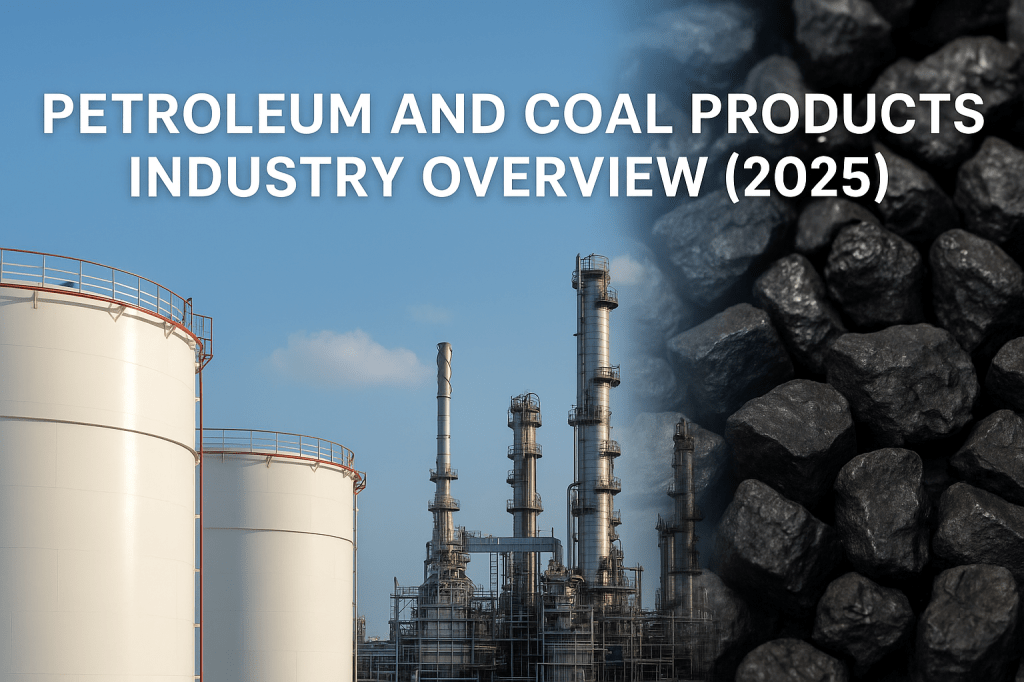
As the world transitions toward more sustainable energy systems, the petroleum and coal products industry in 2025 finds itself at a pivotal crossroads. Despite mounting pressure to decarbonize, the sector continues to play a vital role in global energy and industrial supply chains—particularly in Asia, where growth, energy security, and industrial development drive demand.
🔍 Market Size and Global Outlook
The global petrochemical market is valued at approximately $700.10 billion in 2025 and is projected to reach $1,193.26 billion by 2034, expanding at a compound annual growth rate (CAGR) of 6.11%. This growth is fueled by sustained demand for plastics, synthetic materials, and chemical intermediates. Meanwhile, the coal chemical products market, though slower-growing, is projected to increase from $123.4 billion in 2023 to $174.3 billion by 2032 at a CAGR of 3.9%.
These figures reveal that while the global energy transition is underway, fossil-fuel-derived products still underpin major segments of the global economy.
🔁 Key Trends Reshaping the Industry
✅ Petroleum Sector: Shift from Fuel to Feedstock
Traditional fuels like gasoline and diesel are seeing declining demand, particularly in developed economies.
Refineries are increasingly shifting focus from transportation fuels to higher-value petrochemicals, responding to evolving industrial needs.
Global oil supply is set to rise in 2025, particularly from non-OPEC+ nations, easing pressure on global energy markets.
✅ Coal Sector: Resilience in Asia
While thermal coal faces long-term structural decline globally, demand remains strong in China and India, driven by industrial growth and energy reliability concerns.
Both countries are increasing domestic production, reducing dependence on imports, and expanding coal infrastructure to support steel, cement, and power sectors.
Metallurgical coal, critical for steelmaking, continues to see robust demand in India, which is one of the fastest-growing steel markets.
✅ Technology and Sustainability
AI and IoT technologies are being adopted across the sector for predictive maintenance, efficiency optimization, and real-time monitoring.
Refineries and coal processing plants are under pressure to adopt cleaner production technologies, with environmental compliance becoming a competitive differentiator.
New methods for carbon capture, utilization, and storage (CCUS) and low-emission refining are beginning to emerge, though widespread deployment is still in its infancy.
🌏 Regional Focus: Asia at the Center
Asia Pacific leads the global market in both petroleum and coal products. Several key factors explain this dominance:
Rapid industrialization and infrastructure development in countries like China, India, and Southeast Asia.
A rising middle class driving demand for consumer goods, petrochemical derivatives, and energy.
Government policies in India and China that support energy self-sufficiency, including significant investment in domestic extraction and processing
China remains the world’s largest coal consumer and producer.
India is not only increasing domestic coal output but is also expanding petrochemical refining capacity through new projects.
⚖️ Balancing Growth with Transition
The juxtaposition of robust market growth and the imperative for sustainability defines the petroleum and coal products industry in 2025.
✔ Key Challenges:
Decarbonization mandates and global net-zero targets.
Investor pressure to reduce exposure to fossil fuels.
Geopolitical tensions and supply chain vulnerabilities.
✔ Strategic Responses:
Diversifying output portfolios to include bio-based chemicals and low-carbon fuels.
Investing in carbon management technologies to maintain long-term viability.
Regional collaborations and trade adjustments to address shifting demand and regulatory pressures.
The petroleum and coal products industry in 2025 is not fading—it is adapting. In a world increasingly driven by climate concerns and technological shifts, the industry’s trajectory is marked by strategic recalibration rather than decline. Growth in petrochemicals, continued coal relevance in Asia, and tech-led efficiencies are enabling the sector to evolve while remaining a cornerstone of the global industrial economy.
📌 Key Takeaways:
Petrochemicals are outpacing traditional fuels in value generation.
Asia—especially China and India—remains the bedrock of coal and petroleum demand.
Technological innovation is critical to maintaining relevance amidst the energy transition.
#PetrochemicalGrowth #CoalDemandAsia #EnergyTransition2025 #AIinRefineries #PetroleumSustainability #MetallurgicalCoal #RefineryDiversification #AsiaPacificEnergy #CarbonCompliance #FossilFuelInnovation
 "Connecting communities, empowering nations: Unifying the Regional and Global Economy ."
Leave a comment