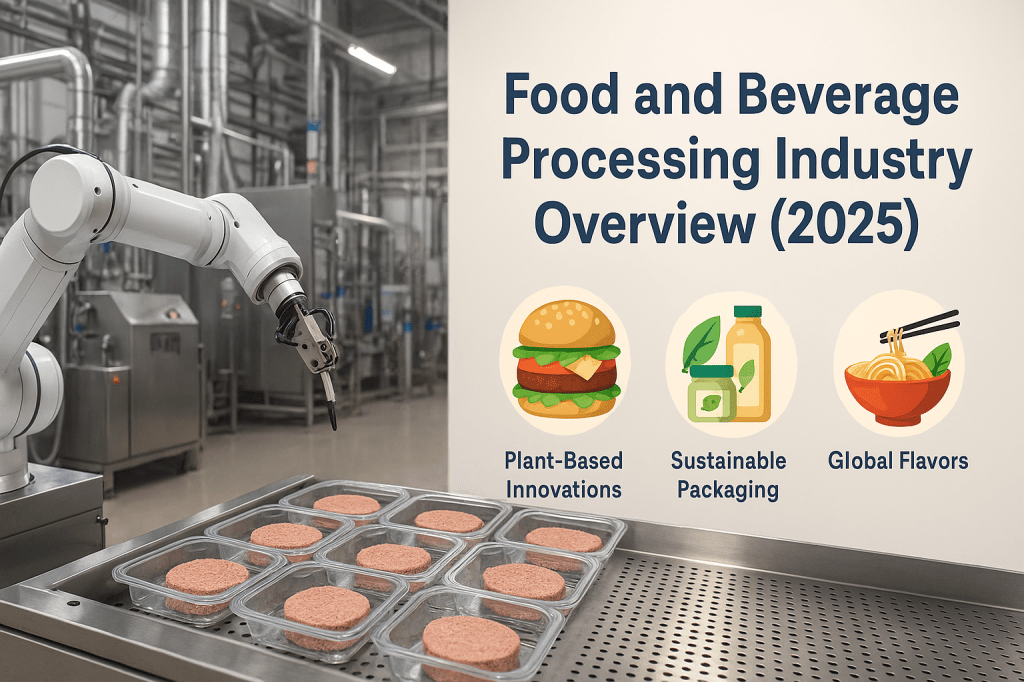
The food and beverage processing industry in 2025 stands at the intersection of innovation, shifting consumer preferences, and pressing sustainability challenges. As the global market for food and beverages surges toward an estimated $7.4 trillion, the processing segment plays a pivotal role in value addition, efficiency, and meeting the ever-diversifying consumer demands.
Market Landscape and Economic Significance
The food processing industry is undergoing significant expansion. Valued at $162.9 billion in 2024, it is projected to nearly double to $299.8 billion by 2033, growing at a CAGR of 7%. Similarly, the food and beverage processing equipment market—an essential subset—is expected to grow from $72.1 billion in 2025 to $106.4 billion by 2032, reflecting global industrial momentum.
This growth is underpinned by demographic shifts such as urbanization, rising disposable incomes, and changing food consumption habits that prioritize convenience, nutrition, and taste diversity.
Key Drivers of Growth
1. Urbanization and Lifestyle Changes:
Urban dwellers increasingly rely on processed and packaged foods due to time constraints and dual-income households.
2. Technological Advancements:
Cutting-edge technologies—like IoT, AI, and automation—are transforming operations, improving food safety, quality control, and real-time supply chain visibility.
3. Consumer Demand for Novelty and Health:
There’s growing interest in plant-based and functional foods, reflecting shifts in dietary awareness and environmental consciousness.
Emerging Trends Redefining the Sector
PlantBased Revolution:
2025 is witnessing mainstream adoption of meat and dairy alternatives, supported by improved taste profiles, texture, and nutritional value.
SustainablePackaging:
Processors are investing in biodegradable and compostable materials, responding to regulatory pressures and eco-conscious consumers.
UpcycledIngredients:
Manufacturers are turning food waste into nutritious, sellable products, reinforcing the circular economy within the food sector.
HealthAndWellness:
Foods tailored for specific health needs—immune support, gut health, and cognitive enhancement—are gaining momentum.
SmartManufacturing:
AI-integrated robotics, digital twins, and predictive maintenance are elevating operational excellence and minimizing waste.
GlobalPalates and Beverages:
The rise of ethnic flavors and functional ready-to-drink beverages (e.g., kombucha, herbal infusions) is broadening product portfolios globally.
Challenges on the Horizon
Despite its growth trajectory, the industry contends with critical challenges:
RawMaterialVolatility:
Fluctuations in commodity prices are squeezing profit margins, especially for smaller processors.
#WorkforceShortages:
There is a growing need for skilled labor capable of managing automated and AI-driven production lines.
RegulatoryCompliance:
Navigating food safety, labeling laws, and environmental regulations across markets remains complex and costly.
SustainabilityDemands:
As climate change intensifies, companies are pressured to reduce carbon footprints, ensure traceability, and adopt greener operations.
The food and beverage processing industry in 2025 embodies a landscape shaped by innovation, consumer empowerment, and sustainable transformation. From intelligent factories to nutritious, ethically sourced meals, every link in the value chain is being redefined.
Companies that embrace digitization, sustainability, and agility will not only capture new markets but also lead in a future where food is not just consumed—but also responsibly crafted.
#FoodProcessing
#PlantBasedInnovation
#SmartManufacturing
#SustainablePackaging
#FunctionalFoods
#UpcycledIngredients
#GlobalFoodTrends
#F&BEquipment
#ConsumerHealth
#FoodIndustry2025
 "Connecting communities, empowering nations: Unifying the Regional and Global Economy ."
Leave a comment