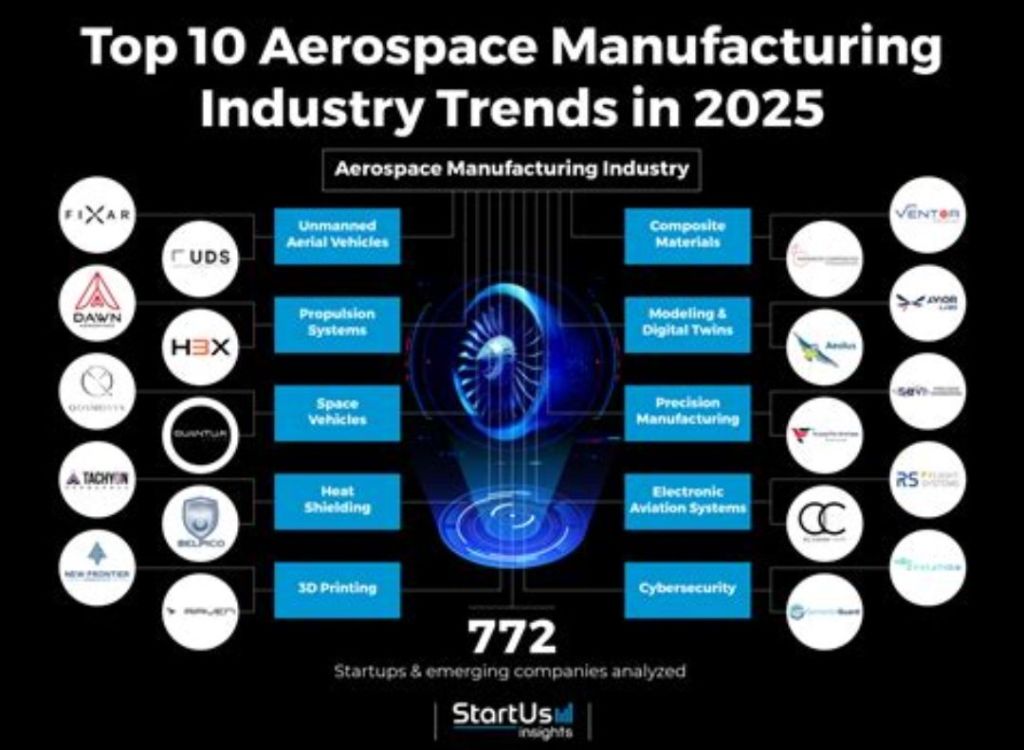
The aerospace industry stands as one of the most advanced and capital-intensive sectors in the global economy. Stretching beyond the bounds of Earth’s atmosphere, it encompasses the design, development, and manufacture of aircraft, spacecraft, missiles, and supporting systems such as propulsion engines and avionics. In 2025, this sector is not just defined by its legacy of innovation and strategic importance—it is also undergoing transformative growth driven by new technologies, sustainability goals, and increasing demand across both civil and defense markets.
A Market Poised for Takeoff
Valued at approximately $373.6 billion in 2024, the global aerospace market is projected to nearly double to $791.8 billion by 2034, reflecting a robust CAGR of 7.8%. This expansion is far from coincidental—it mirrors macroeconomic trends such as the resurgence in global air travel, rising defense expenditures, and a surge in commercial interest in outer space.
The most dominant segment remains commercial aviation, which includes both passenger and cargo aircraft. However, defense aerospace and space exploration are registering accelerated growth, thanks to global geopolitical tensions and public-private partnerships in space missions.
The Powerhouses and Emerging Players
The United States maintains its leadership, home to aerospace giants like Boeing, Lockheed Martin, and Northrop Grumman, which are deeply entrenched in both civilian and military contracts. However, Asia-Pacific is emerging as the fastest-growing region, driven by large-scale investments in aviation infrastructure, indigenous defense programs (like India’s HAL Tejas or Japan’s sixth-generation fighter initiative), and a booming middle-class demand for air travel.
This regional diversification underscores a global rebalancing of capabilities and markets. As North America maintains technological supremacy, countries like China, India, and South Korea are narrowing the gap through policy support, R&D investments, and global joint ventures.
Technology at the Core of Transformation
Innovation is the aerospace industry’s lifeblood. In 2025, several technological domains are redefining aerospace operations:
Artificial Intelligence (AI): Used for predictive maintenance, autonomous navigation, and air traffic optimization.
Additive Manufacturing (3D Printing): Reduces material waste and enables on-demand part production, crucial in remote aerospace facilities.
Advanced Satellite Technologies: Powering everything from global communications to real-time earth observation and defense surveillance.
Blockchain: Enhances supply chain transparency and aircraft component traceability.
Urban Air Mobility (UAM): Emerging concepts like air taxis and drone-based logistics could revolutionize urban transport and defense logistics.
Immersive Technologies (AR/VR): Revolutionizing pilot training, aircraft design simulation, and maintenance procedures.
These innovations are not merely futuristic—they are being deployed at scale to increase efficiency, cut costs, and ensure higher safety margins.
Sustainability: From Slogan to Strategy
Environmental concerns are no longer peripheral to aerospace; they are now central to strategy. The industry is investing in electric aircraft, sustainable aviation fuels (SAF), lightweight composite materials, and digitally optimized flight paths to reduce emissions. As regulators tighten environmental compliance norms and consumers demand greener travel, these shifts are necessary not only for reputation but for regulatory survival.
The idea of “net-zero” emissions in aviation, once seen as aspirational, is becoming a boardroom priority. Initiatives from Airbus and Rolls-Royce on hydrogen propulsion, or NASA’s X-planes targeting supersonic green travel, are evidence of the shift from pilot projects to practical applications.
Challenges Beneath the Surface
Despite its strong growth trajectory, the aerospace sector is not without turbulence:
Supply Chain Vulnerabilities: Post-pandemic shocks and geopolitical frictions have exposed weaknesses in sourcing rare earth materials and semiconductor components.
Skilled Talent Shortage: As technology advances, the need for multidisciplinary talent—from AI specialists to aerospace systems engineers—is outpacing supply.
Cybersecurity Risks: Increased digitization and interconnected systems in both aircraft and satellites raise significant vulnerabilities.
These challenges require coordinated policy frameworks, public-private collaboration, and agile corporate strategies to ensure resilience and competitive advantage.
A Dual-Use Future: Commercial Meets Defense
The line between civil and military aerospace applications is increasingly blurring. Technologies developed for commercial aircraft—such as advanced navigation systems, materials science, and AI—are rapidly being adapted for defense purposes. Likewise, military-grade cybersecurity and aerospace resilience tools are finding applications in commercial aviation and space-based internet systems.
Space is another frontier where dual-use capabilities are growing. Commercial satellites are now integral to national defense strategies, while defense-funded launch vehicles often serve civilian purposes as well.
Flight Path to 2034
The aerospace industry is not just growing—it is evolving. It is transitioning from a traditionally hierarchical, hardware-centric sector into a nimble, tech-enabled ecosystem encompassing manufacturing, digital services, and sustainability.
As global connectivity, security needs, and climate goals intensify, aerospace will remain a pillar of strategic investment and innovation. Countries that cultivate skilled talent, invest in frontier technologies, and build resilient supply chains will define the future of aerospace.
Whether it’s electric planes easing climate burdens, AI optimizing every flight, or the first human landing on Mars, the aerospace sector is writing the next chapter of human progress—midair and beyond.
 "Connecting communities, empowering nations: Unifying the Regional and Global Economy ."
Leave a comment