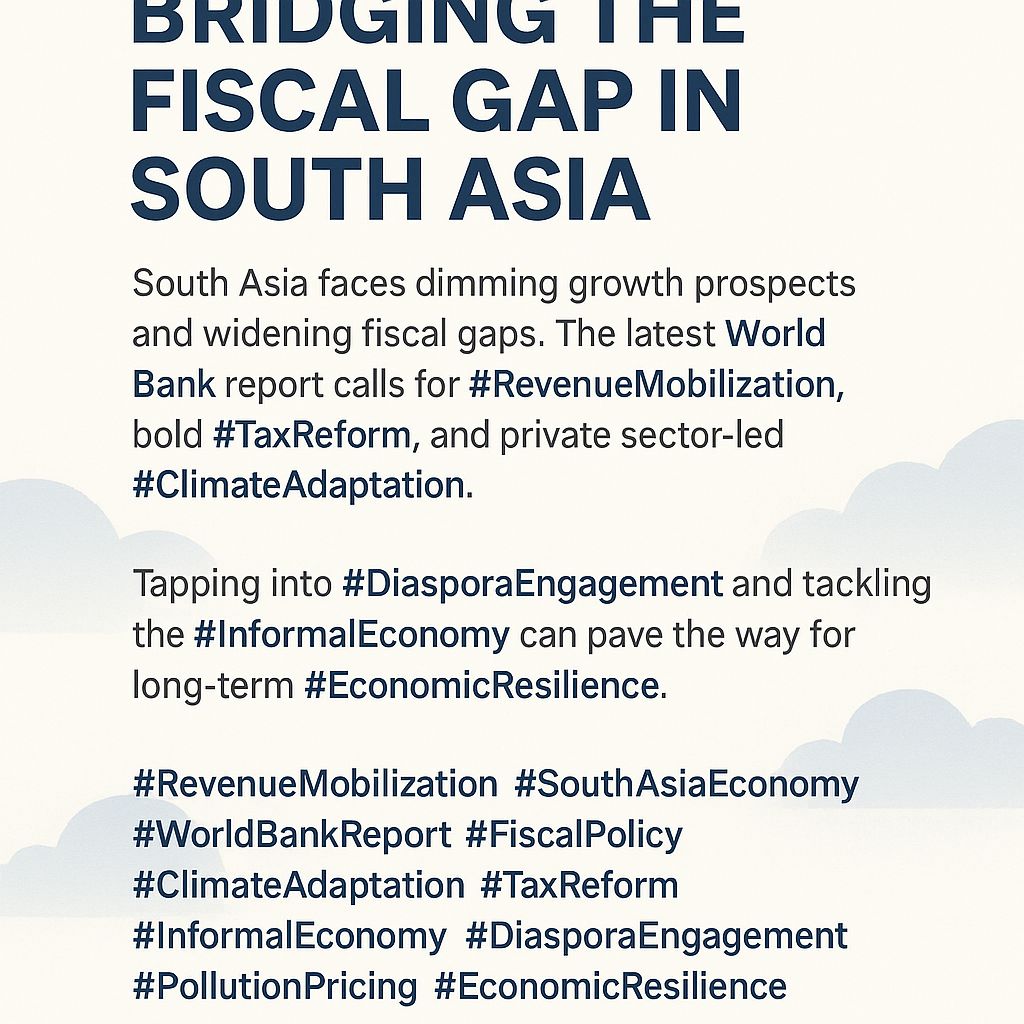
South Asia stands at a critical juncture. The World Bank’s latest regional economic update paints a sobering picture of dimming growth prospects, deepening fiscal vulnerabilities, and escalating climate threats. After a decade of external shocks and internal inefficiencies, the region must pivot decisively toward robust revenue mobilization and climate-resilient policy frameworks to sustain development.
A Downward Growth Trajectory
According to the World Bank, South Asia’s growth—after reaching 6% in 2024—is expected to moderate to 5.8% in 2025. This downward revision underscores a series of compounding pressures: weak global demand, high borrowing costs, policy uncertainty, and limited fiscal room. The region’s capacity to absorb new shocks is now significantly constrained.
In particular, South Asia’s dependence on vulnerable sectors like agriculture, combined with persistent underperformance in formal job creation and private investment, continues to drag on potential growth.
The Revenue Mobilization Deficit
One of the central themes in the World Bank’s report is South Asia’s weak domestic revenue performance. Despite having tax rates comparable to other Emerging Markets and Developing Economies (EMDEs), the region’s tax revenues averaged only 18% of GDP from 2019 to 2023—far below the EMDE average of 24%.
This gap arises not from the absence of taxation frameworks, but from:
Widespread informal economic activity, especially in agriculture.
Narrow and poorly enforced tax bases.
Significant consumption and corporate tax shortfalls.
In five out of eight countries, the revenue gap is as high as 7 percentage points of GDP, suggesting considerable room for improvement.
Reforms for Fiscal Resilience
The World Bank emphasizes the urgent need to strengthen tax policy and administration across South Asia. Recommended actions include:
Eliminating loopholes and tax exemptions.
Modernizing and simplifying tax codes to improve compliance.
Enhancing digital tax enforcement to widen the net and reduce evasion.
Introducing innovative tools like pollution pricing to simultaneously generate revenue and address environmental degradation.
By adopting these measures, South Asian governments can create the fiscal space required to respond to economic shocks and invest in development priorities.
A Fiscal Threat Multiplier
South Asia’s vulnerability to climate change is well-documented, but the World Bank underscores its future fiscal implications. The region could suffer per capita income losses greater than the average EMDE by 2050, driven by higher temperatures, extreme weather events, and their impact on agriculture.
However, the report suggests that about one-third of this climate damage could be mitigated if the private sector is enabled to adapt flexibly—shifting activities and resources to more resilient sectors and locations. Governments can facilitate this by investing in digital infrastructure, transport networks, and access to finance.
Tapping the Diaspora Dividend
A lesser-highlighted yet important insight is the potential of the South Asian diaspora. Roughly 3% of the region’s population lives abroad, sending significant remittances. But beyond financial flows, the diaspora represents an untapped reservoir of knowledge, innovation, and market access. The World Bank encourages strategies to better integrate diaspora capital and talent into domestic growth ecosystems.
A Compact for Sustainable Growth
The World Bank’s report is both a warning and a roadmap. South Asia faces growing external and internal pressures—but it also has the tools to respond. Fiscal sustainability, smart revenue mobilization, and adaptive climate strategies form the triad of solutions for the region’s future.
As South Asia navigates a turbulent global economy, it must harness every lever—tax policy, institutional reform, private sector agility, and diaspora engagement—to safeguard its development goals and ensure shared prosperity in the decades ahead.
 "Connecting communities, empowering nations: Unifying the Regional and Global Economy ."
Leave a comment