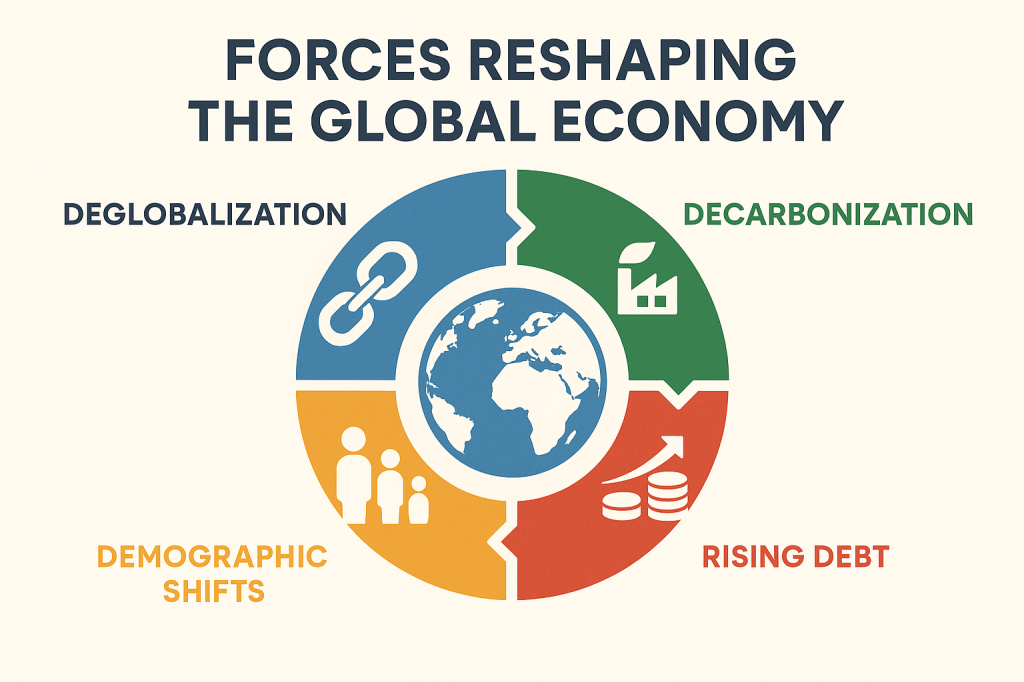
As the global economic landscape undergoes rapid transformation, it is becoming increasingly clear that tariffs are just one piece of a much larger puzzle. A more fundamental realignment is underway, driven by four major policy and structural megatrends: deglobalization, decarbonization, demographic shifts, and rising debt. These powerful undercurrents are not only redefining trade relations and global growth dynamics but are also significantly complicating supply chains and escalating operational costs across economies.
Deglobalization: The Rewriting of Economic Geography
Globalization once promised seamless connectivity and efficiency through interconnected supply chains and cross-border capital flows. However, the rise of economic nationalism, strategic decoupling between major economies like the U.S. and China, and disruptions caused by geopolitical conflicts and pandemics have spurred a reversal. From semiconductors to pharmaceuticals, countries are now rethinking dependency on foreign supply sources. The reshoring and nearshoring of industries—aimed at boosting domestic capabilities—are inherently more expensive and are contributing to structural inflation in many parts of the world.
According to the World Bank, trade as a share of global GDP fell from 60.2% in 2008 to around 52.6% in 2023, indicating a decline in cross-border integration. This recalibration is especially challenging for emerging markets that had previously benefited from export-led growth strategies.
Decarbonization: A Costly but Critical Transition
The global push towards net-zero emissions is another monumental force remapping economies. While essential to mitigating climate change, decarbonization comes at a cost—particularly for carbon-intensive sectors like energy, manufacturing, and transportation. The transition to green technologies involves massive capital investment in renewable infrastructure, electric vehicles, carbon capture, and energy storage.
According to the International Energy Agency (IEA), the world needs to invest nearly $4.5 trillion annually in clean energy by 2030 to meet the Paris Agreement targets. For many countries, particularly in the Global South, balancing development needs with climate goals is becoming an increasingly delicate act. In the short term, these investments are contributing to rising input prices and forcing a revaluation of energy security strategies.
Demographic Shifts: The Dual Challenge of Aging and Youth Bulges
Demographics are becoming destiny. Advanced economies are grappling with rapidly aging populations, shrinking workforces, and ballooning pension liabilities. Japan and parts of Europe are already experiencing economic stagnation linked to demographic decline, while countries like China are also showing signs of premature aging.
In contrast, emerging economies in Africa and South Asia face the opposite problem: large, youthful populations that need meaningful employment opportunities. India, for example, adds nearly 12 million people to its labor force annually, but formal job creation has not kept pace. This divergence is leading to divergent growth models and policy priorities—placing additional stress on global labor markets, capital allocation, and migration flows.
Debt Accumulation: The Silent Drag on Growth
Global debt—public and private—has reached record highs. According to the IMF, global public debt stood at 92% of GDP in 2023, up from 84% in 2019. For advanced economies, debt accumulation has been driven by pandemic-era stimulus, aging-related social spending, and climate commitments. For developing countries, debt often arises from external borrowing for infrastructure and development, leaving them vulnerable to currency volatility and higher interest rates.
The combination of higher inflation and rising interest rates has made debt servicing costlier, crowding out fiscal space for development or social spending. Sovereign debt distress is already visible in several low-income countries, including Sri Lanka and Zambia, where restructuring has become unavoidable.
A New Economic Era: Resilience Through Reinvention
Together, these four forces—deglobalization, decarbonization, demographic change, and rising debt—are not merely economic trends but structural transformations. They require a fundamental rethinking of how economies organize production, allocate capital, and build resilience.
Policymakers and businesses must now focus on flexibility, diversification, and sustainability rather than low-cost efficiency alone. Supply chains need to be reimagined not just to be faster or cheaper, but also more transparent and adaptive. Fiscal policies must strike a balance between long-term investment and debt sustainability. And most importantly, global cooperation must not be abandoned in favor of narrow national interests, as the challenges ahead—climate, pandemics, migration—do not recognize borders.
In sum, tariffs may dominate the headlines, but the real reshaping of the global economy lies beyond them—in the long, slow churn of deep structural change. The road ahead may be complex, but with strategic foresight and inclusive policies, it is still possible to build a more equitable and resilient global order.
 "Connecting communities, empowering nations: Unifying the Regional and Global Economy ."
Leave a comment