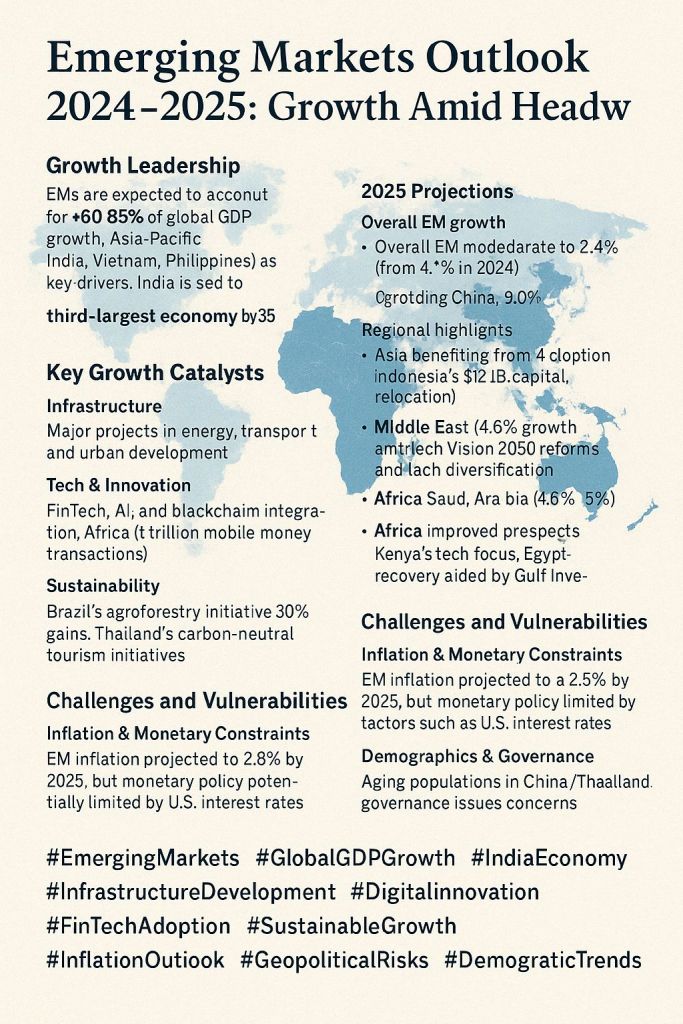
In an increasingly uncertain global economy, emerging market economies (EMs) continue to shine as dynamic engines of growth. With developed economies facing stagnation, it is the EMs—particularly in Asia, Latin America, the Middle East, and Africa—that are expected to account for nearly 60–65% of global GDP growth over the next two years. These projections are rooted in a combination of structural reforms, infrastructure-led development, and digital innovation.
Growth Trends and Regional Highlights
Asia-Pacific remains the key driver, led by India, Vietnam, and the Philippines. India, in particular, is on a steady trajectory to become the third-largest economy by 2035, bolstered by robust domestic demand, digital public infrastructure, and supply-chain diversification. Indonesia’s bold capital relocation plan—estimated at $34 billion—signals both economic ambition and the region’s infrastructure push.
Latin America is witnessing a cautious rebound. While Argentina is emerging from a prolonged economic crisis, Colombia is injecting momentum through its $12 billion renewable energy investments, a move that is expected to improve resilience in the face of global energy transitions.
Middle Eastern economies, notably Saudi Arabia (4.6% growth) and UAE (5.1%), continue to diversify away from hydrocarbons under their Vision 2030 agendas. Investment in technology, tourism, and logistics is central to their transformation from resource-reliant states to knowledge-based economies.
In Africa, Nigeria and Kenya are leading reformist agendas. Nigeria’s foreign exchange liberalization and Kenya’s expanding tech ecosystem are enhancing investment sentiment. Meanwhile, Egypt is recovering from macroeconomic pressures with the help of strategic investments from the Gulf.
Despite these positive trends, overall emerging market growth is projected to moderate to 3.4% in 2025, down from 4.1% in 2024. However, this slowdown is largely China-centric. When China is excluded, the deceleration is much less pronounced—growth hovers around 3.0%—underscoring the resilience and momentum across other EM regions.
Key Growth Catalysts
1. Infrastructure Development
Large-scale infrastructure remains a cornerstone of EM growth. Whether it is Türkiye’s plan to expand its wind energy capacity by 40%, or urban development projects in Southeast Asia, infrastructure serves as both a job generator and a long-term productivity enhancer.
2. Technological Leapfrogging
Emerging economies are rapidly adopting FinTech, AI, and blockchain, transforming financial access and governance. Africa’s $1 trillion in mobile money transactions exemplifies how innovation can bypass traditional bottlenecks, empowering millions.
3. Sustainability Transitions
Sustainable development is gaining traction, from agroforestry in Brazil (yielding 30% productivity gains) to carbon-neutral tourism in Thailand. These green initiatives are not only environmentally necessary but economically strategic, especially amid global ESG investment trends.
Challenges and Vulnerabilities
While prospects remain positive, EMs must navigate a landscape riddled with macroeconomic and structural challenges.
Inflation and Monetary Constraints: Inflation across EMs is projected to ease to 2.8% by 2025, but external factors like the trajectory of U.S. interest rates and the persistence of global tariffs could constrain monetary policy flexibility in several countries.
Demographics and Governance: Some EMs face looming structural issues. China and Thailand, for instance, are grappling with aging populations, threatening long-term labor force sustainability. At the same time, governance and institutional fragility continue to affect investor confidence in parts of Sub-Saharan Africa and Latin America.
Strategic Outlook
Emerging markets are no longer passive participants in global trade and investment—they are shaping the next phase of global economic rebalancing. Their young populations, rising middle classes, and increasing tech adoption offer a powerful counterbalance to the aging, slower-growing advanced economies. However, to unlock their full potential, EMs will need to strengthen institutional frameworks, promote inclusive digital growth, and mitigate geopolitical vulnerabilities.
As the global economy recalibrates post-pandemic and post-globalization, the decade ahead will be decisive for emerging economies. With strategic planning and continued reform momentum, EMs are not only expected to outperform—they are likely to redefine the contours of global growth.
#EmergingMarkets
#GlobalGDPGrowth
#IndiaEconomy
#InfrastructureDevelopment
#DigitalInnovation
#FinTechAdoption
#SustainableGrowth
#InflationOutlook
#GeopoliticalRisks
#DemographicTrends
 "Connecting communities, empowering nations: Unifying the Regional and Global Economy ."
Leave a comment