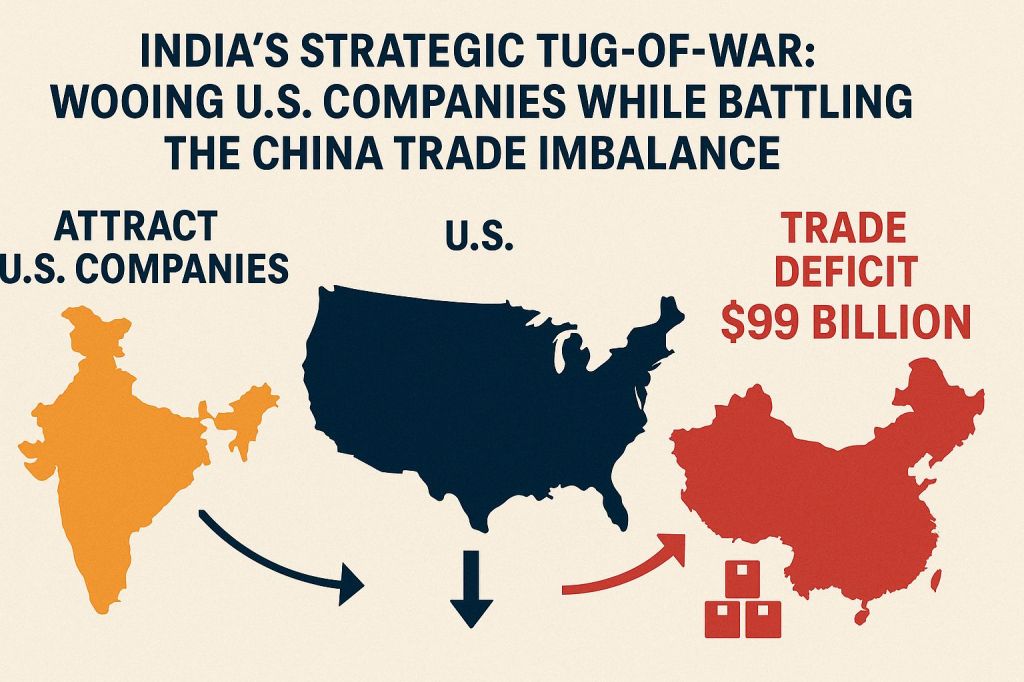
In the midst of evolving global trade dynamics, India finds itself at the intersection of opportunity and vulnerability. On one hand, it is making deliberate and calculated moves to attract U.S. companies that are exploring exits from China due to tariff escalations and geopolitical frictions. On the other hand, India is grappling with a ballooning trade deficit with China — now exceeding a staggering $99 billion — as Chinese goods continue to flood its markets.
This two-pronged reality demands a closer look into India’s trade strategy, the implications of the shifting global manufacturing order, and the policy recalibration necessary to address the inherent contradictions.
The China Dilemma: A Trade Deficit Touching Alarming Highs
India’s trade deficit with China has crossed the $99 billion mark — a number that underscores both the depth of India’s import dependency and the lopsided nature of the bilateral trade relationship. This deficit is driven largely by high-value imports including electronics, machinery, and active pharmaceutical ingredients (APIs), many of which are critical to India’s domestic industries.
While India has taken steps to promote self-reliance through initiatives like Atmanirbhar Bharat, structural dependency on Chinese intermediate goods persists. The asymmetry is stark: India exports primarily raw materials and low-value goods to China, while importing high-end finished products. This imbalance is not only economic but strategic, as it exposes Indian industries to supply-side vulnerabilities and price manipulation risks.
The U.S. Pivot: A Rare Window of Opportunity
Amid the U.S.-China tariff war, many American firms — especially those in electronics, pharmaceuticals, and consumer goods — are seeking alternative production bases. India has seized on this trend, positioning itself as a natural and democratic partner with a large labor force, expanding infrastructure, and improving ease of doing business.
Government schemes such as Production Linked Incentives (PLI), tax reforms, and land-labor regulation easing are aimed at making India a preferred destination for global manufacturers. Moreover, India’s digital and startup ecosystem, now the third largest in the world, adds to the appeal for tech-based firms.
However, competition is intense. Countries like Vietnam, Indonesia, and Mexico are also offering attractive packages. To outperform them, India must accelerate reforms in logistics, contract enforcement, and industrial land aggregation.
The Contradiction: Attracting Investment vs. Import Penetration
Here lies the core paradox: while India is persuading American firms to shift supply chains from China to India, Chinese goods continue to penetrate Indian markets deeply. Without a robust industrial base and competitive manufacturing ecosystem, India risks becoming a mere assembly hub rather than a comprehensive manufacturing powerhouse.
Furthermore, excessive import penetration from China not only damages Indian MSMEs but also weakens the argument for India as a credible alternative to China. For global firms, a strong domestic manufacturing capability and a resilient internal market are prerequisites for long-term investment.
Way Forward: Strategic Decoupling and Smart Coupling
India must walk a fine line between strategic decoupling from China in sensitive sectors like electronics, telecom, and defense, while smartly coupling in areas where complementarities exist. Simultaneously, India must deepen trade and technology ties with the U.S. and its allies through bilateral agreements, value-chain integration, and innovation partnerships.
Enhancing indigenous capabilities in semiconductors, green technologies, and pharmaceuticals will be key. The upcoming semiconductor fabs, drone manufacturing hubs, and defense corridors signal early progress, but scale and speed are critical.
India’s trade journey in the current geopolitical climate is both promising and precarious. By aggressively courting U.S. companies and seeking to become a hub for alternative global value chains, India is signaling its intent to become a central player in the post-China supply world. But this ambition can only materialize if matched by bold reforms and a decisive strategy to curb the unsustainable trade deficit with China. The balancing act is delicate, but the stakes — economic sovereignty and strategic autonomy — are too high to ignore.
#IndiaTradeDeficit
#USIndiaStrategicPartnership
#ChinaImports
#TariffWars
#GlobalSupplyChain
#MakeInIndia
#FDIinIndia
#ManufacturingShift
#PLIIndia
#EconomicResilience
 "Connecting communities, empowering nations: Unifying the Regional and Global Economy ."
Leave a comment