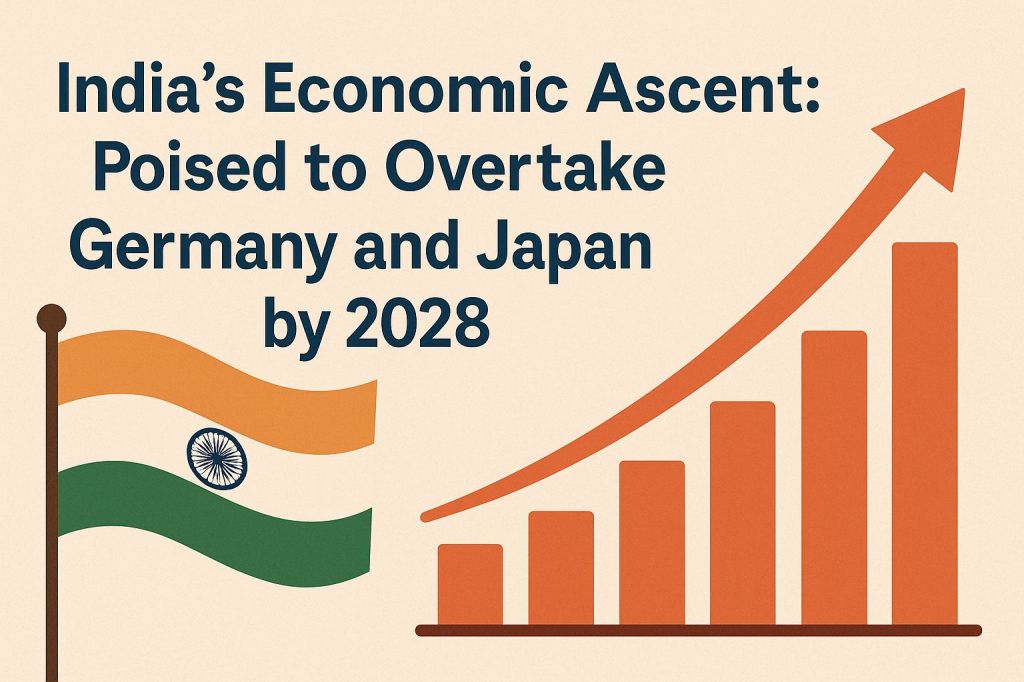
India’s economic narrative is undergoing a profound transformation, with a bold forecast made by the CEO of NITI Aayog: India is likely to surpass Germany and Japan to become the world’s third-largest economy within the next three years. This projection isn’t merely symbolic—it reflects a combination of strong structural reforms, resilient macroeconomic fundamentals, and strategic global positioning.
At the core of this ambition lies India’s consistent high growth trajectory. The economy is expected to grow around 6.5% in 2025, maintaining its status as the fastest-growing major economy. While agencies such as Fitch have slightly revised their FY25 growth forecast for India down to 6.2%, this figure still outpaces most other large economies, particularly in a global context marked by inflationary pressures, monetary tightening, and trade uncertainties.
The Growth Context
The projected overtaking of Germany and Japan—two advanced, mature economies—is significant. Germany, the powerhouse of Europe, and Japan, a leader in advanced manufacturing and innovation, have both experienced slower growth in recent years due to demographic stagnation, supply chain realignments, and aging workforces. In contrast, India enjoys a demographic dividend, digital transformation, and an expanding consumer base.
To contextualize, India’s GDP in nominal terms stood at around $3.7 trillion in 2024. With average growth hovering between 6–7%, and assuming a stable rupee and moderate inflation, India could potentially reach or exceed $5 trillion by 2027–2028. Japan and Germany, whose economies are hovering around $4.2 trillion and $4.5 trillion respectively, are expected to see growth rates of less than 2%, indicating a plausible overtaking scenario by India.
Investment and Policy Drivers
India’s economic rise is not accidental. The government has focused heavily on infrastructure, digital public goods, ease of doing business, and targeted incentive schemes like the Production-Linked Incentive (PLI) scheme to attract manufacturing and tech investments. Furthermore, India is recalibrating its trade and foreign investment policies to strengthen its position in global supply chains, particularly as companies seek alternatives to China.
NITI Aayog’s projection aligns with broader global expectations. The IMF, World Bank, and other global financial institutions have regularly acknowledged India’s role as a key driver of global growth. The digital economy, especially fintech, healthtech, and e-commerce, continues to witness exponential growth. India is also making strides in green energy and space technology, creating new growth frontiers.
Challenges Ahead
Yet, this journey is not without its hurdles. India must tackle structural issues such as labor market rigidities, educational disparities, and income inequality. Additionally, a growth rate of 6.2%–6.5% may not be sufficient on its own if inflation remains volatile or external shocks disrupt trade flows.
Moreover, global rating agencies, including Fitch, remain cautious about the impact of rising oil prices, global trade disruptions, and domestic credit cycles. Fitch’s minor downward revision of the FY25 forecast serves as a reminder that while momentum is strong, economic resilience requires constant calibration.
A Global Leadership Role
India’s economic expansion has geopolitical implications. As it rises in economic rankings, its role in global forums—like G20, BRICS, and the WTO—will gain more weight. This creates opportunities for India to influence global trade norms, climate change negotiations, and technology governance.
In conclusion, India’s ambition to overtake Germany and Japan is supported by both current trends and forward-looking policies. While agencies might differ slightly in growth estimates, the trajectory remains clear: India is emerging not only as an economic heavyweight but also as a shaping force in the global order.
#IndiaEconomy #GlobalGrowth #EconomicForecast #NITIAayog #FitchRatings #GDPGrowth #EmergingMarkets #StructuralReforms #IndiaVsGermany #IndiaVsJapan
 "Connecting communities, empowering nations: Unifying the Regional and Global Economy ."
Leave a comment