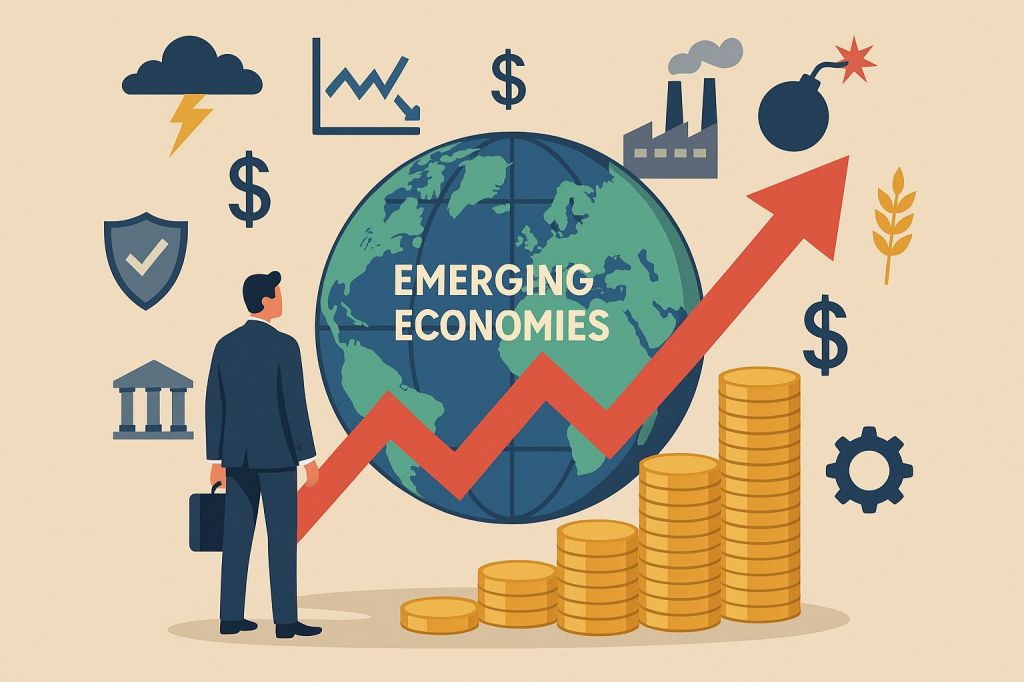
As we approach the midpoint of the twenty-first century, the global economy seems to be settling into a rhythm—but not necessarily one of strength. Global growth is projected to stabilize at 2.7% in 2025-26, which may look acceptable at a glance but falls short of what is needed to drive sustainable development, reduce poverty, or close the gap between rich and poor nations. Beneath this stable surface lies a disquieting truth: the engines of global growth, particularly the Emerging Market and Developing Economies (EMDEs), are losing steam.
From Global Tailwinds to Local Headwinds
Over the past two decades, EMDEs have powered about 60% of global growth. China, India, and Brazil—the “EM3”—have been instrumental in reshaping the global economic architecture. Their rapid integration into global trade and finance helped EMDEs’ share of global GDP soar from 25% in 2000 to around 45% today. However, this momentum is now being threatened by rising debt burdens, climate disruptions, demographic challenges, and global protectionism.
The post-2000 boom period was characterized by trade liberalization, stable macroeconomic conditions, and sweeping structural reforms. Today, however, many of these economies face increasing political instability, stalling reforms, and heightened global uncertainties—from geopolitical tensions to a fragmented trade environment.
The Widening Gap in Living Standards
Despite the notable progress, the promise of EMDEs catching up with advanced economies is slipping away. The convergence in per capita incomes that many economists forecasted at the start of the century has slowed dramatically. The reason is clear: global growth is no longer enough, and domestic growth engines are sputtering.
Heightened policy uncertainty, inflationary pressures, climate-related natural disasters, and a slowdown in the investment cycle have created a vicious loop—undermining confidence and stalling long-term development agendas.
The Crisis of Aspiration for Low-Income Countries
The story is even more concerning for Low-Income Countries (LICs), many of which saw promising trajectories in the early 2000s. Several LICs transitioned to middle-income status due to favorable global conditions and bold reforms. However, this progress has stalled alarmingly in the past decade. Many current LICs face sluggish per capita growth, intensified conflict and fragility, and growing exposure to climate-related risks.
Across nearly every developmental metric, today’s LICs are lagging behind the position of countries that successfully transitioned two decades ago. Their economies remain vulnerable to both global and domestic shocks, including volatile commodity prices, weak institutions, and inadequate infrastructure.
A Fork in the Road: Reform or Regression?
The economic outlook presents both a warning and a call to action. If EMDEs and LICs are to revive their growth stories, significant course corrections are necessary—at both national and international levels.
1. Investment and Productivity: Stronger emphasis must be placed on human capital development, digital and physical infrastructure, and innovation. Increased investment is essential, not just in quantity but in quality.
2. Macroeconomic Stability: Countries must return to fiscal prudence. Inflation control, fiscal consolidation, and improved tax systems are non-negotiables for rebuilding economic credibility.
3. Inclusive Policies: Gender equity, labor force participation, and regional trade integration can unlock new sources of growth. Many LICs also possess untapped tourism potential and vast natural resources that could be vital in the global green transition.
4. Global Cooperation: Addressing debt vulnerabilities, securing climate finance, and creating a fairer trade environment requires coordinated international support. A fragmented global order can severely constrain the development prospects of EMDEs and LICs alike.
Regional Differences, Common Challenges
While growth is expected to moderate in regions like East Asia and Central Asia, others such as Latin America, Sub-Saharan Africa, and South Asia may experience a slight uptick. Yet, even where growth is forecasted to rise, it is often driven by domestic demand rather than structural resilience. Without long-term investments and reforms, these gains may be fragile.
A Developmental Crossroads
As we close the first quarter of the twenty-first century, this is a crucial moment of reflection. The last 25 years have been a story of rising interdependence, growing influence of EMDEs, and increased economic complexity. But going forward, growth alone will not be enough. The focus must shift toward sustainable, inclusive, and resilient development.
For EMDEs and LICs, the next phase will be defined not by how fast they grow, but by how smartly they respond to emerging challenges. The path to prosperity is still open—but only if nations act decisively, with clarity, courage, and cooperation.
 "Connecting communities, empowering nations: Unifying the Regional and Global Economy ."
Leave a comment