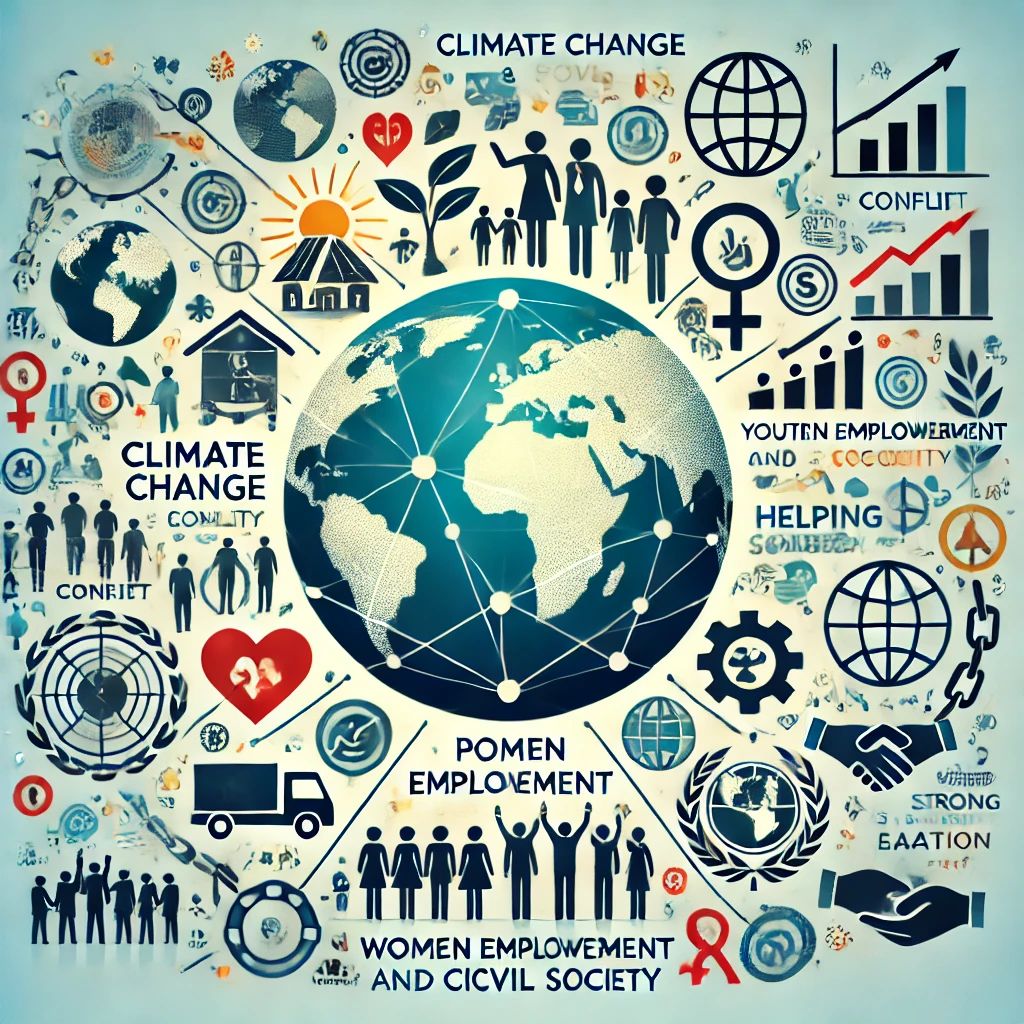
The world today faces an unprecedented convergence of crises: escalating wars in the Middle East and Ukraine, intensifying climate disasters, and looming economic instability fueled by mounting global debt. According to recent IMF data, global debt levels are expected to cross $100 trillion this year — the highest in recorded history. Additionally, estimates suggest that addressing future pandemics and climate change alone will require investments of nearly $3 trillion annually.
These numbers are daunting, and the complexity of these challenges — from poverty to climate resilience to health security — cannot be neatly compartmentalized. Recognizing this, the World Bank has redefined its mission. It no longer focuses solely on poverty eradication but now includes the broader objective of building a livable planet. This shift acknowledges the reality that development, sustainability, and economic stability are all interconnected.
Expanding the Vision: From Poverty Eradication to Livable Planet
The Bank’s expanded vision means focusing on global problems through a local lens. Livability differs from country to country:
In conflict-ridden regions, fragility and violence dominate development priorities.
In climate-sensitive geographies, adaptation and mitigation efforts top the agenda.
In other areas, governance reform, institutional resilience, and public service delivery define livability.
This context-based approach encourages “global thinking, local execution,” ensuring that solutions are not one-size-fits-all but are tailored to each country’s unique challenges and opportunities.
Partnerships: The Cornerstone of the ‘Better Bank’
Given the scale of these challenges, no single institution can solve them alone. The World Bank’s ongoing reform agenda hinges on forging robust partnerships — with other multilateral development banks, the private sector, governments, and civil society. Collaboration is essential not only for mobilizing resources but also for achieving speed and scale in implementation.
The approach involves breaking down institutional silos, ensuring faster delivery, and aligning with broader global goals. Rather than working in isolation, the Bank aims to be the connective tissue that brings diverse actors together.
Empowering Women and Youth: Catalysts for Economic Growth
Two critical demographics are at the heart of the Bank’s reform agenda: women and youth.
Women: In emerging markets, women face disproportionate barriers to opportunity. Yet, investing in women’s participation in the economy is not just a moral imperative; it’s an economic strategy. Female empowerment has a direct multiplier effect on productivity, income growth, and poverty reduction.
Youth: With 1.2 billion young people entering the job market in emerging economies over the next 15 years, the need for job creation is immense. However, current trajectories predict only around 400 million new jobs in these regions — leaving a shortfall of approximately 800 million. This gap represents both a challenge and an opportunity. Failure to bridge it could fuel instability and disillusionment, while success could result in sustained economic growth and innovation.
The Need for Speed and Execution
The Bank’s reform efforts are also focused on enhancing institutional speed — ensuring that projects move from planning to execution more rapidly. Time is a critical factor, especially as climate risks and conflict escalate. The emphasis is on reducing bureaucracy, enhancing cross-sector collaboration, and focusing on outcomes rather than processes.
Changing the Trajectory Through Collective Action
In the face of compounding global crises, the World Bank’s evolving strategy is rooted in realism, ambition, and partnership. The recognition that poverty eradication, climate resilience, gender equality, and job creation are deeply intertwined has given rise to a more holistic development framework.
The world’s challenges are massive, and the numbers — whether they are related to debt, job deficits, or climate costs — are staggering. But as the Bank’s leadership rightly emphasizes, these trajectories are not fixed. They can be changed through collective effort, strategic partnerships, and targeted investments in people and the planet.
The message is clear: destiny is not preordained; it is shaped by action — and action must be swift, inclusive, and global.
 "Connecting communities, empowering nations: Unifying the Regional and Global Economy ."
Leave a comment