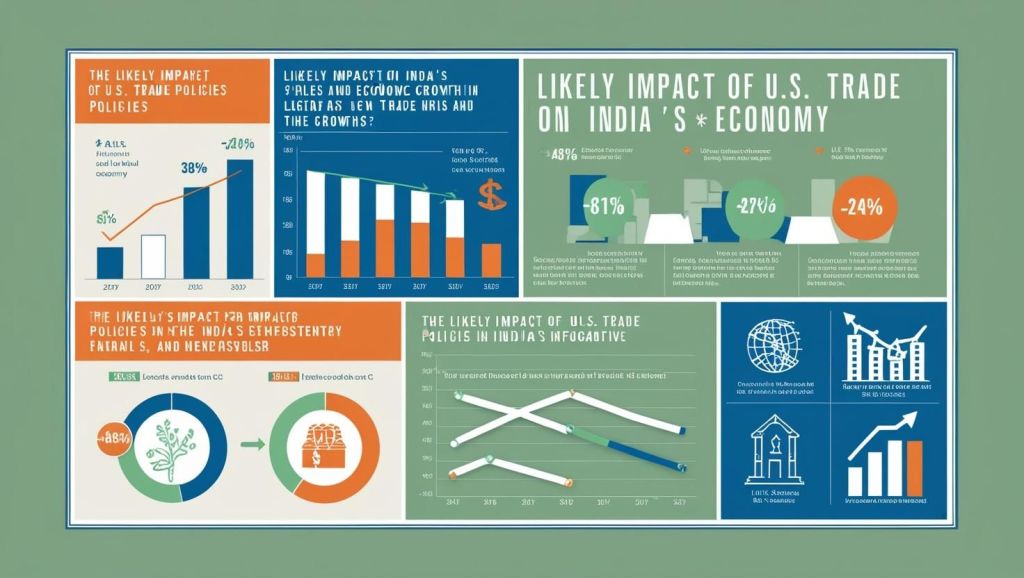
The United States, being one of the largest economies and a key trading partner for India, wields significant influence over global trade through its policies. Whenever U.S. trade policies shift — whether through tariffs, sanctions, incentives, or strategic trade partnerships — ripple effects are felt across major economies, and India is no exception. Let’s critically analyze how evolving U.S. trade policies could shape India’s trade and economic landscape.
1. Impact on Indian Exports
India exports goods worth over $78 billion to the U.S. (as per 2023-24 data), with key items including pharmaceuticals, textiles, gems and jewelry, machinery, and IT services. If the U.S. adopts more protectionist trade policies — such as increasing tariffs or favoring domestic manufacturing through subsidies (e.g., under the Inflation Reduction Act or CHIPS Act) — it could make Indian exports relatively costlier or less competitive. For example, any tightening of non-tariff barriers, quality standards, or country-of-origin restrictions could disproportionately hurt India’s textile and pharmaceutical exports.
2. Opportunities Through ‘China Plus One’ Strategy
On the flip side, U.S. trade tensions with China have already opened opportunities for India to step in as an alternative supplier. As the U.S. moves to diversify its supply chains, sectors like electronics manufacturing, semiconductors, and automotive components can benefit Indian manufacturers, provided India addresses challenges related to infrastructure, scale, and labor reforms. Initiatives like Make in India and the Production Linked Incentive (PLI) scheme are critical in positioning India to seize these opportunities.
3. Effect on India’s IT and Services Sector
India’s IT and software services exports to the U.S. alone amount to nearly $150 billion annually. If U.S. trade policies include tightening immigration norms (H-1B visa restrictions) or data localization mandates, it could adversely affect the Indian services sector. However, shifts in U.S. digital trade policies toward more open, cross-border data flows could work to India’s advantage by easing service delivery.
4. Impact on Indian Agriculture and Food Exports
The U.S. often imposes strict sanitary and phytosanitary standards on agricultural imports. Any hardening of these policies can affect Indian exports of basmati rice, spices, and seafood. On the other hand, the U.S.’s commitment to climate-resilient agriculture and sustainable sourcing could push India toward higher compliance standards, potentially increasing competitiveness in the long run.
5. Currency and Monetary Policy Spillovers
Trade policies are often accompanied by monetary shifts. If the U.S. Federal Reserve tightens monetary policy in response to trade imbalances, it could lead to a stronger dollar and weaker rupee. This depreciation may temporarily benefit Indian exports but also raises the cost of crude oil imports and external borrowing, affecting India’s current account balance.
6. Global Supply Chain Realignments
Policies like friendshoring and reshoring by the U.S. are likely to encourage American companies to look toward trusted allies. While this could make India an attractive destination for manufacturing investments, competition from Mexico and Vietnam remains strong. India will need to address logistical bottlenecks, labor productivity issues, and regulatory complexities to secure its place in global supply chains.
7. Geopolitical Considerations
The U.S. increasingly links trade with strategic interests. Initiatives like the Indo-Pacific Economic Framework (IPEF), where India is a key member, show promise for closer trade and investment ties. However, India must navigate its delicate balance between U.S. strategic cooperation and its relationships with Russia, Iran, and China. Trade policy decisions could therefore come with geopolitical strings attached.
8. Critical Imports: Energy and Defense
U.S. export policies regarding crude oil, LNG, and defense equipment are crucial for India. Any export restrictions or sanctions could impact India’s energy security and defense modernization. Conversely, enhanced U.S. cooperation in these areas could reduce India’s dependence on volatile suppliers.
A Double-Edged Sword
U.S. trade policies represent both risks and opportunities for India. Protectionist moves could harm Indian exporters in the short run, while global realignments could open unprecedented doors. India’s response needs to be strategic: investing in manufacturing scale, skilling, regulatory simplification, and diplomacy. Most importantly, India must strengthen its trade competitiveness and avoid over-dependence on any single market. The next decade will be shaped by India’s ability to convert these global shifts into long-term economic gains.
 "Connecting communities, empowering nations: Unifying the Regional and Global Economy ."
Leave a comment