
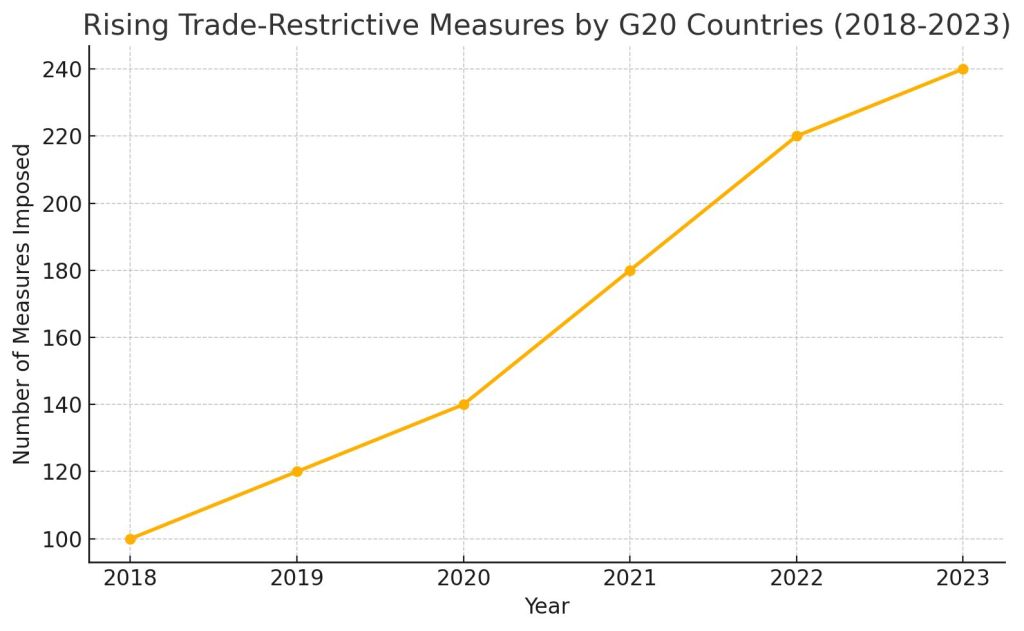
In recent years, the global economy has witnessed an increasingly concerning trend — economic fragmentation. This phenomenon refers to the gradual disintegration of interconnected global trade systems as countries adopt trade-restrictive measures and industrial policies designed to promote domestic industries at the expense of international cooperation. While national interests are understandably prioritized, such policies risk undermining the broader efficiency and stability of the global economy.
Understanding Economic Fragmentation
At its core, economic fragmentation occurs when cross-border trade and investment flows become constrained by tariffs, export controls, localization requirements, and restrictive industrial policies. Nations begin to pull away from global integration, focusing instead on self-reliance or economic alliances with politically aligned partners. The result is a world divided into trade blocs with limited economic interaction across borders.
This trend has been visible through rising tariffs and protectionist policies among major economies. For instance, between 2020 and 2023, the number of trade-restrictive measures imposed by G20 countries increased by nearly 70%, according to data from the World Trade Organization (WTO). These measures include higher import duties, export bans on critical raw materials, and the reshoring of strategic manufacturing sectors.
The Inefficiency of Fragmentation
Global trade is built on the principle of comparative advantage — each country specializing in what it does best and trading with others for mutual benefit. Fragmentation disrupts this balance. When trade barriers rise, resources are misallocated, production costs increase, and consumers face higher prices.
For example, consider the semiconductor industry. The U.S. and China are both investing heavily in domestic chip manufacturing, driven by security and strategic concerns. However, the semiconductor supply chain is inherently global, involving multiple countries that specialize in different stages of production. Artificially duplicating these capacities domestically results in higher costs, inefficiencies, and slower innovation, with ripple effects on sectors ranging from electronics to automotive manufacturing.
Impact on International Cooperation
Beyond economic inefficiencies, fragmentation weakens the ability of nations to work together on global challenges. Issues like climate change, pandemic response, and financial stability require international coordination. A divided world — where trust erodes and cooperation is conditional on geopolitical alignment — makes such coordination difficult.
The recent global vaccine distribution effort highlights this problem. Despite multilateral initiatives like COVAX, vaccine hoarding by wealthier nations and export controls by key manufacturers disrupted supply chains, leaving poorer countries vulnerable. This failure in cooperation illustrates how fragmented policies can deepen global inequalities.
Warnings
The International Monetary Fund (IMF) and the World Bank have repeatedly sounded the alarm on the long-term costs of fragmentation. According to IMF estimates, severe economic fragmentation could reduce global GDP by as much as 7%, equivalent to erasing the entire economic output of Japan and Germany combined. Even moderate fragmentation scenarios could cost around 1–2% of global GDP annually.
Critical Perspective: Balancing Security and Global Integration
While economic fragmentation poses serious risks, it is also important to understand why countries are embracing protectionism. National security concerns, supply chain vulnerabilities revealed during the COVID-19 pandemic, and geopolitical tensions have forced countries to rethink excessive dependence on foreign suppliers. Industrial policies aimed at domestic job creation and technological self-sufficiency are politically popular and strategically prudent in some cases.
However, the challenge lies in balancing these legitimate domestic concerns with the broader benefits of global integration. Governments need to recognize that going too far in the direction of isolation can backfire, both economically and diplomatically.
The Road Ahead
To counter the risks of fragmentation, the global community needs to invest in trust-building, rules-based frameworks, and new forms of cooperation. Regional trade agreements can serve as building blocks, but they must remain open and inclusive rather than exclusive. Initiatives to diversify supply chains should emphasize resilience without abandoning efficiency.
Additionally, dialogue between major economies — even those with differing political systems and ideologies — remains critical. Forums such as the G20, WTO, and IMF must be strengthened to provide neutral platforms for dispute resolution and global policy coordination.
Economic fragmentation is a growing threat that could severely hamper global growth, efficiency, and international cooperation. While domestic industrial strategies and security concerns are understandable, policymakers must tread carefully. The costs of a fragmented global economy — lost innovation, rising consumer prices, and weakened global problem-solving capacity — far outweigh the short-term political gains. Now more than ever, the world needs collective thinking, data-driven decisions, and policies that bridge rather than widen economic divides.
 "Connecting communities, empowering nations: Unifying the Regional and Global Economy ."
Leave a comment