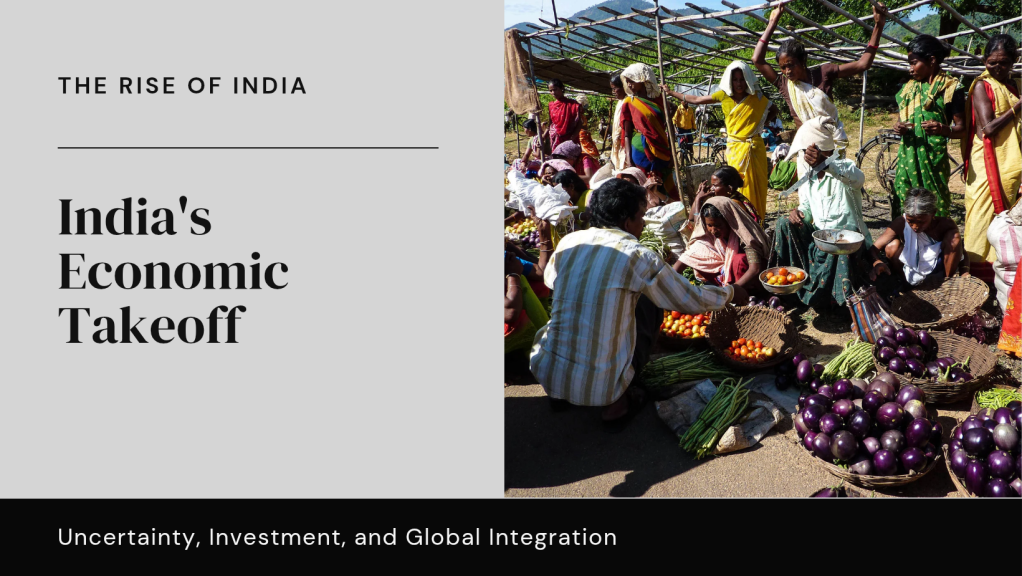
India stands at a pivotal moment in its economic journey—reminiscent of China’s quiet but transformative rise in the late 20th century. The global narrative on India is increasingly optimistic, with international media and policymakers recognizing its potential as a major economic force. However, skepticism within the country persists, which may not be entirely detrimental. Overconfidence often leads to policy complacency, and doubts fuel a more rigorous approach to economic reforms and growth strategies.
Lessons from China’s Takeoff: Are We Following a Similar Path?
China’s economic ascent from the late 1970s to the early 2000s was characterized by a sequence of bold policy decisions, structural reforms, and global market integration. Between 1979 and 1991, China’s economy underwent significant liberalization under Deng Xiaoping, despite political turbulence like the 1989 Tiananmen Square protests. By the early 2000s, it had established itself as the world’s factory, integrating into global supply chains and attracting massive foreign direct investment (FDI).
India, too, embarked on liberalization in 1991, dismantling protectionist barriers and embracing market-driven reforms. While its growth trajectory has been impressive, it has yet to reach the same level of economic dominance that China achieved in the early 2000s. The question is: Are we at the brink of our own takeoff, or are structural issues holding us back?
The Paradox of Confidence and Investment: Is the World Betting on India?
A key contradiction in India’s growth story is the gap between international confidence in its potential and the declining levels of FDI. Historically, FDI flows act as a barometer of global investor sentiment and economic stability. However, India’s FDI inflows are currently at one of their lowest points in recent years. This raises critical questions:
If foreign markets are truly confident about India’s future, why are they not investing at the same levels as before?
What role does global uncertainty play in investor hesitation?
FDI and Global Uncertainty: A Natural Aversion to Risk
Money, by nature, is risk-averse and seeks stability. In periods of uncertainty, capital tends to flow into established economies, particularly the United States. Several factors contribute to the current global uncertainty:
1. Geopolitical Tensions – The ongoing conflicts in Ukraine, the Middle East (Palestine-Israel, Iran, Turkey), and the unpredictable political climate in the U.S. with Donald Trump’s return have created volatility in global markets.
2. Monetary Policy and Interest Rates – The U.S. Federal Reserve’s high-interest rates make the dollar more attractive, pulling investments away from emerging markets like India.
3. Supply Chain Realignments – Global businesses are still recalibrating supply chains post-pandemic, making them hesitant to commit to long-term investments in uncertain environments.
Thus, while FDI might be subdued in the short term due to these factors, India’s medium-term prospects remain robust. Once geopolitical uncertainties ease, capital inflows are likely to resume—provided India continues making itself an attractive investment destination.
Policy Reforms: Opening Up for a Supply Chain Revolution
For India to truly integrate into global value chains, further policy reforms are essential. The country needs to provide more transitional benefits, lower taxes on imported inputs, and create a business-friendly ecosystem. Policies should focus on:
Tax Incentives for Supply Chain Integration – Lowering duties on intermediate goods used in exports to enhance competitiveness.
Regulatory Ease – Simplifying bureaucratic hurdles for foreign investors.
Infrastructure Development – Strengthening logistics, ports, and industrial clusters.
A comparison with China shows that India must prioritize manufacturing-led growth to ensure its takeoff is not delayed. China became a manufacturing powerhouse by providing a highly efficient production ecosystem. India, despite its strong services sector, still struggles with manufacturing bottlenecks.
The Bangladesh Case: A Cautionary Tale for India?
Until recently, Bangladesh was considered a rising star in South Asia, with its GDP per capita surpassing India’s in 2021. However, its rapid economic progress has faced a sudden reversal due to internal financial turmoil, currency depreciation, and political instability. The recent economic crisis in Bangladesh serves as a warning:
Economic growth without structural resilience is fragile.
Overreliance on a single sector (textiles in Bangladesh’s case) makes economies vulnerable.
Political instability can derail investor confidence, leading to financial crises.
For India, the lesson is clear: Diversity in economic strengths, sound fiscal policies, and political stability are key to sustaining long-term growth.
Is India Ready to Hit the Global Stage?
India’s economic trajectory suggests that it is on the verge of a takeoff moment, much like China in the early 2000s. However, the road ahead requires pragmatism, policy consistency, and adaptability to global economic shifts. Key takeaways include:
Skepticism within India is healthy as it prevents overconfidence and promotes well-calibrated reforms.
Global FDI trends are more reflective of geopolitical uncertainty than India’s fundamentals—but India must continue to make itself an attractive investment hub.
Policy refinements are needed to accelerate India’s integration into global supply chains, particularly through tax incentives and infrastructure investments.
The Bangladesh crisis is a reminder that economic growth without structural stability is unsustainable.
If India successfully navigates these challenges, it will solidify its position as a global economic powerhouse in the coming decade—not just in perception, but in tangible economic indicators.
 "Connecting communities, empowering nations: Unifying the Regional and Global Economy ."
Leave a comment