Introduction
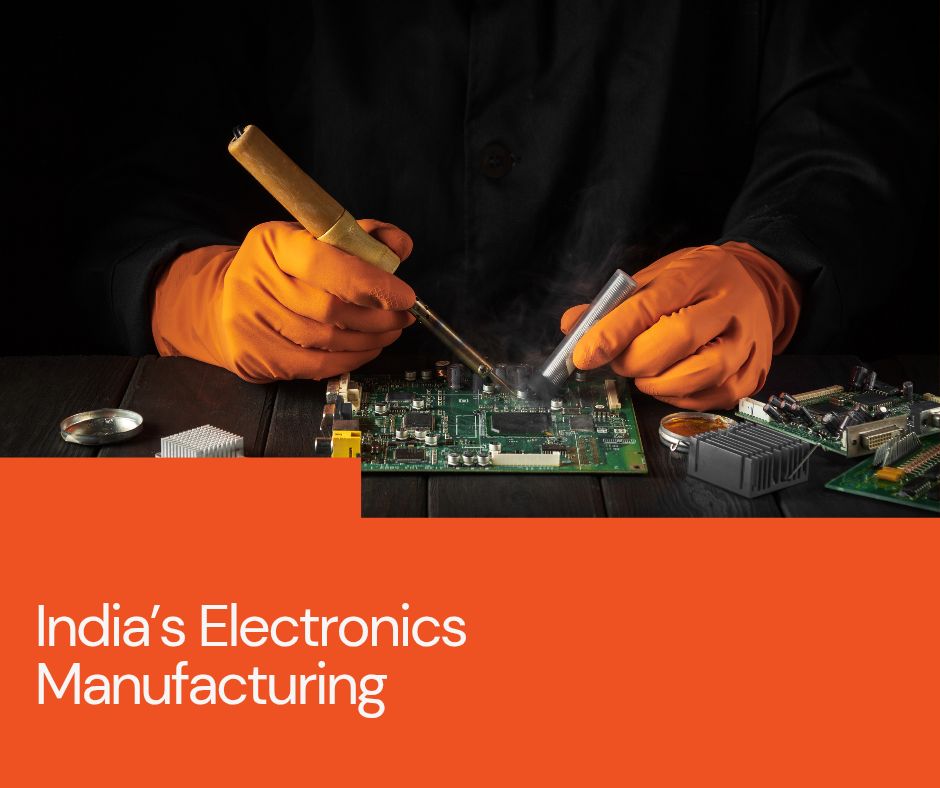
India’s electronics manufacturing industry has entered a transformative phase, fueled by government policies, foreign investments, and shifting global supply chain dynamics. Initiatives like the Production-Linked Incentive (PLI) Scheme, Electronics Manufacturing Clusters (EMC) 2.0, and the India Semiconductor Mission (ISM) have positioned India as a serious contender in the global electronics market.
With an ambitious target of USD 500 billion in electronics production and USD 200-225 billion in exports by 2030, India is on the path to becoming a global hub for electronics manufacturing and semiconductor innovation. However, while the industry is growing rapidly, critical challenges persist, including high import dependency, limited R&D investment, and infrastructure bottlenecks. This blog critically analyzes the growth drivers, challenges, and strategic measures required to unlock the full potential of India’s electronics sector.
Key Growth Drivers
1. Government Policies and Incentives
The Indian government has implemented several strategic policies to boost domestic electronics manufacturing:
- Production-Linked Incentive (PLI) Scheme: Offering 4%-6% incentives on incremental sales of electronics, the scheme has attracted companies like Apple, Foxconn, Samsung, and Dixon Technologies to establish manufacturing operations in India.
- Electronics Manufacturing Clusters (EMC) 2.0: Encouraging local production by providing infrastructure support for manufacturing hubs.
- India Semiconductor Mission (ISM): A USD 10 billion program to reduce import dependency and build a robust semiconductor ecosystem.
These initiatives have significantly increased foreign direct investment (FDI) and encouraged local manufacturing of high-value electronic components.
2. The China Plus One Strategy
As global companies seek to reduce dependency on China, India has emerged as a prime alternative for electronics manufacturing.
- India’s mobile phone exports surged by 40%, rising from USD 11.1 billion in FY2023 to USD 15.6 billion in FY2024.
- Major electronics firms, including Apple, Samsung, and Foxconn, have shifted a portion of their supply chains to India.
- Tamil Nadu, Karnataka, and Uttar Pradesh are leading electronics manufacturing clusters, attracting significant investment.
This strategy is diversifying India’s supply chain and strengthening its role in the global electronics ecosystem.
3. Surging Demand for Consumer Electronics
The rapid expansion of India’s middle class, coupled with increasing internet penetration, has fueled demand for consumer electronics:
- India accounted for 15.5% of global smartphone shipments in Q3 of 2024, ahead of the US and second only to China.
- Rural India now has over 524 million wireless subscribers, significantly boosting mobile phone demand.
- The rise of 5G, AI, and IoT is driving demand for next-gen electronics.
With continued investment in digital infrastructure and smart cities, India’s domestic electronics market is expected to continue expanding.
4. Semiconductor Industry
The Indian semiconductor industry is projected to grow from USD 38 billion in 2023 to USD 109 billion by 2030. Government-backed initiatives, including PLI for semiconductor fabs and the Design-Linked Incentive (DLI) Scheme, are attracting investments in chip manufacturing.
- Tata Electronics has announced India’s first semiconductor fabrication plant in Dholera, Gujarat, with an investment of INR 91,000 crore (USD 11 billion).
- Micron Technology is setting up an Assembly, Testing, Marking, and Packaging (ATMP) facility in Gujarat, investing USD 2.75 billion.
- Adani Group and Tower Semiconductor are developing a USD 10 billion semiconductor fab in Maharashtra.
With rising domestic semiconductor demand driven by automotive electronics, telecom, and AI applications, India’s semiconductor industry is poised for sustained growth.
Challenges
Despite strong growth, India faces critical structural and policy challenges that could hinder its ambitions.
1. High Import Dependency and Tariffs
India remains heavily dependent on imported electronic components, primarily from China and Hong Kong:
- India imported over USD 12 billion worth of components from China in FY2024, accounting for more than half of its total electronic imports.
- High import tariffs (ranging from 10%–15%) create a cost disadvantage of 10%–14% for assembly and 14%–18% for component manufacturing.
Reducing import duties on critical components while boosting local production is essential to enhance competitiveness.
2. Limited R&D and Innovation
India’s R&D expenditure remains low at 0.64% of GDP, compared to 2.41% in China and 3.47% in the US. The electronics sector requires higher investment in innovation, design capabilities, and intellectual property (IP) development.
- Lack of domestic semiconductor R&D facilities hinders innovation.
- Private sector participation in R&D is only 36.4% of total expenditure, significantly lower than other major economies.
- Investment in advanced manufacturing technologies, AI-driven automation, and Industry 4.0 applications remains limited.
To build a globally competitive electronics industry, India must incentivize private sector R&D and create a stronger design ecosystem.
3. Infrastructure and Supply Chain Bottlenecks
- Electronics clusters lack world-class facilities, increasing manufacturing costs.
- Logistics inefficiencies lead to higher production and export turnaround times (7-10 days).
- High land lease costs near ports and airports make factory setups expensive.
Addressing these infrastructure gaps is critical to scaling up domestic production.
4. Workforce and Skill Shortages
The industry faces a shortage of 10 million trained professionals over the next decade. Specialized talent in semiconductor design, AI-driven electronics, and precision manufacturing is in short supply.
- The Apprenticeship Embedded Degree Program (AEDP) under India’s New Education Policy is expected to produce 2 million job-ready graduates annually.
- Increased investment in vocational training programs is needed to meet industry demand.
Bridging the skill gap is essential to support India’s electronics growth trajectory.
The Road Ahead
To achieve its USD 500 billion electronics production target by 2030, India must prioritize the following strategies:
- Enhance Local Manufacturing of Critical Components
- Expand PLI schemes to cover semiconductor fabs, Printed Circuit Board (PCB) production, and key electronic sub-assemblies.
- Reduce import dependency by scaling up component manufacturing clusters.
- Increase R&D and Design Capabilities
- Provide tax incentives for private sector R&D investment.
- Strengthen collaborations between academic institutions, startups, and global tech firms.
- Develop World-Class Infrastructure and Logistics
- Invest in dedicated electronics manufacturing zones with low-cost land and supply chain facilities.
- Improve export logistics efficiency to reduce turnaround times.
- Strengthen Semiconductor and AI Investments
- Expand the India Semiconductor Mission (ISM) to support next-generation chip technologies.
- Leverage public-private partnerships (PPPs) to fund semiconductor R&D.
- Improve Workforce Training and Talent Development
- Scale up AI, semiconductor, and electronics design education programs.
- Develop industry-driven apprenticeship programs.
Conclusion
India is at a crucial juncture in its electronics manufacturing journey. With strategic policy execution, infrastructure development, and workforce training, India can compete with China, Vietnam, and other global leaders in electronics manufacturing.
By building a self-reliant electronics ecosystem, India can transform itself into a major global electronics export hub, driving economic growth, innovation, and technological leadership in the coming decade.
 "Connecting communities, empowering nations: Unifying the Regional and Global Economy ."
Leave a comment