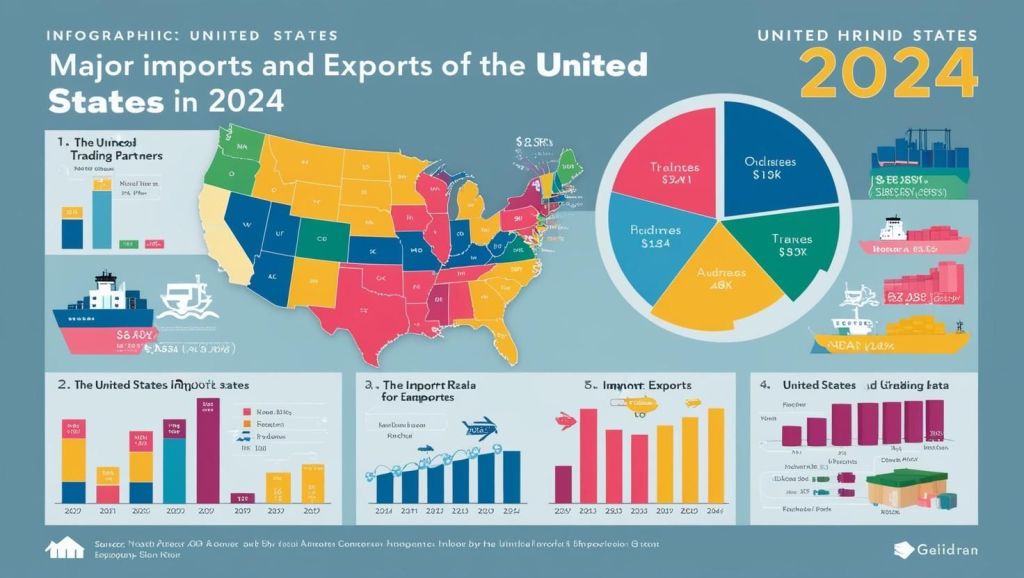
The United States, as the world’s largest importer and second-largest exporter, continues to shape and influence the global trade ecosystem. The trade dynamics in 2024 reflect significant changes driven by geopolitical shifts, economic diversification, and emerging industries. With trade volumes exceeding $5.4 trillion and a growing trade deficit of $84.4 billion as of September 2024, the evolving trade patterns present a nuanced perspective on global interdependence and strategic economic alliances.
Key Characteristics of US Trade in 2024
The US trade portfolio reflects a combination of economic resilience and underlying challenges. The overall trade of goods and services surpassed $5.4 trillion in the four quarters leading up to June 2024, underscoring the country’s expansive involvement in international commerce. However, this growth is shadowed by a widening trade deficit, which hit $84.4 billion in September 2024 – a record high that highlights persistent import reliance.
Despite these figures, US exports experienced a modest 3% growth in the first quarter of 2024, driven largely by advancements in technology, renewable energy, and the semiconductor sector. This uptick suggests that while the trade balance leans towards imports, key industries are gaining traction in global markets.
Shifts in Trading Partners: A Closer Look
A deeper dive into trade relationships reveals a shifting landscape:
Mexico has emerged as a dominant trade partner, but the escalating trade deficit reflects increased imports from Mexico, particularly in automotive and electronics sectors. This points towards deeper integration of North American supply chains, albeit with a growing imbalance.
China’s shrinking share in US trade signifies the ongoing decoupling strategy. In its place, nations like Vietnam are experiencing exponential growth, with the US trade deficit with Vietnam multiplying by over five times in the last decade.
India’s trade relationship with the US continues to flourish, reaching $120 billion in fiscal 2024. This trend highlights India’s growing importance as a strategic partner, driven by sectors like IT services, pharmaceuticals, and textiles.
Emerging Trends and Strategic Adjustments
Several transformative trends are reshaping US trade in 2024:
1. Nearshoring and Supply Chain Diversification:
Amidst geopolitical tensions and supply chain disruptions, US companies are intensifying efforts to relocate manufacturing closer to home. Mexico and other Latin American countries have emerged as prime destinations for nearshoring, ensuring greater supply chain resilience.
2. Green Energy and AI Trade Growth:
Exports in green energy technologies, electric vehicles (EVs), and AI-driven products have surged, contributing to the 3% export growth. The US is positioning itself as a leader in the global transition to sustainable energy, leveraging innovation in clean technologies.
3. Protectionist Policies on the Horizon:
Anticipated shifts towards more protectionist trade policies in 2025 could reshape the existing trade balance. Proposals to increase tariffs on critical imports, especially from China, could further influence trade realignment across Asia and Latin America.
Balancing Growth and Deficit Management
The widening trade deficit, particularly with nations like Mexico and Vietnam, underscores the inherent challenges of import-heavy trade patterns. While the US remains competitive in emerging industries, imports continue to outpace exports, contributing to economic vulnerabilities.
The diversification away from China represents a strategic recalibration rather than an outright decoupling. This move reduces risk but necessitates deeper engagement with alternative partners, potentially leading to new imbalances. Additionally, while nearshoring addresses supply chain fragility, it may drive up costs for US consumers in the short term.
On the positive side, India’s growing trade footprint presents a balanced opportunity for collaboration in sectors like pharmaceuticals and technology, fostering mutual growth without contributing significantly to the trade deficit.
A Dynamic but Uneven Path Forward
As the US navigates the complexities of 2024’s trade landscape, the interplay between innovation, supply chain diversification, and geopolitical shifts will shape its economic trajectory. While the current dynamics reveal both growth and imbalance, strategic policy adjustments and emerging partnerships offer pathways towards a more sustainable trade framework.
The challenge lies in managing deficits while fostering export-driven growth, ensuring the US retains its pivotal role in the evolving global economy.
 "Connecting communities, empowering nations: Unifying the Regional and Global Economy ."
Leave a comment