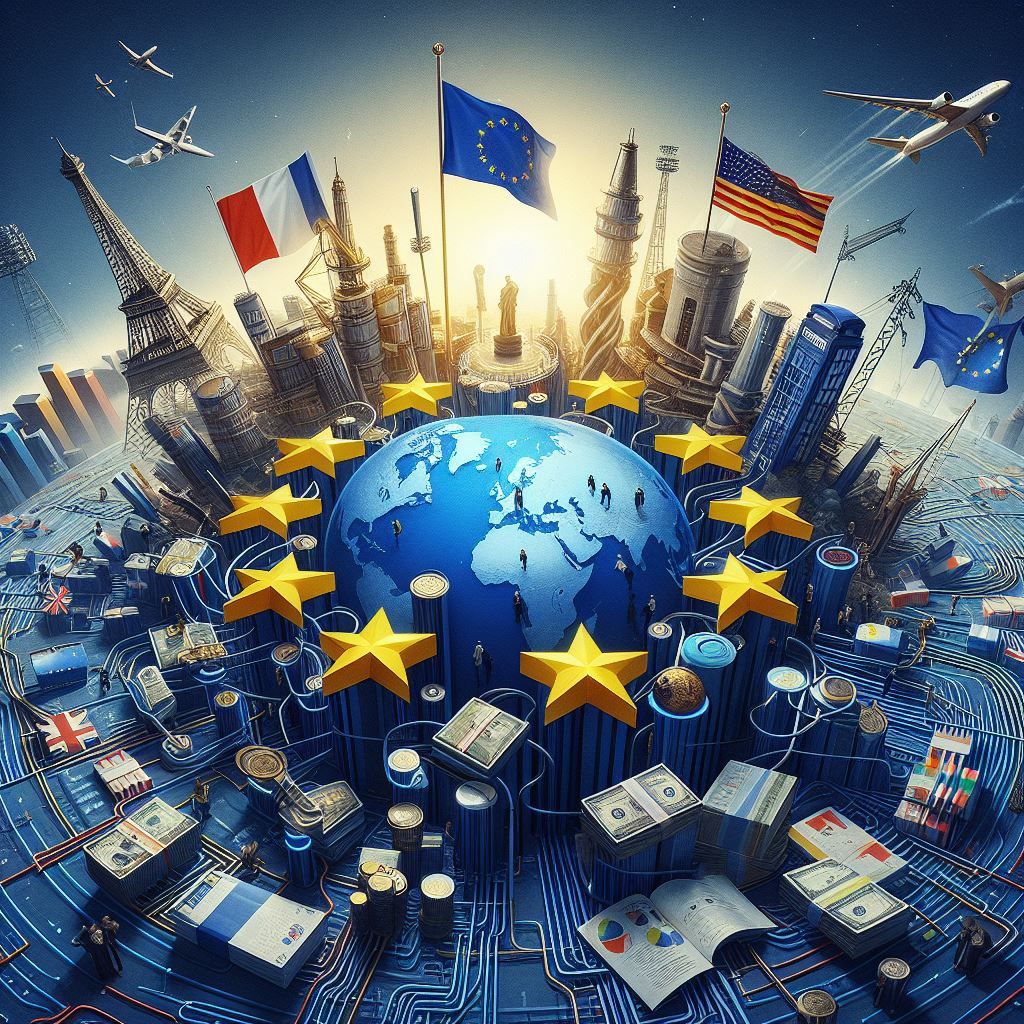
The European Union (EU) is a vast and influential entity that has played a significant role in shaping global economies. With a collective output of almost $20 trillion, the EU stands as one of the largest economic powerhouses in the world, second only to the United States. However, with such immense size and power also come drawbacks and challenges.
The concept of a European federation, a United States of Europe, has long been debated and proposed. In many ways, the EU already embodies the characteristics of a federal government, with member states sharing a common currency, agreeing on policies together, and making collective trade deals. However, there are also inherent differences that pose challenges for the EU.
One of the primary problems faced by the EU is the difficulty of managing economies with diverse backgrounds. The member states of the EU have vastly different economic structures and levels of development. The economies of powerhouse countries like Germany, France, and Italy differ significantly from those of smaller developing economies like Romania or Slovenia. Therefore, finding a balance between the economic management styles required for each country becomes a complex task.
For instance, Germany, with its established and stagnant economy, requires different economic policies compared to Romania, which is still developing and heavily relies on commodity exports. Trade negotiations and agreements become particularly challenging when countries with highly competitive exports have to strike a compromise with nations that need protection for their industries. Germany, with advanced industries and valuable products, can negotiate favorable trade deals for itself, while smaller countries like Romania may struggle to compete in the global market.
Additionally, the EU’s influence extends beyond trade agreements to monetary policy. The EU sets interest rates for member countries, but this poses challenges as interest rates may not be suitable for all economies. Economic policies that work well for highly advanced and wealthy countries may not be effective for smaller, developing nations.
Despite these challenges, the EU also brings positive influences to its member economies. The EU acts as a platform for collaboration and cooperation, fostering economic growth and stability. The idea of a unified Europe provides a large internal market, open borders, and free movement of goods and services, all of which can benefit businesses and consumers alike. Moreover, the EU provides financial assistance to less developed member states, helping them catch up and improve their economic conditions.
However, the EU’s influence is not confined to its member economies alone; it has a significant impact on the global economy as well. As a major global producer and consumer, the EU wields considerable control over countries within and beyond its borders. This power presents both opportunities and risks. The EU’s economic policies and actions can influence global trade flows, investments, and financial stability.
Therein lies the challenge. The EU must balance its role as a collective entity representing diverse economies while ensuring that the decision-making process considers the unique needs and challenges of each member state. Striking this delicate balance will not only benefit the European Union itself but also have far-reaching consequences for the global economy.
The European Union’s influence on the global economy is undeniable. As one of the largest non-sovereign entities, it holds significant power and control. However, the diversity of its member economies presents challenges in aligning economic policies and trade agreements. While the EU brings positive influences to its constituent economies, it also faces internal and external challenges. Finding a harmonious balance between the unique needs of member countries and the collective entity will be crucial for the EU’s continued success and for the stability of the global economy.
 "Connecting communities, empowering nations: Unifying the Regional and Global Economy ."
Leave a comment