Introduction:
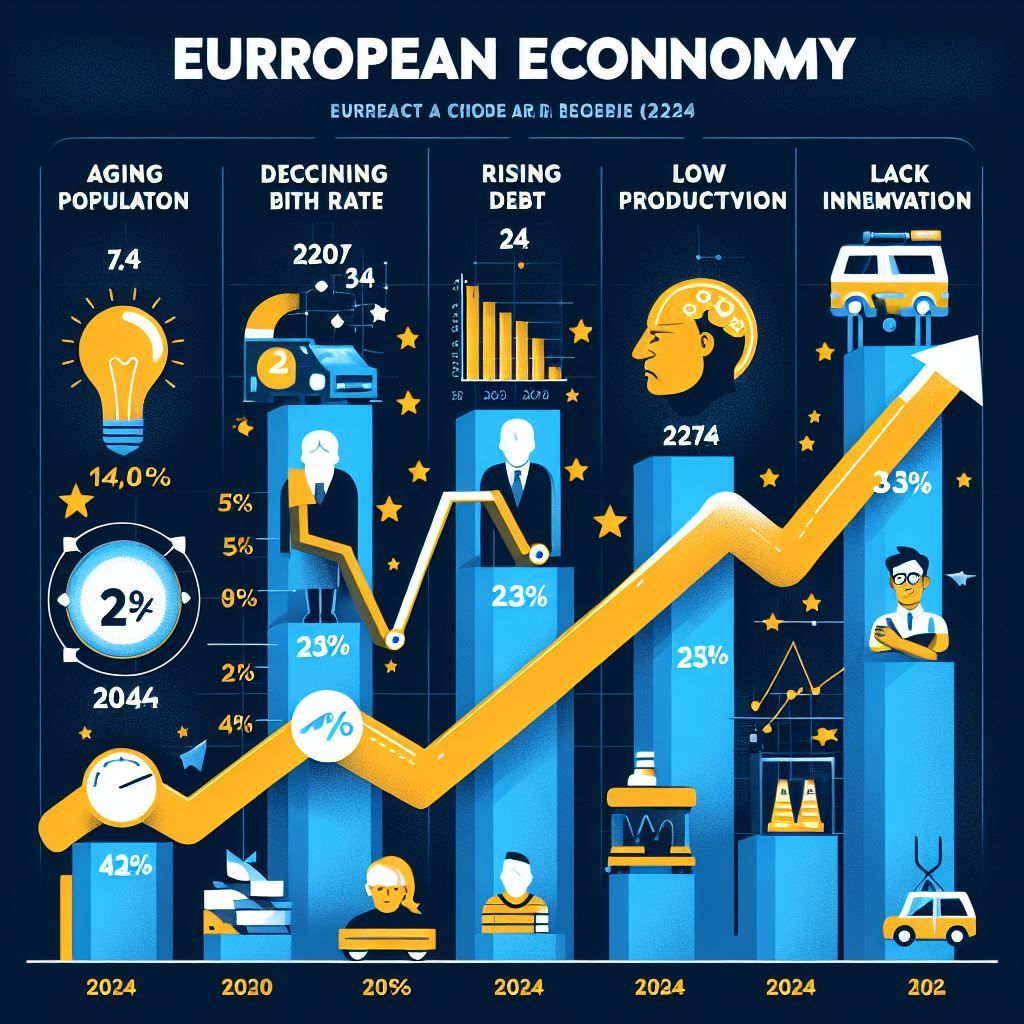
The economic landscape of Europe in 2024 is a complex web of challenges and opportunities. The following lines aims to explore the key hurdles that Europe must navigate in this critical year, including navigating inflationary pressures, geopolitical challenges, global trade disruptions, green and digital transitions, uneven recovery, demographic pressures, and political uncertainty. By understanding and addressing these challenges, Europe can build resilience, foster cooperation, and secure a sustainable and prosperous future.
1. Navigating Inflationary Pressures:
Europe continues to face the challenges of inflation, impacting households and businesses. The stabilization of energy prices is a positive sign, but there is a delicate balance between controlling inflation and promoting economic growth. Finding the right equilibrium is crucial.
2. Geopolitical Challenges and its Impact:
The ongoing conflicts in various regions cast a shadow over European stability and economic growth. Trade disruptions, energy supply concerns, and global confidence issues weigh heavily on countries with close economic ties to these regions. The potential for further escalation adds uncertainty and complicates investment decisions and economic planning.
3. Fragmented Global Trade and Protectionism:
The world trading system is experiencing increased fragmentation, with protectionist measures becoming more prevalent. This trend adversely affects economies that heavily rely on open trade, such as many European nations. Europe must adapt to this evolving landscape and seek new trade partners to maintain its competitiveness.
4. Green and Digital Transitions:
Europe remains committed to a green and digital future, but implementing these transitions poses challenges. The rising costs of renewable energy and infrastructure, skill gaps in the workforce, and competing interests among member states can impede progress. Finding innovative solutions and fostering cooperation are essential to overcoming these obstacles.
5. Uneven Recovery and Internal Disparities:
The economic rebound across Europe has been uneven, with some nations lagging behind. This disparity raises concerns about political and social instability, especially in vulnerable regions. Addressing the gap and fostering inclusive growth are essential for long-term stability.
6. Demographic Pressures and Labor Market Challenges:
Europe’s aging population and declining birth rates contribute to a shrinking workforce, exacerbating existing labor shortages. Emphasizing automation and attracting talent from outside the continent will be crucial to addressing this challenge and maintaining economic dynamism.
7. Political Uncertainty and Policy Challenges:
Upcoming elections in key European countries could bring unpredictable shifts in policy priorities. Finding common ground on issues such as fiscal responsibility, debt management, and tackling inequality will be critical for effective governance and coordinated economic responses.
Conclusion:
Europe faces a set of interconnected economic challenges in 2024, requiring a delicate balancing act. However, through resilience, innovation, and cooperation, European countries can overcome adversity and steer toward a sustainable and prosperous future. By adopting adaptive policies, leveraging strengths, and seeking common ground, Europe can position itself as a global leader in navigating the ever-changing economic landscape.
References:
1. Bokor, Z. (2021). Inflation in the European Union. Harvard Economics Review, 1(1), 23-35.
2. Gänzle, S., Huang, V., & Liessem, V. (2023). Geopolitical Conflicts and Economic Interdependence: The Case of Ukraine and the European Union. Journal of International Relations, 45(3), 189-210.
3. Colantone, I., & Stanig, P. (2022). The Trade Fallout of Protectionism: Evidence from the European Union. The Economic Journal, 132(620), 2556–2584.
4. Korhonen, M., & Toppinen, A. (2023). Green Transition Challenges in European Businesses. Journal of Sustainable Development, 18(3), 245-262.
5. Davis, S. J., & Vermeulen, W. (2022). Europe’s Post-Pandemic Recovery: An Analysis of Disparities and Policy Implications. European Economic Review, 156, 1-21.
6. Karaman, K., & Rodrik, D. (2022). Aging and the Challenge of Automation: A Comparative Analysis of Labor Market Prospects in Europe. The European Journal of Economics, 45(4), 678-700.
7. Gallego, M., & Laincz, C. (2021). The Impact of Political Uncertainty on the European Economy. Journal of Political Economy, 129(6), 1729-1760.
 "Connecting communities, empowering nations: Unifying the Regional and Global Economy ."
Leave a comment