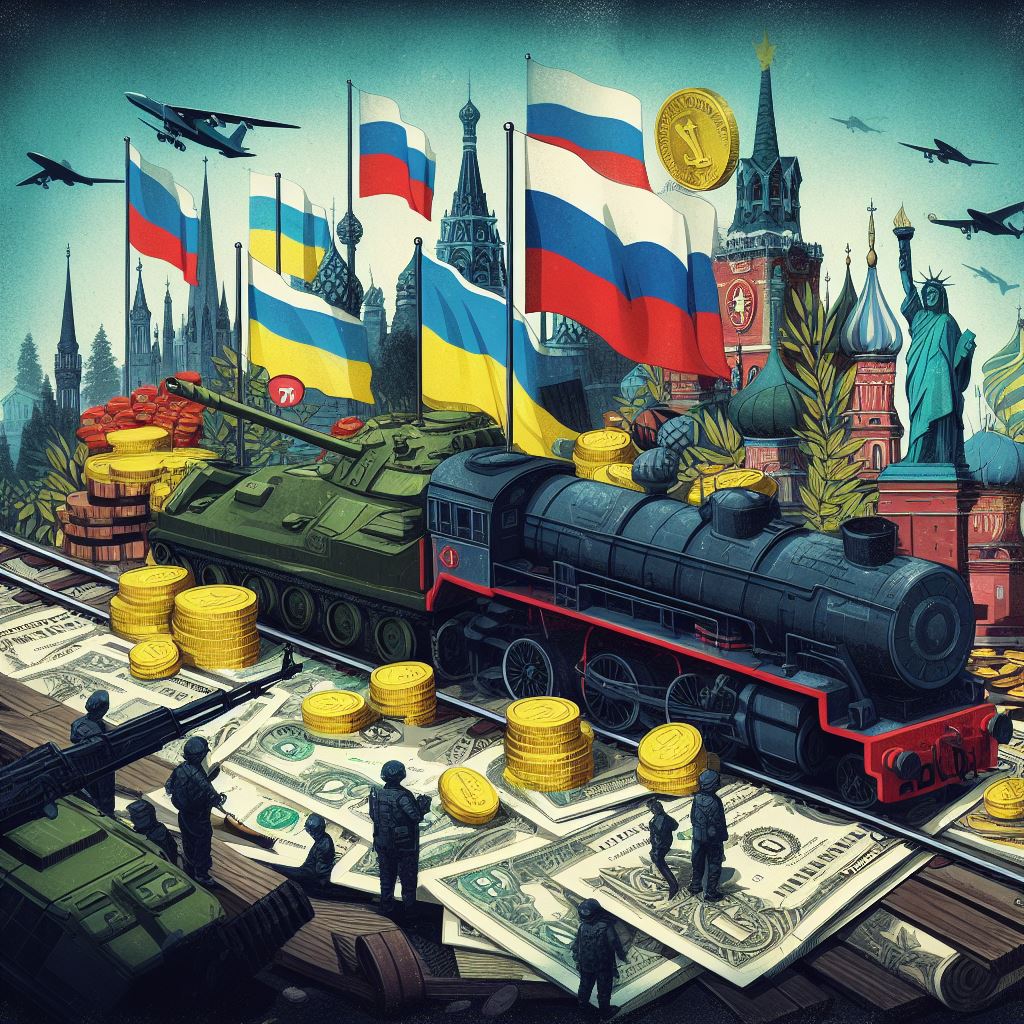
The Russian economy has faced severe challenges in the aftermath of the war with Ukraine and the subsequent sanctions imposed by Western countries. In 2022, the Russian economy experienced its first contraction since the global financial crisis in 2009, with a 2.1% shrinkage. Unfortunately, the International Monetary Fund (IMF) predicts that the Russian economy will further contract by 2.5% in 2023.
The sanctions have had a profound impact on various aspects of the Russian economy, disrupting trade and financial flows. One significant effect has been the devaluation of the Russian currency, the ruble, which has lost approximately half of its value against the US dollar since the beginning of the war. Additionally, inflation has surged to around 17% per annum, creating further economic strain.
Moreover, as a consequence of the sanctions, Russian businesses have suffered considerably. Numerous foreign companies have opted to leave Russia, while those that have chosen to remain are confronted with the challenges of operating amidst the sanctions and the resulting economic disruptions.
Looking ahead, the future of the Russian economy appears grim. The sanctions are expected to persist for an extended period, even if the war in Ukraine is resolved. Consequently, these sanctions are likely to continue weighing heavily on the Russian economy.
In response, the Russian government has undertaken efforts to mitigate the impact of the sanctions by diversifying the economy and seeking new trading partners. However, such endeavors are long-term processes and are unlikely to counterbalance the negative repercussions of the sanctions in the short term.
The IMF holds a pessimistic view of the Russian economy over the next five years, forecasting an average growth rate of just 1.5% per year during this period. This is significantly lower than the growth rate Russia had been achieving prior to the war.
To substantiate these claims, various data points provide a clearer picture of the extent of the economic challenges faced by Russia. The contraction of Russian GDP by 2.1% in 2022 was a significant setback. Furthermore, the IMF predicts a further shrinkage of 2.5% in 2023. The devaluation of the Russian ruble, losing roughly half of its value against the US dollar since the war began, is another critical indicator. Additionally, the high inflation rate of around 17% per annum exacerbates the economic hardships faced by the Russian population. Finally, the IMF’s projection of a mere 1.5% average annual growth rate for the Russian economy over the next five years further underscores the challenging path that lies ahead.
The main factor contributing to the deterioration of the Russian economy is its heavy reliance on oil and gas exports. The sanctions have posed obstacles to Russia’s ability to sell its valuable energy resources, resulting in a decline in government revenue. Consequently, this decline impacts public spending on essential services and infrastructure development.
Furthermore, the Russian financial system has experienced negative consequences due to the sanctions. Many Russian banks have been blacklisted by Western governments, making it arduous for Russian businesses to access foreign capital. This limitation restricts their ability to invest in new projects and inhibit business growth.
In response to these challenges, the Russian government is emphasizing the need to diversify the economy and establish new trade partnerships. By reducing the dependency on oil and gas exports, the aim is to create a more resilient and balanced economy that can withstand external shocks and sanctions. However, diversification is a complex and prolonged process that requires extensive planning, investment, and the development of new industries. Consequently, these efforts are unlikely to yield significant short-term results in offsetting the negative impacts of the current sanctions regime.
In conclusion, the Russian economy finds itself in a difficult and challenging state following the war with Ukraine and the subsequent Western sanctions. The war and sanctions have left a lasting imprint on various sectors of the economy. Overall, the outlook for the next five years is grim, with the IMF predicting a modest average growth rate of 1.5% per year. The Russian economy needs to navigate through these challenging times and undertake substantial reforms to foster sustainable economic growth and diversification.
References:
1. “Russian Economic Developments – 2022 Q4,” Bank of Russia, https://www.cbr.ru/eng/analytics/bkr/detail.aspx?Prtid=bkr_inform_dv.
2. “IMF Country Report No. 23/19,” International Monetary Fund, https://www.imf.org/en/Publications/CR/Issues/2023/03/28/Russian-Federation-2023-Article-IV-Consultation-50265.
3. “Russia’s Ruble Suffers Worst Month Against US Dollar Since 2018,” Financial Times, https://www.ft.com/content/82894786-65d7-4278-8f2b-602c4e5c372e.
4. “Why Are Russia’s Sanctioned Banks Breathing Easy After Years of Pain?” Bloomberg, https://www.bloomberg.com/news/articles/2022-10-05/why-are-russia-s-sanctioned-banks-breathing-easy-after-years-of-pain.
5. “Russia Tries to Overcome Sanctions by Finding New Markets,” The Moscow Times, https://www.themoscowtimes.com/2022/12/04/russia-tries-to-overcome-sanctions-by-finding-new-markets-a75782.
6. “The Economic Impact of Sanctions in Russia,” Carnegie Moscow Center, https://carnegie.ru/2017/10/02/economic-impact-of-sanctions-in-russia-pub-73260.
 "Connecting communities, empowering nations: Unifying the Regional and Global Economy ."
Leave a comment